


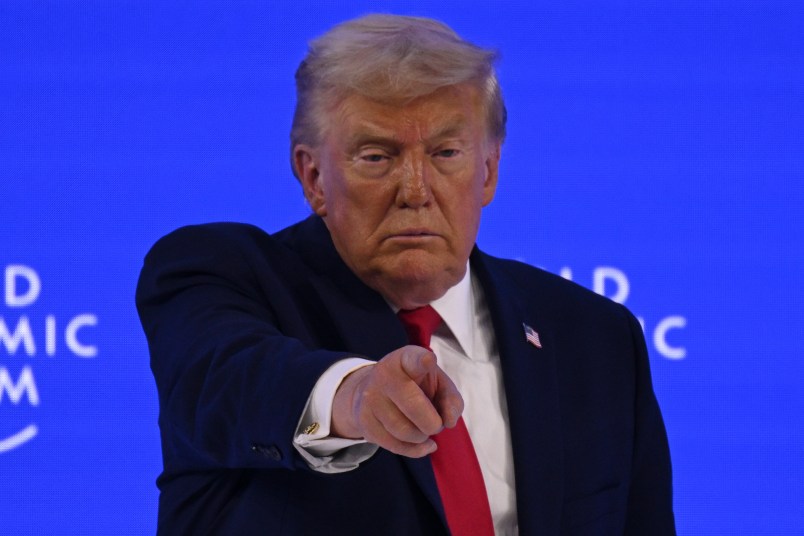
Day after day we’re seeing more signs of Donald Trump’s slipping grip not only on public opinion, but at the margins of the GOP itself. But I thought it was a good time to remind ourselves that Donald Trump isn’t the only problem. Yes, there’s the GOP, which could easily dispatch him at any point if he didn’t have an iron hold over the party. There’s the 30%-40% of voters who are solidly in the MAGA camp. Without them, Trump’s nothing. I don’t mean either of those. I’m talking about the global authoritarian movement, which includes and is even perhaps led by Trump. But it exists quite apart from him and has roots in some of the wealthiest and most powerful people and governments around the world.
I’m talking about the Authoritarian International which includes a host of authoritarian governments around the world, the princelings of the Gulf monarchies, the sprinkling of European right-ravanchist governments, the rightward portion of Silicon Valley (which accounts for a larger and larger percentage of the top owners if not the larger community), the Israeli private intel sector, various post-Soviet oligarchs and, increasingly, the world’s billionaire class. Trump is their avatar, but they exist and are now joined together in a way that will outlive him personally and electorally.
Early in the Biden administration I talked to a U.S. hedge funder who gets invited to the confabs Mohammed bin Salman has put on for the world’s billionaires since he became the country’s de facto leader. He described that world to me, a bit about its mores, what he saw. As you’d imagine for this 21st Century kind of Kremlinology, who gets to sit next to MBS at the dinners is the subject of close scrutiny and much envy. At the last of these confabs before this conversation, Jared Kushner had been given the seat of honor at something like every dinner. He was MBS’s guy. And remember, this was when Trump was at his nadir. Maybe MBS and the Saudis just had a better view of America’s political future than I did. Certainly possible. But the bigger takeaway was: this wasn’t just a transactional relationship. Kushner and MBS and Trump and MBS were a thing in and out of office.
It is not so much an anti-democratic world — though it is certainly that — as an anti-civic world. It’s a world of private, one-off deals, mutual pledges of secrecy, often enforced by soft, mutual extortion, and above all, a rejection of democratic accountability. We saw this coming into view during the late Biden administration, when Biden was already rapidly losing public support, with Elon Musk’s increasingly brazen efforts to run U.S. foreign policy from Twitter and SpaceX. The Saudis meanwhile were trying to ease Biden out of office through the manipulation of oil prices. It was no accident that Musk was advancing a strongly pro-Russian line in Ukraine, where he was most visibly trying to undermine U.S. policy.
I’ve discussed this concept in the past. So I don’t want to belabor the point of its existence. I want to point out how its forces are arrayed against civic democracy in the U.S. — quite apart from Donald Trump. This wasn’t always the case. There didn’t use to be so many U.S. billionaires. And they characteristically had economic views which aimed to preserve their wealth. But they were not clearly on the right in the way they are now. They have moved an increasingly anti-civic democratic direction as the scale of their wealth and their identity as a class has exploded. They also weren’t so increasingly allied with primitive economy petro-states of the Gulf.
The point is that they will exist no matter what happens to Trump. They command vast economic resources; they run the governments in many countries where the government never changes; they have deep tentacles into the U.S. political system and many of its key players are from the U.S. Trump didn’t create this movement precisely. But his role in global politics over the last decade solidified it as a self-conscious group and congealed it together. Any movement of civic democratic revival in the U.S. will be menaced by its continued existence. Now is the time to think about how a revived and revitalized civic democratic movement in the U.S. could combat it and avoid being destroyed by it.