


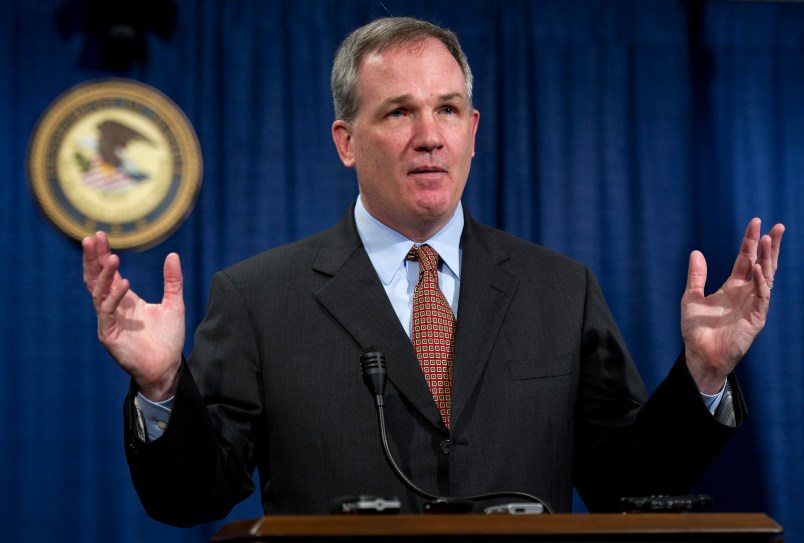
Here’s a funny little nugget about the Pat Fitzgerald/James Comey relationship.
You’ll remember that Pat Fitzgerald first came to be known by the broad politically-attuned public when he was special counsel investigating and eventually convicting Bush White House advisor Scooter Libby over the disclosure of CIA agent Valerie Plame’s identity. James Comey first became known to this broader politically-attuned public because of a series of actions he took during the Bush administration, stuff like the so-called “hospital bed” showdown over the admin’s domestic surveillance program. Now move forward to early 2007 and we at TPM were in the thick of the so-called US Attorney firings scandal, for which TPM eventually won a Polk Award.
As you’ll remember, there was a specific group of U.S. Attorneys who were summarily fired because they resisted or refused to pursue trumped-up prosecutions tied to baseless allegations of voter fraud. (The whole scandal was fundamentally a voting rights story.) But beyond those clear-cut cases where U.S. Attorneys were fired there was a broader penumbra of uncertainty and question. Various evidence eventually emerged showing that the political cabal at the DOJ had at least considered firing a much larger group of U.S. Attorneys. Did they just decide not to? Did these U.S. Attorneys comply with politicized demands and save their jobs? All sorts of names came up. I think there was one email or spreadsheet that proposed firing Chris Christie. It was all very unclear and we were extremely interested in finding out who didn’t get fired as much as those who did.
In any case, at some point during the story, James Comey came into this category. And to be crystal clear when I say “this category” I mean the general question of whether he was a complier or a resister in the broader U.S. Attorney firing saga. I don’t remember now what specific documents raised this question. My general recollection is that we eventually decided that he hadn’t done anything wrong, even in this very general sense. But those specifics don’t really matter for the purposes of this post.
One day, I was walking home from the original TPM office on 6th avenue and 28th street in Manhattan and I got a call or an email saying that Pat Fitzgerald had called the office and wanted to talk to me. My best recollection is that reporter Paul Kiel got the message and passed it along to me. Maybe Fitzgerald left me a voicemail. I can’t remember. In any case, at the time remember that Fitzgerald was probably best known as the prosecutor who had insisted that journalists Judith Miller and Matthew Cooper divulge their sources in the Valerie Plame/Scooter Libby investigation and threatened both of them with jail if they didn’t. Cooper got a last minute reprieve but Miller eventually spent almost three months in jail for contempt.
Whatever you might think of Miller or Fitzgerald, that saga focused the attention of and shaped the outlook of every journalist working in any part of the federal criminal justice or national security space. In 2006, there was actually a story I never pursued because it had all the hallmarks of a case that could land a journalist in exactly the position that Miller and Cooper had been in. Just to speak very generally, it was one of those situations where the journalist has committed no bad acts but where the journalist comes into possession of material which had real bad acts attached to it, albeit ones the journalist had no part in and which took place before the journalist even came into the picture. The law is pretty clear on this kind of situation; the journalist has no criminal liability in the kind of situation I described. But if you have knowledge about the bad acts, a judge can absolutely demand you share what you know.
I knew I could not betray a source like that. Normally, I thought I’d be ready to spend time in jail over it. The complication was that, at the time, my wife was pregnant with our older son. I thought about it and thought about it and decided I couldn’t get myself into a position where I had to go to jail when my wife was in the second half of her pregnancy. So I just never published it. With a bit more experience with the difference between what can happen and what’s likely to happen and a bit more distance from the Plame story I might have made a different decision. But that was the decision I made then. And to be clear, this wasn’t just hypothetical — very high-profile, very clear cut and unlovely bad acts. It was risky. It woulda been risky a decade later.
Hand it off to another journalist who can run the risk? Doesn’t work that way. You’re still the link in the possession chain and still on the line for divulging what you know even if you don’t publish. To be clear, if it was a “change the course of history, the public absolutely needs to know this” kind of story I might have made a different decision. It was a big story and an important public corruption story. But it wasn’t like that kind of story.
So back to Pat Fitzgerald.
I’m a worrying sort of guy. I had no idea why Fitzgerald would want to talk to me. I’d never had any communication with him before. His name hadn’t come up with any to do with the firings story. In my head I knew that if a federal prosecutor wants to squeeze you for your sources, a personal phone call probably isn’t how it works. But that didn’t make me feel any better. I didn’t like the sound of this. But when I got back to my apartment I faced the music and called.
I called the number and said, This is Josh Marshall returning your call. To the best of my recollection Fitzgerald said some brief but complimentary things about our firings coverage and then said, Comey’s solid. He didn’t have anything to do with this stuff. Fitzgerald’s say-so carried a lot of weight at the time. I asked him if there was anything else he could share. He said there wasn’t that much else to say, just that he knew the players involved and generally what went down and wanted to share his perspective with me. To make this a bit more concrete, though I don’t remember the specific issue, what raised the question at all was some document or reference somewhere that could have pointed to something or simply meant nothing. It was that fragmentary and ambiguous. It was a very brief exchange but the gist was that he knew the background of whatever was referred to and it was in the nothing category. Point being that there wasn’t more to share because there wasn’t actually anything there.
I thanked him for sharing his perspective and we ended the phone call. I probably breathed a sigh of relief that I wasn’t going to jail. Their relationship was known but this solidified in my mind that they must be tight. Otherwise, why else reach out like this for something that wasn’t even really an issue? It wasn’t like Comey was under any kind of suspicion, even from us. It was just something that came up as a stray possibility in our coverage.
And that was that.