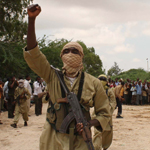
The bombing in Kampala, Uganda, Sunday during the World Cup final — which killed one American, injured 5 others and killed 75 other people — marks the first attack by al Shabaab outside of Somalia, a senior Administration official said today.
“There are indications that al Shababb was indeed responsible for it,” a senior administration official told reporters in a background briefing via conference call that I was just on. The group has claimed responsibility for the attacks, and the Administration finds that claim credible.
The administration official would not rule out a change in U.S. policy to provide military assistance to the transitional government in Somalia, which is battling an al Shabaab insurgency. “We’re taking stock of recent events to determine if this is now a trend that al Shabaab will be on and will take all appropriate measures,” the official said.
Not parsing words, the official described al Shabaab as a “group of murderous thugs.”Purported links between al Shabaab and al Qaeda heighten U.S. concerns that al Shabaab may have the means to go along with its expressed intent of striking U.S. targets. Al Shabaab has ties with both al Qaeda on the Arabian Peninsula and al Qaeda in East Africa, the official said. “Al Qaeda-Arabian Peninsula is probably the most operationally active of any of the al Qaeda franchises in the region,” in this senior official’s assessment. There are a large number of Somali refugees in Yemen and a lot of traffic back and forth between those two countries, according to the official.
“Its agenda is very similar to al Qaeda’s agenda,” the official said.
Al Shabaab’s attack in Uganda is just the latest example of why Somalia has been a focal point of concern for Obama Administration national security officials. A militant insurgency group with territorial ambitions in the southern part of Somali, al Shabaab was created in 2006 and has been on the U.S. government radar for quite some time. Al Shabaab has made terror threats before, but U.S. intelligence has no specific warning that that the Uganda attack was imminent, the official said.
The U.S. government designated al Shabaab a terrorist group in 2008 and considers its leaders to have ties to al Qaeda, although the foot soldiers in the group are Somali nationalists not jihadists. “It has what I would refer to as a dual persona,” the administration official said. “Al Shabaab has domestic agenda inside Somalia that is a bloody one. It has a terrorist agenda that it has now manifested itself outside Somalia.”
U.S officials have also been concerned for some time with the movement of U.S. residents, especially Somali immigrants, to Somali. “There are a number of U.S. persons who have traveled to Somalia to join up with al Shababb and with al Qaeda,” the official said. The U.S. government has been reaching out to Somali communities in the states, in places like Minneapolis, to try to get a handle on the radicalization that seems to be happening. The U.S. is also monitoring for Somalis coming into the U.S. determined to commit these kinds of terrorist acts, the official said.