


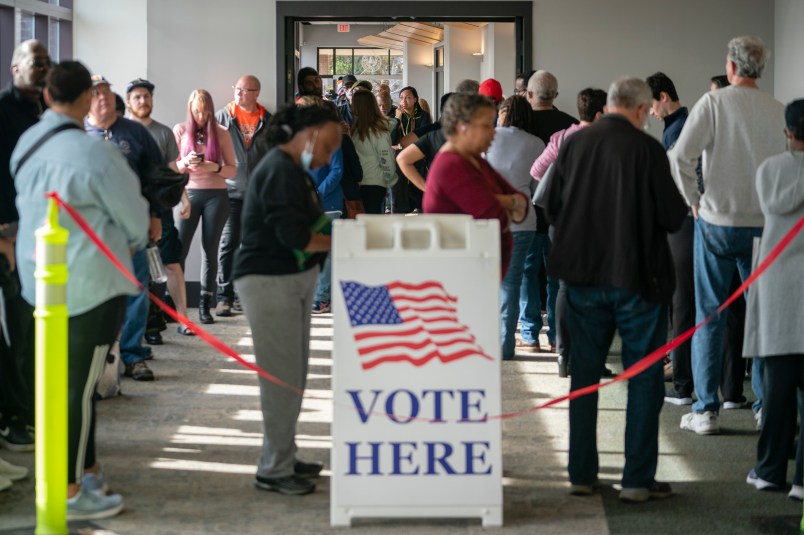
Both the calendar and the events in Minneapolis have brought the midterm elections suddenly into focus. We had a special election in Texas in which Democrat Taylor Rehmet scored a double-digit victory in a state senate election in a district Donald Trump won by 17 points just last year. This also comes as polls, which for much of 2025 were more tepid for Democrats than many hoped, have moved more clearly into wave territory. The upshot of all these data points is that Democrats, unsurprisingly, are prepped for a strong midterm showing … as long as the votes are fairly counted. Or to put it a different way, if Donald Trump is looking to avoid losing the House in November and possibly the Senate, him getting more popular or running a super good midterm campaign probably isn’t a viable course of action.
We know about Donald Trump and elections. We had a preview of it in 2020. And now we’re in Trump II where the president has already gone a long way to building a highly politicized domestic paramilitary force which is under his direct personality authority. Many people have rightly been worried for months about the president using ICE to harass voters or create a climate of fear in key cities on election day. Remember that right after the killing of Alex Pretti on Jan. 24, Attorney General Pam Bondi sent a letter to the governor of Minnesota offering to withdraw ICE from Minneapolis if the state would essentially surrender its sovereign governing authority. Along with surrendering public assistance rolls and abolishing sanctuary policies, Bondi demanded access to the state’s voting rolls to free Minneapolis from ICE occupation. So the nexus beyond violence and occupation and the state’s sovereign authority to administer elections no longer has to be imagined. It’s right there.
Because of this I’ve heard from a number of you asking about voting rights and voting rights groups to support. As long time readers will know, voting rights is TPM’s single most consistent area of reporting focus over 25 years. The U.S. Attorney firing scandal was in fact a voting rights scandal. And we’re actually just days away from relaunching The Franchise, our weekly voting rights newsletter, as we get into this year’s midterm cycle. (More on that soon.) And there are a lot of good voting rights groups that have been working this territory, often tirelessly, for many years. But this isn’t a time when any particular national voting rights group, even one of the really good ones, will do, or not the versions of them that might have existed as recently as the 2024 or 2020 election cycles. To borrow a phrase, what you need is a wartime voting rights group. And at this point I don’t have a clear enough sense of which might qualify. (If you do, let me know.)
Let me unpack what this means.
Traditionally, voting rights has been fought out especially in the courts but also in state legislatures and in various forms of protest activism. There’s also a strong remedial element. If states pass onerous voter ID laws, you want to have people helping voters understand what kinds of IDs they need to vote and where to get them. But the prospect of armed paramilitaries harassing or obstructing voting at the behest of the president or other coercive and extra-constitutional attacks puts us in totally new territory. It not only requires new policy responses it requires a very different mentality and field of imagination for what kinds of resistance to unconstitutional and criminal attacks on the electoral process are possible.
As we’ve discussed numerous times over the last year, the critical issue here is the latent, underused and often under-appreciated sovereign authority of the states. And we are beginning to see the first signs of states using these powers. At least two states have set up portals for citizens and members of law enforcement to report criminal conduct of ICE and other federal agents for future prosecution. These are small steps, not directly tied to voting. But they show a growing recognition that the federal government is now in renegade, anti-constitutional hands and is committing various criminal acts as matters of policy. So much of modern state authority is invested in institutions and processes aimed at collaborating with federal authorities that it takes much more of a leap of imagination than it might seem from the outside to do otherwise.
This will of course still require a lot of court actions and possibly legislative actions as well. It will certainly require a lot of citizen organizing. But it has to be heavily tilted toward protecting each state’s ability to conduct elections in the face of extra-constitutional incursions by the federal government. Conventional voting rights law just doesn’t envision federal occupations where certain classes of citizens may not want to venture outside of their homes or fear getting shot. I don’t know how they would view a gambit like Bondi’s asking for voting rolls as the price of withdrawing federal forces from a state. While we’re at it, Senate Minority Leader Chuck Schumer (D-NY) should absolutely add robust protections against ICE, CBP or any other DHS police agency becoming involved in any way in election administration to his list of asks to approve DHS funding. Even if the White House doesn’t agree to this or even if they agree and then violate the new law it is critical to raise the salience of the issue and public focus on it now.
For those of us who’ve been following voting rights activism for a long time, we’re in different territory. It’s no longer about passing good laws where possible and contesting the constitutionality of bad ones everywhere else. We’re in a terrain where broad and often force-based extra-constitutional and anti-constitutional actions must be assumed. State control over the administration of elections is now the sheet anchor of democratic government in the United States. It must be defended not only in the courts but through creative and aggressive means by state authority itself, by creative non-compliance, by withholding state resources and revenues from the federal government, by collaboration with citizen-led initiatives and even down to mobilizing a state’s policing authorities to block illegal actions by the federal government to deprive citizens of their right to a free and fair election. Every player in the constitutional system is not only permitted but obliged to make their own judgments on the constitutionality of actions by every part of the government. The promise of the American democratic experiment now resides in the Free States of the Union. They cannot accede to the illegitimate actions of a renegade executive.
I remain mostly optimistic about the prospects of a free and fair 2026 election. But that’s because of the structural impediments blocking the federal government from preventing one and because of the strength of civic-democratic traditions in American political culture, ones which are already showing themselves and turning the public strongly against the administration. The forces of democratic action are simply stronger than the criminal ones in the Trump White House. But nothing can be taken for granted. For that strength to be meaningful and decisive, it will have to be mobilized.