
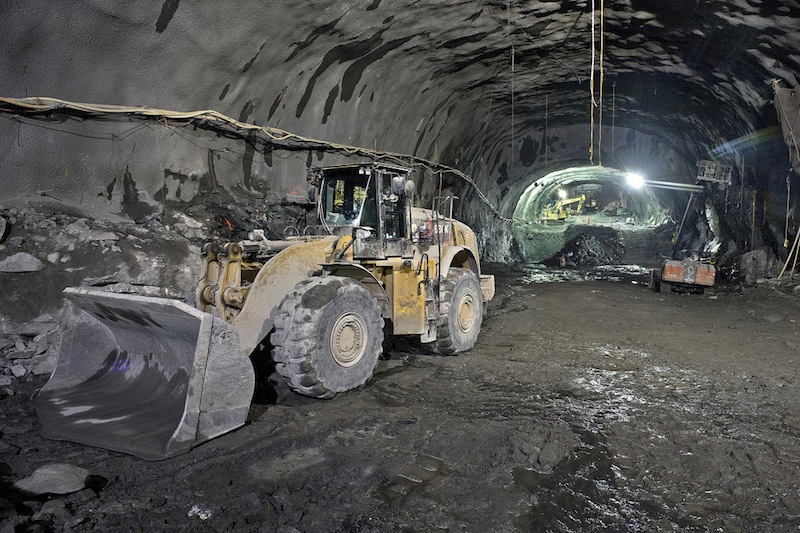
Earlier I posted a link to this incredible slideshow of the tunnels and caverns being excavated out of the bedrock under New York City for a new subway line and how they looked like moonscapes or the lunar excavations from 2001. TPM Reader TT explains for us just why they look that way …
The pictures of the 2nd Avenue Subway excavation are indeed impressive, and to someone like me, who has worked on mass excavation public works projects, they are nearly equivalent to porn (ok, maybe the sports section, or Car & Driver).
However, there’s a very specific reason why the walls and ceilings of the tunnels and stations look like “moonscapes”. That is not Manhattan Island bedrock, but rather the concrete which will cover it in perpetuity once those tunnels and stations are completed.
Specifically, they are covered in what’s known as “shotcrete”. Shotcrete is nothing more than concrete mixed at a standard 3000 to 4000 psi, but with a very high slump so it can be pushed through a hose and literally “shot” onto a wall or ceiling. (Slump is the measure of a specific concrete design’s plasticity, or workability. Paving concrete for roads, loading docks, aircraft runways and taxiways, and so on, has a very low slump, usually an inch or less, particularly if it’s being slip-formed; the same is true for tunnel “rings” if a tunnel is being cast in place as opposed to having pre-cast concrete panels installed.
By contrast, structural concrete, for walls, culverts, manholes, and the like, has a very high slump, at least three to four inches, since it has to be maneuvered into and appropriately vibrated inside relatively narrow forms.) So a shotcrete mix design is one that includes a fair amount of water, a smaller coarse aggregate (i.e. stone) than other mix designs, and various admixtures and such so that the concrete can be highly and effectively pressurized through a small hose over dozens if not hundreds or feet, and then sprayed onto a wall. So, after enough rock “face” has been exposed (OSHA standard is no more than 4′ if I remember correctly) through digging, cutting, or blasting, the shotcrete crew comes in, drills hundreds of holes where they place steel bolts of varying length and thickness, secure those bolts with grout, hang thousands of square feet of wire mesh on them, and then spray and finish shotcrete. Then the excavation crew comes back in and the whole process begins anew, until you reach the bottom elevation called for in the plans.
Why use shotcrete? Well, you can’t have excavation without support of excavation (SOE). Those walls need to be supported so they don’t cave in. After all, excavation is an activity that does much violence to the earth’s crust, and the further you go down (or across, as in a tunnel) with exposed “face” the greater the chance that a cave-in will occur. So you need to put something in place to stabilize the soil/rock so that work can continue, whether it’s shotcrete, sheet piles, or what have you. It also means that you can pour your concrete walls directly against the shotcrete itself, and not have to worry about voids or anything around the foundation of your structure since no section of the face will have fallen out.
(And if you want an idea of what an honest day’s work looks and feels like, join a shotcrete crew. Tough, tough way to earn a living, believe me.)