


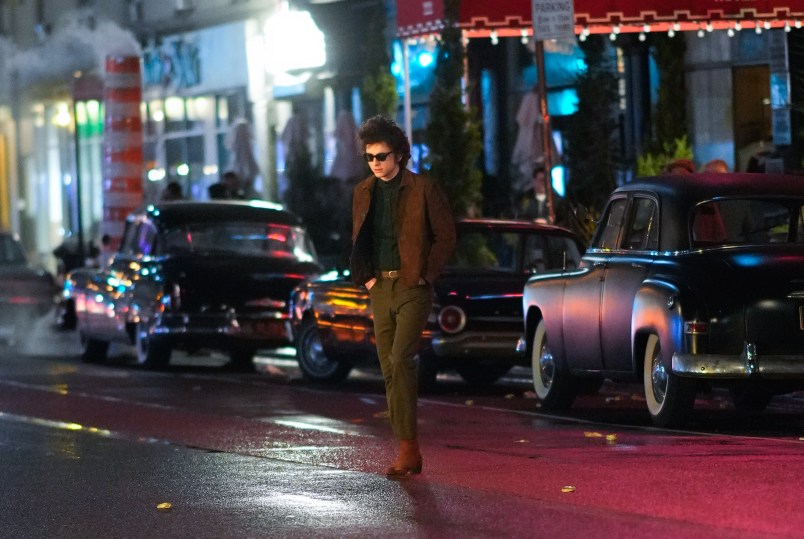
I got the opportunity to see the new Dylan movie at an advance screening a couple nights ago. And I wanted to share a few thoughts about it. I don’t know how to write a movie review. And I don’t know enough about movies to write one anyway. These are just some of my reactions.
First, for a tl;dr: I liked it. I recommend it. Especially if you’re at all a fan of Bob Dylan.
I’m a difficult audience for this kind of film. I know every detail and anecdote from the history the movie chronicles — each meeting, plot point, verbal exchange, performance. That’s not bragging. It’s an admission. I’m way too deep into this stuff. What that means is that it’s really hard for a biopic to recreate or dramatize these events in a way that does not seem, at least for me, sentimental, cliched, overdone. Even if you don’t know all the details as an obsessive, this material has been discussed and mythologized endlessly. How can it possibly be fresh? Biopics such as these often have a stations-of-the-cross air to them, with the hero floating from one iconic moment to the next. So there’s like a Sword of Damocles of cliché and treacleiness hanging over a project like this.
But for me, Like a Complete Unknown managed to avoid this pitfall, which surprised me. The sword doesn’t come down.
Timothée Chalamet is a big part of this. Somewhere I saw an interview with Chalamet in which he said this isn’t supposed to be Bob Dylan. Don’t go in thinking it is. You can go see Bob Dylan if you want, he pointed out. He’s still touring. It’s an interpretation of a particular time and set of events.
This is obvious. But some obvious things need to be said. And that comment helped me come to the film in the right, open frame of mind. His performance is what really anchors the whole movie. But we’ll get to that in a moment.
What also makes it work is that right off the bat James Mangold, who directed the movie and also co-wrote the screenplay, tosses out the specific details of how key events happened and allows himself to be creative with the timeline. That kind of compression and reworking is standard in movies about historical events. Here it involves a bit more risk since a lot of people know the details. But it made the whole thing more fresh. It set the stage for the rest of the movie because I was immediately on notice: this is an impressionist painting, not a photograph. Take it on that basis.
At the beginning of film we have a moment with Seeger, Guthrie and Dylan in a hospital room. That moment never happened. It collapses five or six different progressions and timelines. But it was unbelievably powerful. It was truer than a lot of the real facts.
What also struck me is that the Dylan portrayed here is a very unheroic young man. My understanding is that Dylan’s involvement with the project was minimal, no more than a few meetings with Mangold and some conversations with Chalamet. But that non-involvement must have been a choice. He could have been involved if he wanted to be. I noticed in the closing credits that Dylan’s longtime manager Jeff Rosen is listed as one of the producers. And the entire project probably wouldn’t have been possible without access to Dylan’s song catalog, which is the necessary spine of the whole movie. The actual Dylan must have been fine with Mangold and Chalamet making whatever kind of movie they wanted to make.
Biopics, especially music star biopics, usually follow a standard formula: Young hungry artist full of ambition, triumphant success, period of out of control drug abuse and/or struggle with personal demons (Behind the Music interlude), comeback and final triumph. This movie doesn’t do any of that. First of all, it’s not properly a biopic. It only covers about four years of Dylan’s life, from early 1961 when he shows up in New York City to his fabled 1965 appearance at the Newport Folk Festival where he “goes electric.” But the script, which Mangold cowrote with Jay Cocks, doesn’t try to create some story of triumph or evolution or any morality tale.
This is a Dylan who is electrifying and charismatic, albeit in an untraditional way, but also socially awkward and even a little spectrumy. He strikes up a relationship with his girlfriend Sylvie (a composite representation of Suze Rotolo, the woman you see with Dylan walking down the snowy street on the cover of his second album). He then casually cheats on her with Joan Baez. When Sylvie travels to Europe for three months to study painting, he’s heartsick and can’t bear her leaving and then promptly strikes up again with Baez until Sylvie comes back. As the movie goes on it’s a little hard to make sense of whether he’s cheating on Sylvie with Baez or Baez with Sylvie. Partly this is the movie’s impressionistic rendition of time. But the real story has lots of other women in the mix. In fact, by the time of the climactic scenes of the movie in 1965, Dylan had already started another relationship with a woman named Sara Lownds, which he seems to have kept hidden from almost everyone, and who he secretly married during a break in his 1965 tour. In other words, the precise set of characters and triangles is a confection. The gist is pretty much spot-on.
The movie makes no effort to build any dramatic tension underneath this behavior or suggest some hidden demons or inner sorrow to explain it. He’s just a guy in his early twenties who without any overt malice is up for all the sensual and emotional gratification on offer and isn’t very focused on making any hard choices to limit the destructive impact of his actions. He’s a magnet for women who want to be with him and mother him. And he’s up for being with them and being mothered. And writing songs in the middle of the night while they’re trying to sleep. And that’s just how it is.
In one of the Baez’s character’s main scenes with Dylan she tells him he’s “kind of an asshole.” In another she kicks him out of her apartment in the middle of the night. And she remains totally in love with him right up until the movie’s end.
This comes up again and again in every treatment of the first years of Dylan’s career. People can’t help doing things for him. People take him in. He lives on their couches. They buy him meals. His love interests are always mothering him. Everyone who comes into contact with him in New York seems to instantly mark him out as not only special but needing to be cared for. A waif. The songs really do speak for themselves. But there seemed to be an aura around the guy even before there were many songs.
The move to electric blues and rock music is in a way similar. In the standard telling, this is a story of generational succession. Dylan is like an electric butterfly emerging from the chrysalis of the Folk Revival. But in Dylan Goes Electric!, the book upon which the movie is based, Elijah Wald explains that it is possible to see the story in a very different way. “In most tellings, Dylan represents youth and the future, and the people who booed were stuck in the dying past,” Wald writes. “But there is another version, in which the audience represents youth and hope, and Dylan was shutting himself off behind a wall of electric noise, locking himself in a citadel of wealth and power.”
That full story is too complicated for a couple hour movie. But for the purposes of the movie, this showdown isn’t just or maybe principally about an artist remaining true to an artistic vision. (He didn’t need to appear at Newport that year and he didn’t need to do that set when he was there.) It’s as much a story of a young man getting angsty and cranky and feeling confined in a world of fame and adulation which has grown up around him and which he’d constructed around himself and simply wanting to break something. And folk music and the Folk Revival, which had rebuilt itself around him, is what he decides to break. Young men like to break things. We know this, right?
The movie captures how Dylan gets away with a lot because of who he is. But it’s not an act. He really is that person. It’s only barely alluded to in a momentary pan of the camera in the movie. But according to most accounts, after the cacophonous and mood-breaking Newport performance, Dylan goes off and sulks. He’s shell-shocked. Like I said, young men are like this, right?
The standout parts in the movie are Edward Norton as Pete Seeger, the one fully formed person in the whole narrative, and Monica Barbaro as Joan Baez. For me, Elle Fanning’s Silvie is too one-dimensional. Her character doesn’t operate at the level of the other two.
As for Timothée Chalamet’s performance, all I can say is that it lives up to all the billing and probably exceeds it. There are a lot of Dylan mannerisms to copy, as a person and as a performer. But this isn’t an impersonation. He manages to become another version of him: if Dylan wasn’t Dylan but the physical body of Timothée Chalamet that was somehow also Bob Dylan, another version of him. Like I said, I don’t know enough about movies. But that’s how it worked for me. This is also the case with his musical performances, which as far as I can tell Chalamet does entirely himself. Maybe they overdubbed or CGI’d his guitar playing. But the finger work is real. He clearly learned to play a pretty passable folk guitar. I know Dylan’s performance style really well and when I watched this I struggled to think of anything he was missing. But again, it’s not impersonation. It’s another version of Dylan that in the movie seemed just as real.
The one overriding sense I had was what I can only call the smallness of the movie. By that I don’t mean that it’s limited in ambition or execution or subpar in any way. I mean that it is very close up, very intimate, all in a close up and small space inhabited by Dylan and a few other key people. There’s not a lot of grandness in it. The scope of Dylan’s fame and cultural gravity by 1965 are alluded to at key points, so you know that he’s definitely become a big deal. But that never becomes the movie’s center of gravity. And what the ’60s supposedly was or was about to become in 1965 … I can’t think of where the movie really gets into that at all, apart from a few wardrobe changes in the last third of the film. Even the recreations of the Newport Folk Festival capture some of this. Look at the archival footage and it looks big and storied and grand. The film captures a bit more the smallness, more like the summer entertainment programming at the park in a midsized town, albeit with admittedly bigger crowds. But not that big.
It’s very difficult to capture why any of this acoustic vs electric, folk music vs electric blues mattered so much to people at the time. It’s a very faraway world. But it really mattered a lot in those communities. And Ed Norton’s Pete Seeger character really captures why that was, why it wasn’t just some fuddy-duddy nonsense. As I said above, it’s really Norton’s Seeger and Barbaro’s Baez who steal this show in a lot of ways. But I wondered when I was watching this: is there an audience for this? We live in an era of Marvel Comics movies and dis-intermediated social media memes. This is small, up-close, intimate. Chalamet’s Dylan remains in most ways kind of inscrutable, you see him mostly reflected in the other lead characters. He speaks mostly, literally, through the music, which he performs through the film. In a basic way, we’re left not really knowing exactly what makes the guy tick, except through the music. That was the right filmmaking decision. Because I don’t think we know exactly what makes this guy tick. And anchoring the film to whatever interpretation Mangold and Cocks came up with would limit it way too much. I hope there’s an audience for it. I loved it. But again, it’s intimate and small. It’s about a far away land and time that I think the movie captures in a powerful way. But far away it is.
I’m looking forward to seeing it again.