


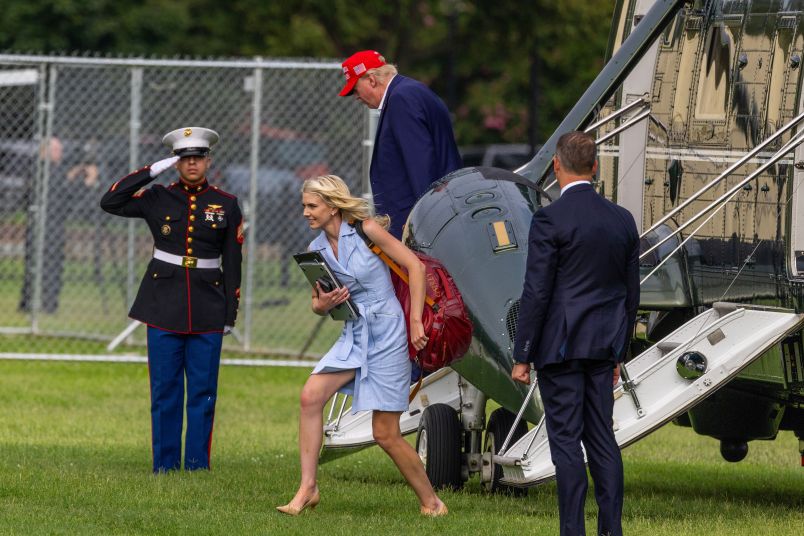
If you’ve been online in the last few days you’ve undoubtedly been exposed to Natalie Harp Discourse (NHD), the phenomenon surrounding a woman who has served since January 2025 as President Trump’s human emotional comfort blanket. Attention to Harp had been growing online over the last couple weeks. (Perhaps the canonical account on her role was published by the New York Times just after the 2024 election.) Even the TPM Editors’ Blog has been in on the action. But it kicked into high gear on Sunday when Sen. Jon Ossoff (D-GA) referenced her with a mere three words in a campaign speech which was then sliced and diced for maximum social media exposure. Let me quote the full sentence with the three words about Harp in italics: “He golfs and trades stocks. See, he doesn’t want to do the job. He wants to build his ballroom and travel with Natalie on their apparently defenseless flying palace gifted by the emir of Qatar.”
This may seem like fluff and frivolity to some. But among other things it brings to the surface a question that has hovered around the opposition to Trump ever since he entered the political scene more than a decade ago. I had been thinking about this in recent weeks because it becomes increasingly relevant, especially with the onset of the 2026 midterms.
Put simply, we know that Trump is a mammoth threat to American liberties, civic democracy, the entire more or less rules-based global order which he has already half-way destroyed, though its erosion was already a source of his rise. This is all true. The opposition to him realizes this and yet there is a paradox: in pumping up and broadcasting these warnings and criticisms, they also build Trump’s myth, the mental and symbolic architecture of his power. You’re probably familiar with this yearslong debate. One person will lay into Trump’s endless vanity, the degenerate hunger for the most abject kinds of sycophantic praise, the slapdash administration of government, the festival of rake stomps. Then someone else comes back, “Oh, you think he’s funny and don’t see the danger he represents!” A related thread turns on those who won’t tolerate any suggestion Trump won’t get exactly what he wants, a kind of militant doomerism, self-enervation as activism.
I am of course a harsh partisan in this far-flung conversation. But I want to focus on it here from a greater distance, seeing the meta-debate in whole as part of the challenge Trump’s opposition has had making sense of him — the ways in which arguing the case for the threat he represents paradoxically inducts these would-be opponents into the work of building his legend, puffing up the symbols of Trump’s power which, in this age of memes and symbols, really are power. When people accuse Trump of being a dictator, trampling norms and opposition, taking absolute power … he positively relishes it. They are singing from his hymnal, validating his pretensions through the expressions of their fear of his power.
Which brings us back to Natalie.
The mere three words above have spurred an epic freakout and rampage from everyone in or adjacent to the White House and anyone looking to be. Did Ossoff strike a nerve or is this — recapitulating the dynamic I described above — an example of Ossoff somehow walking into a trap? Remember the rule: no matter what happens it’s always what Trump wanted and it will always be great for him!
Okay, okay, let me try to get back to the “focus from a greater distance” I promised.
Trump’s allies are pushing so hard on the idea that Ossoff was accusing Harp and Trump of carrying on an extramarital affair not only because it allows them to play the victim but because that’s actually a much more comfortable story. Trump has never run from his record as a serial philanderer or even from the countless women who have accused him of misconduct ranging from boorishness to rape. He sees it as part of his legend, a symbol of his power. It’s his brand.
Trumpworld couldn’t care less if people think Trump’s cheating for the 1,900th time. As his power declines, that’s advantage more than insult. What worries them is the image of an 80 year old man wildly dependent on a clinically fan-girlish 30-something whom he appears to cling to as a kind of human emotional support blanket as his faculties and political power fade. When she was living at Bedminster she couldn’t be as ready at hand as she believed he needed. So she moved into the women’s locker room. When a car in the entourage didn’t make her available enough, she chose to ride crumpled in the trunk of his SUV. That’s image-debilitating, disturbing, uncomfortable to look at it — not so much because her troubled personality happily embraced it but because he was so in need of it. It’s a vivid, peristalsis-inducing tableau of late Mad Kingism, a shell of Dictator-He-Man-ism encasing a pitiful, weak and needy reality. It’s kryptonite to Trump’s image, which is to say, to Trump himself. It makes him look pathetic. And in the world of symbols of power, dominance, weakness and decline that Trump created, hammering that truth is the path to breaking his power.