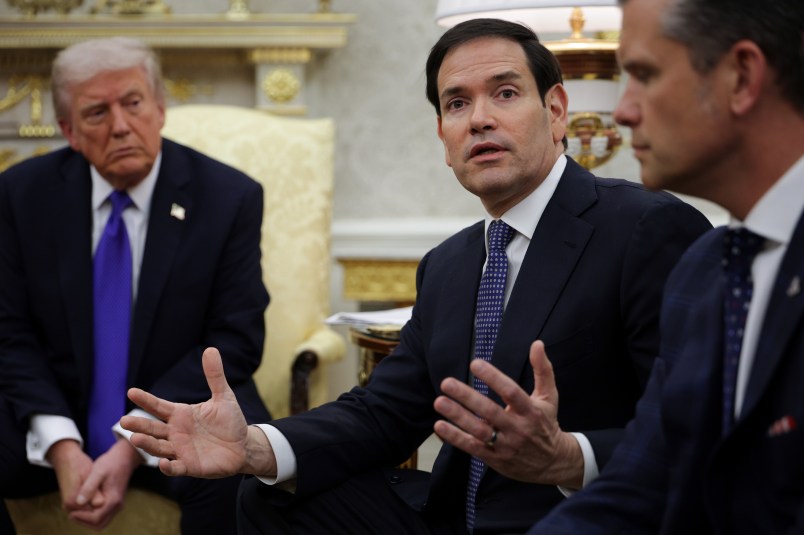
Secretary of State Marco Rubio today made some extraordinary comments after briefing G7 leaders about the progress — albeit difficult to call it that — in the U.S.’s Iran War. He seemed to say that the U.S. won’t be able to reestablish freedom of transit through the Strait of Hormuz even as a final war objective, let along doing so in the short term by force or threat. He said he told the G7ers that one of the post-war challenges will be Iran setting up a tolling system for passage through the Strait. In other words, Iran will be so empowered after the war that it will be able to assert or seriously contest sovereignty over the Strait.
This is such a remarkable statement that I want to quote it at length. I had seen more garbled and clipped versions of it. These are from a report in The Hill.
“I did describe to our allies, however, that immediately after this thing ends, and we’re done with our objectives, the immediate challenge we’re going to face is an Iran that may decide that they want to set up a tolling system in the Strait of Hormuz. Not only is this illegal, it’s unacceptable, it’s dangerous for the world. And it’s important that the world have a plan to confront it.”
You note “the world” needs to get on this. He then said that the U.S. “is prepared to be part of that plan.” But part of, not lead. And then …
“But these countries have a lot at stake, not just the G7 countries, but countries in Asia and all over the world have a lot at stake and should contribute greatly to that effort, to ensure that neither the Strait of Hormuz or, frankly, any international waterways should ever be something that’s controlled or tolled by a nation-state or by a terroristic government like the one that exists in Iran today and that clerical, radical clerical regime.”
The key here is that the U.S. seems to expect the war to end without any agreement simply not to block the Strait of Hormuz or exact tolls through it, which means claiming sovereignty over it as a kind of inland waterway. There’s really no way to describe this other than conceding that Iran will emerge from the war massively strengthened. We’ve come a long, long way from regime change and unconditional surrender. The other way to view it is that Rubio concedes that Iran will come out of the war massively strengthened and that it’s up to Europe and perhaps some countries in Asia to fix it.
Needless to say, there’s a lot here that requires explanation. The EU powers seem to be saying they’ll be part of some post war plan to keep the Strait open. But only after the conflict is over. Point being they don’t want to be operating in any war zone. But wait! … if Iran is claiming sovereignty over the Strait and charging tolls, you don’t necessarily change that without at least threatening to go to war again. And that’s clearly not what the EU powers are signing off on.
Clearly we need to know more of what on earth Rubio is saying here. But what’s clear is that the U.S. has seemingly given up on free passage through the Strait even as part of a final settlement.