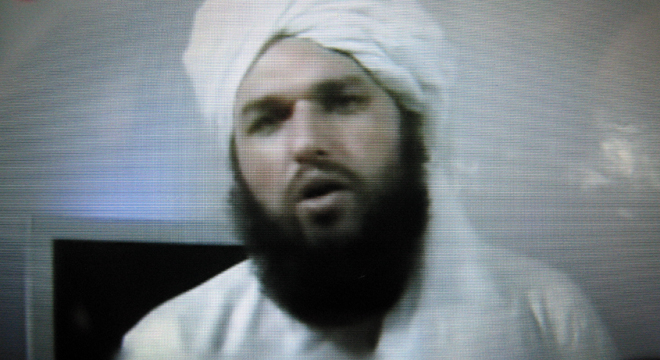
Pakistani officials are reporting that Adam Gadahn has been captured in Pakistan.
If you’re not familiar with Gadahn, he may be unique in the history of America’s fight with al Qaida. Gadahn was born in Oregon and raised as a Christian, though he is of partly Jewish ancestry. He was born Adam Pearlman.
Unlike John Walker Lindh, a pretty shambling and lackluster jihadi, who showed up in Afghanistan and briefly fought with the Taliban before and after 9/11, Gadahn’s the real deal. He genuinely joined al Qaida and has apparently been a fairly high-level operative in the organization, though he’s mainly focused on making videos and being an al Qaida spokesman to the English-speaking world.Gadahn has also already been charged with treason, an extremely rare charge in American law. Remember, the definition of treason is actually written into the US Constitution. And it’s a very high bar — though one Gadahn seems to meet pretty handily. I believe he’s the first American to be charged with treason since the cases that emerged from World War II.
Aside from the good news of his capture, Gadahn’s arrest will likely spawn another round in the on-going civilian v. military trial debate. What makes his arrest particularly interesting in terms of this debate, however, is that Gadahn was indicted for treason and other civilian crimes back in 2006. And no one has raised any objections to those charges. (For what it’s worth, the same is true of bin Laden.) What’s more, it’s not entirely clear to me that he could be charged with treason in any but a real, civilian court.
As noted above, the terms of conviction for treason are written into the US constitution. On that count it says, “No Person shall be convicted of Treason unless on the Testimony of two Witnesses to the same overt Act, or on Confession in open Court.” Now, I confess I’m out of my element on this count in terms of the jurisprudence. But I would think the reference to a trial “in open Court” would rule out at least a lot of Star Chamber type proceedings.
In any case, it’ll be interesting to see how this plays out. And I’d like to hear from anyone who can add any knowledge to this question of the law of treason.