



I corresponded with a TPM Reader from the tech world recently who marveled at the political salience of data centers when data centers have been around since the late 90s. Many data centers today are orders of magnitude larger than their pre-AI relatives, gobbling up much more energy, making more noise and physical pollution. But he noted that the bulk of them aren’t nearly that large. These points each have some truth to them, though I think it understates the real-world impact of hyperscaler data centers. And, as I’ve noted, a lot of our collective social angst about data centers and AI is really focused on oligarchy — the way that it appears to be the tech oligarchs’ world and we’re just living in it. The ability for town and county councils to say no to data centers is irresistible precisely because it’s the one case where democratic self-government is in a position to say “NO!” and that’s so contrary to all our other experience these days. But there’s an entirely different vantage point on this question I want to focus on.
The impact of particular data centers in particular places is one issue. But the macro-story is even bigger and more jarring. Axios has a piece this morning about how the housing sector is getting hammered by the hyperscaler AI boom, both buildings and buyers. And as you may have heard the lack of affordable housing is a rather pressing issue in American society today. This applies to everything from inflation/scarcity of the physical building blocks that are used for building housing to the scarcity of capital to fund it. If that sounds overstated look at this chart from a study we discussed late last month and which got written up in various publications.
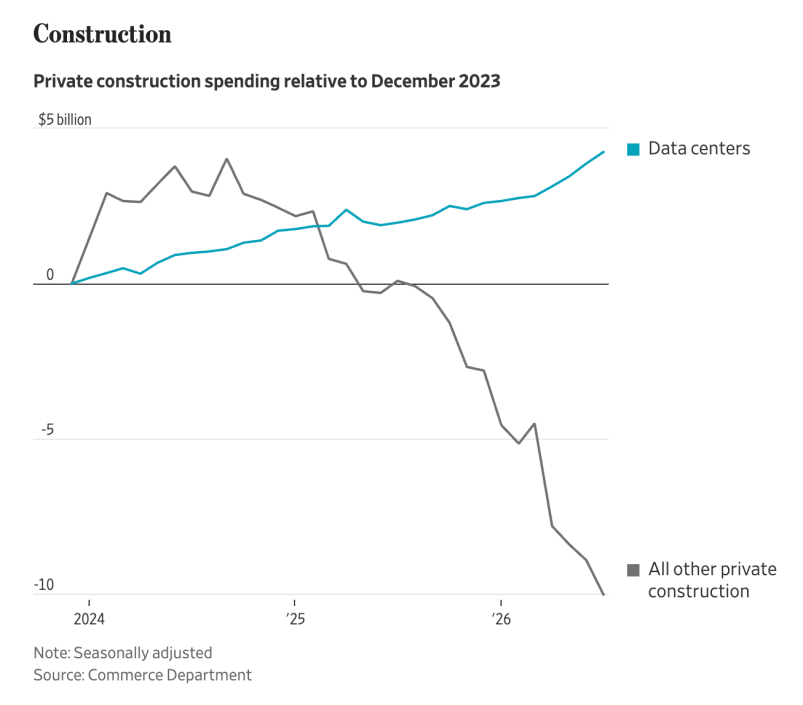
I keep coming back to this graph because it’s so eye-popping, almost impossible to believe. As you see in the legend, the blue line is data centers. The grey line is everything else. Everything else. Commercial properties. Rental properties. Single family homes. Multiple family homes. Pick your preferred flavor of development, NIMBY, YIMBY, urban, rural, it’s in there. You basically have rapid data center growth and everything else contracting.
Many of us first saw the signs of the hyperscale AI boom when we noticed that computer memory had suddenly gotten wildly more expensive, after decades when the price of memory fell as though under the force of gravity year after year. Some forms of computer memory that go into personal computers have quadrupled in cost over the last 18 months because AI’s demand for all forms of computer chips is so great. That’s now spread to the entire economy. This is about more than the AI boom itself. It’s about who the economy is working for. In a general sense, it’s probably a safe bet at any time that the economy is largely working for people with capital. But in an economy driven by consumption, that at least ties back significantly to things people want. The simple reality here is that the AI boom is making huge amounts of money for people at the top of the economic ladder (almost entirely through the equities market) while choking off investment in everything else. Housing and commercial construction are getting crowded out. And this is, as we noted above, at a time when the cost of housing is a huge political issue and one that can only be fundamentally addressed through increasing the supply of housing. We have this running debate about why people are so down on the economy when economic indicators either aren’t that bad or are really good. This is pretty clearly the answer.
You can see all of that through this prism. The interplay between data centers and housing construction captures the larger story in the most powerful and elemental way. There’s nothing new about the economy not being run on the behalf of the have nots or those struggling on the lower rungs of the economy. But this is something different. It’s an economy being run pretty indifferent to the needs or, more importantly, even the consumption desires of the middle and even many of the upper rungs of the economy. The simple reality we see here is that a tiny number of people — dozens at most, mostly in Silicon Valley — are able to drive the direction of the whole economy and in a way that at least in the short-term (the long term probably too, but I’m just talking about what we factually observe right now) is straining everyone else. They’re creating a lot of paper wealth for other people too. But again, that’s heavily weighted to the highest strata of the economic ladder.
It remains difficult to overstate the degree to which the entire private economy has been disfigured by the ongoing AI boom.