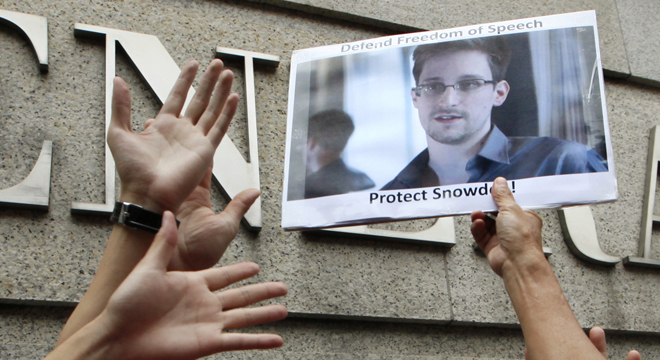
There’s a new Snowden article out in the Times that’s well worth your time to read. I suspect it will confound at least a few of the assumptions held by people on either side of the Snowden divide, sympathetic or not. The gist of the article is that Snowden’s decision to leave Hong Kong came rather late, after one meeting with his Hong Kong lawyers and that Snowden seemed to have arrived in Hong Kong with only a very limited understanding of what his legal position would be once he arrived and disclosed his identity.Specifically, Snowden was figuring on or hoping for a substantial period of time at liberty while his extradition case worked its way through the Hong Kong SAR court system. What he didn’t figure on is that he might spend that time in jail and – crucially for Snowden – without his computer.
Here’s a key passage …
Mr. Snowden, who has just turned 30, comes across as intelligent, analytical and quick-witted, Mr. [Albert] Ho said. But he also came to Hong Kong from Honolulu without a well thought-out plan, while overestimating how free he would be to move around Hong Kong after his disclosures and underestimating the public attention he would receive, Mr. Ho added.
“He’s a kid, I really think he’s a kid, I think he never anticipated this would be such a big matter in Hong Kong,” Mr. Ho said, adding that, “He enjoys Pepsi, he prefers Pepsi to wine, that’s why I say he’s a kid.”
Mr. Ho presented an image of Mr. Snowden that differed in some respects from the public image that he presented in a video released by the Guardian newspaper of Britain when Mr. Snowden first stepped forward to take responsibility for leaks of classified information about American surveillance programs.
In the video, assembled over a period of days from various remarks made by Mr. Snowden, he appeared to have devised a clear plan of action together with a willingness to defy the United States.
But Mr. Ho described his client as someone with a vague sense of his legal options and a limited understanding, at least until the dinner over pizza last Tuesday, of his legal rights in Hong Kong. During the dinner, Mr. Ho said, “he came to a full grasp of the situation and better understanding of the reality.”
Mr. Snowden strongly disliked the possibility that he might be held without bail in prison without access to a computer for long periods of time punctuated by numerous court appearances, Mr. Ho said, adding that, “he was a loner, he didn’t have much support until people like us” started giving legal advice.
Once Snowden got the gist of his position he had two questions for the Hong Kong authorities – who clearly wanted as little contact with him as possible and would only communicate with him through an intermediary. The two questions where whether Snowden could be assured he could remain at liberty while his extradition case proceeded (they couldn’t guarantee that) and whether he could be assured safe passage out of Hong Kong (on this, the SAR government seemed more than happy to help).
If neither question received a favorable answer Snowden’s next step was going to be seeking the advice of Stephen Young, the US Consul in Hong Kong, who Snowden’s lawyer Mr. Ho, knows socially. “But,” the Times continues, “there was no clear plan on what to seek from Mr. Young, and the Hong Kong government’s assurance of safe passage meant that this plan was never discussed in depth, Mr. Ho added.” I can only imagine what sort of advice might have been requested or been on offer.
It is only fair to notice that Ho, as Snowden’s lawyer, does have an interest, perhaps an obligation, to make his client seem as much of a naif as possible. But it still makes Snowden seem like someone seriously out of his depth in terms of the nature of the situation he’d gotten himself into and how relatively little research (quite possibly difficult to do) he’d done on what would happen once he got to Hong Kong.