

 Members-Only Article
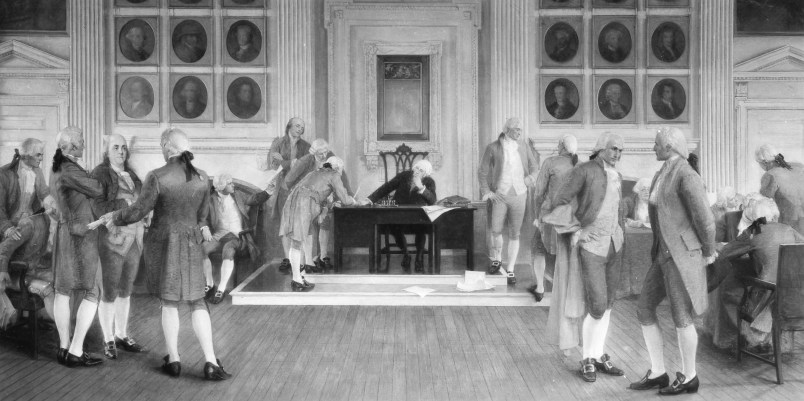
Members of America’s founding generation had an ambivalent and evolving understanding of the role and importance of public or civic “virtue.” In the 1760s and 1770s, many of them were caught up in a kind of republican idea world which made this kind of virtue the cornerstone of any republic. The anchor of republican government wasn’t well-designed constitutions or legal accountability. It was the virtue of the free citizenry. By the late 1780s, many were developing a more pragmatic and jaded view of human nature and focused more on creating systems in which greed, the drive for power and other unlovely parts of human nature could be placed into some kind of enduring counterbalance. That was the basis of what became the federal Constitution and the driver especially for the two young ideologues, James Madison and Alexander Hamilton, both men in their thirties, who pressed the project forward.
I was thinking about this this morning when I saw a post by Leah Greenberg, the co-founder of Indivisible. She commented on the “utter moral failure of the elite of this country” when referring to a passage from an article by journalist Ed Luce who recounted talking to numerous leaders throughout the American power structure, all of whom said how critical it was for powerful public figures to set an example by speaking out and defying Donald Trump, and none of whom agreed to speak on the record.
Luce concluded by saying “it has felt like trying to report on politics in Turkey or Hungary.”
This got me thinking about the question of civic virtue.
That idea of civic or republican virtue that those men in the 1760s and 1770s were talking about was a deeply gendered one. The word actually originally meant “manliness.” (It’s the same root as virility.) But we could, without too much, trouble recast the term and concept in less gendered terms. It was mostly about an ethic of stoicism, self-denial and an indifference to the fame, flattery and riches that supposedly provide a guard against the kinds of corruption that can undo a republic. What I mean is something related to that but distinct. It’s closer to something I discussed back in April when I used the analogy of doctors: that doctors are given great social prestige and a fair amount of wealth in our society and that entails or should entail running some risks and having some broader social obligation in a way that a jeweler or a barber does not. Doctors hold the keys to life and death. We grant them a lot for that. And they need to live up to that at critical moments.
This applies to all of us in our own ways. The doctor analogy helps illustrate the point. But it applies to, and should apply especially to, everyone in positions of great authority and to those to whom our society has given so much. In other words, the people Luce was talking about, who he refers to as “lawmakers, private sector executives, retired senior military figures and intelligence chiefs, current and former Trump officials, Washington lawyers and foreign government officials.” These people profited by this system, this republican system; what they have was made possibly by it. So they have an obligation to defend it when it’s under severe threat. That’s the civic virtue that’s important, that’s real. Needless to say these are apparently quite notional obligations because hardly any of these people appear to feel under any pressure to do so. But an obligation shirked doesn’t make the obligation any less real.
Everyone has their limit. In autocracies, people lose their jobs, their fortunes, their freedom, their families, their lives. The reality is that we are not, at least currently, talking about anything that extreme for people with this degree of privilege. We’re mostly talking about losing contracts, or in certain cases jobs or business advantage. Even in the handful of cases of people facing criminal prosecution or under indictment, we’re talking about charges that are highly unlikely to ever lead to conviction. Yes, there are big legal bills. But if you can’t give your life for your country, it shouldn’t be too hard to pay some legal bills for it. In the overwhelming majority of cases, the asks are simply not that great. They’re real. But they are not that great. And as Luce’s interlocutors appear to readily grasp, each person speaking out makes it easier for the next.
The opposition discourse about this commonly speaks about “courage.” I don’t think that’s right. Business leaders and politicians run plenty of risks all the time. You risk millions on a bet for billions. You release that once-prized House seat for a shot at the Senate. They take lots of risks. But on their own behalf. The issue here is obligation. We’re all implicated in this. It’s like doctors who want to run for the hills the first time their medical duties might run some risk for them, as I argued in that April post. Fuck that. There’s a web of preferment and incurred obligation that governs all of this, all of us.
Every leader in society — whether it’s business or government or the arts or anything in between — has this obligation. In a perverse and ironic way, Trump’s very argument about the corruption of the American elite is most vividly and visibly confirmed in the way he has so easily plowed through it. That social and civic corruption is deep and real. To the extent the American Republic is still in the game, taking punches but still in the ring, it’s large numbers of fairly ordinary people, without any great amount of power on their own who are doing it. You see that in ground level organizing, in turnout at town halls or No Kings demonstrations.
In many post-revolutionary societies, it’s military or social heroism that becomes a benchmark of preferment and power in post-revolutionary society, much more than birth or money, which almost inevitably come to the fore in more stable societies. If the American Republic comes through this, we should and I suspect to some degree will have something like this.
Everyone should be judged in their context. Not everyone has to be leading a march or running for office. Small risks aren’t as good as big risks, but they outshine taking none at all. You can see who is most indifferent to these incurred obligations. And you’re right to look down on them, just as we look down on people who neglect their parents or their children or any other obligation. And this, this basic calculus of obligation, that we are none of us solo players only responsible for looking out for our own private garden, gets us back to some element of what those folks in the late 18th century were talking when they talked about civic virtue.