


I want to return to a topic I’ve alluded to in several recent posts. The U.S. Constitution, U.S. law and U.S. civic culture all have a deep resistance to the use of the military in civilian spaces, except under the most extreme circumstances. Even then, we rely almost exclusively on what are in effect state and part-time militias, which are incorporated into the federal U.S. military but still distinct from it, at least largely based in the communities in which they are occasionally deployed. This issue came to the fore early in the second Trump administration with federalized National Guard troops deploying in various blue states and even “hostile” red states at least offering to deploy their guards into blue states. But the real game is Immigration and Customs Enforcement and Customs and Board Patrol and other, increasingly super-sized federal policing forces within the Department of Homeland Security. And they’re not military.
Over time, I’ve realized I’m being too literal about this. As a legal and constitutional matter, these aren’t military forces. They’re civilian policing agencies. But the aversion to military deployments in civilian areas isn’t simply a matter of technical designations, the formal unfreedoms of military service, the different legal code, the focus on war-fighting. There is a substantive reality of the desire to menace and dominate civilian spaces as though they are enemy territory, conquered rather than governed.
Since Trump’s reelection, it became a standard point in American political discourse that Donald Trump sees blue states as something like conquered territory. In his mind, he won them fair and square in the 2024 presidential election. The country is his. He owns it. And all its might falls on his political foes and those who resist him.
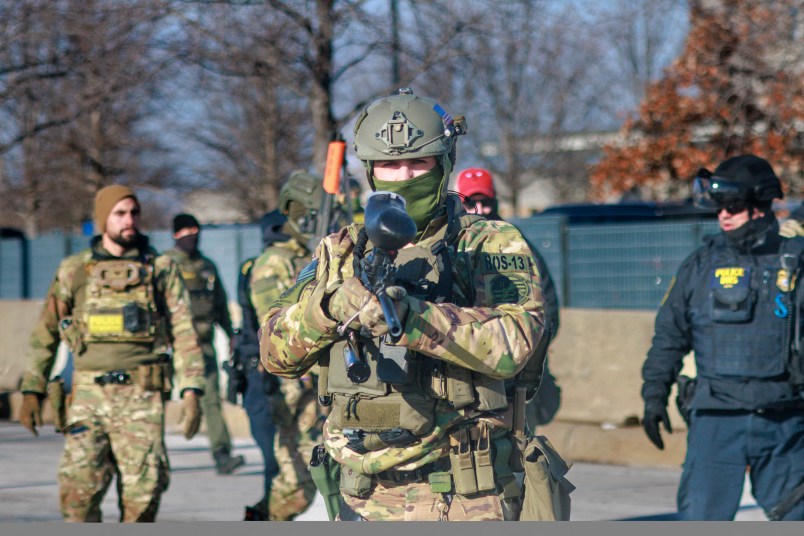
This came into focus for me a few days ago when I was looking at photographs coming out of Minneapolis. A professor on Bluesky compared the aesthetic and bearing of the ICE and CPB agents to something out of Fallujah 20 years ago — the mix of camo, masks, the small bits of tech and body armor. I realized these are soldiers. They’re dressing to look like soldiers, like they’re in a war zone. And really they are, not in a technical but a substantive way. When we think out the traditions and prohibitions embedded in our national culture and the situation we’re in, it’s the substance that matters rather than the legal designations. The distinction between soldiers and police is a fairly modern one. It’s not rooted in science or genetics. It’s tied to our ideas about our relationship to government force, civilian self-government and law versus domination. To maintain our bearings, to adapt traditions to present, to remain in touch with their meaning and protective power rather than their technical application, we need to focus on the substance. These are occupations, with what looks and is intended to look very much like a military force, which is acting like a military — far more than actual soldiers and National Guard do, because centuries of training and law curb those impulses. They’re being sent into these cities to menace and overawe, like some modern day equivalent of the Normans dominating the English countryside with their motte-and-bailey castles.
Part of civilian government and civic democracy is that you can resist things all you want. You just can’t break laws. Most of civic freedom is contained in the empty spaces between those two things. If you look at the trend of Trump rule in blue cities and blue states, the clear trajectory is that not being dominated is getting closer and closer to being a criminal offense, likely through conspiracy laws and such.
When we think about how to understand Trumpism and what to do about it, we need to be thinking way beyond the literal and technicalities. It’s really about how we got to be like conquered territories in our own country and how we un-get there. That requires thinking beyond the narrow technicalities of civilian and military laws and life.