


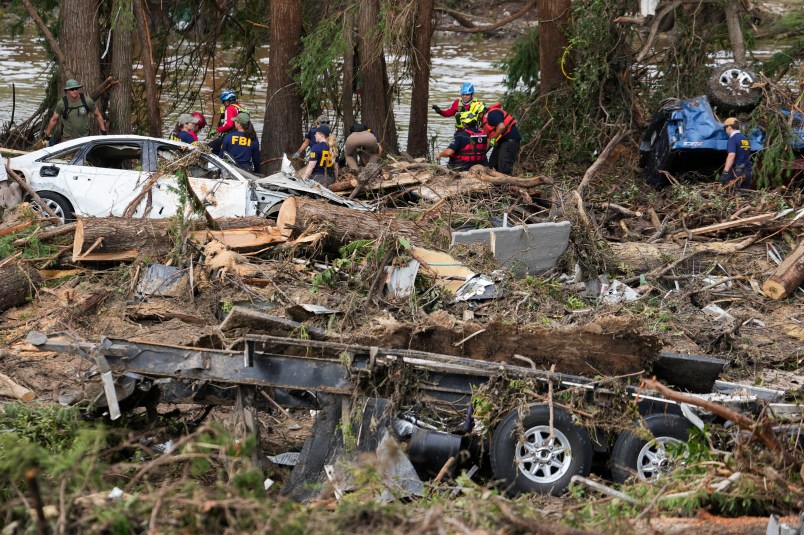
As more than a hundred fatalities have been confirmed in Texas flash floods and some 170 remain missing, Department of Homeland Security Secretary Kristi Noem has both denied that DOGE cuts to the National Weather Service played a role in the tragedy and also focused on the importance of timely and effective communications about extreme weather events, which she says wasn’t up to par. Coverage of the Texas flash flood calamity has made clear that it’s not just the work of forecasters that is critical. You can have a timely and accurate forecast but it does little good if it isn’t effectively communicated to local authorities in the effected areas. That “last mile” communication is critical and it seems like there were breakdowns on that front both with county officials and possibly on the National Weather Service side, where a senior position in charge of liaising with local officials was vacant at the time of the floods. But even as the rescue workers were searching for bodies in Texas on Tuesday, DHS canceled a $3 million grant aimed at ensuring precisely those kinds of “last mile” communications.
The grant was to something called New York’s Mesonet, and the story goes back a decade, to a series of extreme weather events which caused billions of dollars of damage and led to the loss of at least 60 lives in New York state. New York’s Mesonet is a series of towers around the state to collect accurate and localized data.
Two years ago, DHS awarded a $3 million grant for something called the “Empower Project,” which planned to leverage New York’s Mesonet data to “build a next-generation scalable decision-support tool suite for the emergency management enterprise.” What Empower was meant to do was coordinate disaster response in extreme weather events and specifically make sure there was effective “last mile” communications between forecasters, state disaster officials and local officials on the ground in specific areas. In other words, it aimed at improving precisely the kind of “last mile” coordination and communication that fell short in Texas. If locals officials aren’t notified effectively and on time, it doesn’t matter how great the data collection towers are.
As the Empower website puts it, “By integrating advanced analytics, real-time localized high resolution Mesonet-based weather data, critical infrastructure ‘lifelines,’ social vulnerability data, and novel visualization capabilities, the Empower tool will provide a rapid assessment of changing weather conditions and their potential impacts on communities and critical infrastructure.”
But on Tuesday the grant recipients at State University of New York, Albany were notified by DHS in a form dated July 8th that the entire grant was being terminated “for convenience of the Government.” The order, signed by DHS contracting officer John Whipple, instructed researchers to immediately cease work on the project.
The Albany Times Union reported earlier this morning that Sen. Chuck Schumer has written a letter to Noem asking her to reconsider the decision.