

 Members-Only Article
I want to expand on what I mentioned in Morning Memo about some really good work from the Just Security guys on better understanding the delay in the deployment of the National Guard.
From the get-go, TPM’s coverage has been more circumspect about the decision to involve the military in the response to the attack.
Why?
The big fear in the days after the election, and especially as we got closer to Biden’s inauguration, was that President Trump would use civil unrest as a pretext for involving the military and then hijack the deployment and use it to hold on to power.
Even as I type this, I’m struck by how extraordinary it was that we were even thinking in those terms. But we were. And there was plenty of reason to be highly alarmed about the prospect of Trump engineering such a coup.
The big data points at the time were:
- In early December 2020, former Trump national security adviser Michael Flynn, recently pardoned by the President, privately and publicly calling for martial law and for the military to oversee a redo of the election.
- That shocking but cryptic Jan. 3 op-ed in the Washington Post by all 10 living former secretaries of defense, titled “Involving the military in election disputes would cross into dangerous territory”
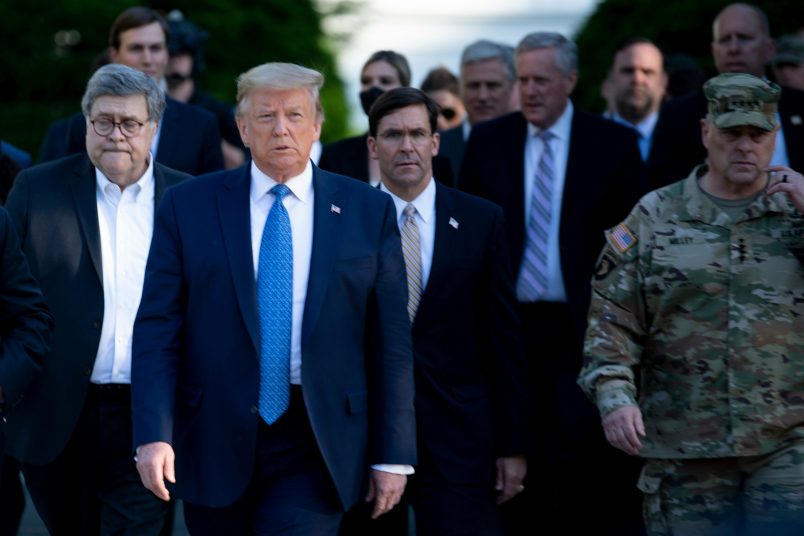
- The way in June 2020 President Trump had used the National Guard and federal law enforcement to clear Lafayette Square across the street from the White House for his own photo op — and personal appearances at the scene (see photo above) by Secretary of Defense Mark Esper and Joint Chiefs Of Staff Chairman Mark Milley (for which Milley later apologized).
The Just Security analysis adds a lot more to the picture. It draws on subsequent reporting, much of it from recent books, and on last month’s report from the Pentagon’s inspector general. The IG report included written and oral testimony from Acting Defense Secretary Christopher C. Miller that bears directly on these questions and illuminates his thinking at the time. It all but confirms that he was operating from a defensive crouch, determined not to let Trump misuse the military for extra-constitutional shenanigans.
Miller doesn’t emerge as a saint exactly. While he may have been concerned about avoiding misuse of the military, he couched it in terms of “irresponsible narratives” and “hysteria,” including about his own role as a so-called Trump stooge who would facilitate a coup. So Miller was playing against the political optics, too, perhaps, not just engaging in a rearguard action against the White House. Top military officials like Milley were in a somewhat different position.
The Just Security analysis points out though that there’s reason to think Miller’s real substantive concern was the President invoking the Insurrection Act, and using that as the pretext for a power grab. Go read it. They unpack it at length, and I’m not doing it justice here.
As for TPM’s coverage, it always seemed two-dimensional to spotlight the critiques of the Pentagon for responding grudgingly to the Jan. 6 attack without fully grappling with the fears that preceded that day of Trump orchestrating a military coup to seize power. What we knew about these fears before Jan. 6 didn’t line up very well with a popular theory of the case that the Pentagon stalled the deployment because it was sympathetic to the rioters or wanted to give them more time to succeed. This remained an unconvincing theory even after it came out that Mike Flynn’s brother, an Army general, was involved in the decision chain.
But that’s not to say that the Pentagon’s delay wasn’t an enormous threat to the constitutional order. It was! And not just because it put Congress at greater peril of being overrun by rioters, and Vice President Mike Pence of coming into direct contact with people chanting for him to be hung. What the delay suggests is that the civilian and military leaders at the Pentagon were trying to thwart, undermine, and do an end run around the President.
From where we all sit, this seems almost altruistic compared to the theory that the Pentagon was pro-riot. But it’s not the way things should work in the chain of command. And it reveals that things were pretty well busted in the final days of the Trump presidency. Perhaps in the historic sweep of things we’ll come to see that the Pentagon was just trying to land a shot-up plane before it crashed. Maybe we can be grateful they landed it, but we have a lot of work to do to fix it.