



A friend sent me this new Bain & Company study on the growth required to match the current levels of capital expenditure on AI, essentially breaking down the cost of the data center and other associated build outs. It’s an interesting document, not simply for the number-crunching and the predictions, but as a document in the more literary and analytic sense. Needless to say, Bain isn’t coming at this from any “boo capitalism!”/”this is insane lol” viewpoint. But the conclusions aren’t that far from the “this is insane lol” position. It’s very much, “hey! we can do this” but also, “um … wow, there’s quite a lot to do.”
The broad stroke numbers are these. The study says that to keep up with the current levels of capital expenditures AI will need to become a $6 trillion dollar market by 2031. (To give some perspective on that number, a recent Gartner study predicted that global IT spending will be just under $6.4 trillion this year. So devices, hardware, software, services, kind of everything.) It then posits that we can see the beginnings of, with some level of out-year predictability, something on the order of a $1.5 trillion market — which would be made up of a greatly expanded consumer market (Claude apps, ChatGPT, etc.) of between $200 and $400 billion and then an enterprise market (software, sales, marketing, business optimization) of between $1 and $1.4 trillion. So we’re left with about $4.5 trillion to go. That’s where the crash course in innovation comes in.
Bain sees four key areas: search and ad growth ($200M to $400M); “autonomous everything” ($400B); physical AI ($900B); and then rounding out the list is “new product development.” You can see the breakdown in this chart. The gray part we might cheekily call “real”; the red part is well, other stuff.
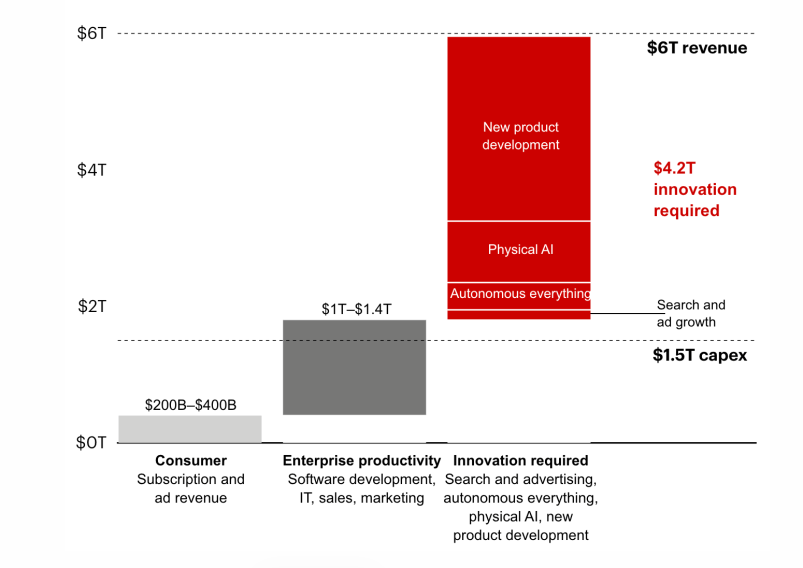
First a few thoughts from someone with fairly limited insight. “Search and ad growth” seems highly LOL to me. That’s something I know a little about. It’s not hard to imagine there are going to be a lot autonomous things. So, okay, maybe. I have no idea. “Physical AI” is quite interesting, however much value it will generate. Really everything we’re talking about in the AI space today is LLMs, large language models. That’s about producing human-like language and something that looks a lot like cognition. Physical AI is about modeling things that happen in three dimensional space. Basically it looks toward lots of testing that wouldn’t have to take place in the real three dimensional world anymore but could be done in computer models. I have no ability to know how much value this would generate. (Here’s an article I read earlier today about AI “godfather” and Turing prize winner Yann LeCun; he’s skeptical about the purported dangers of AI and has his own company which seems to be focused on physical AI.) Then, finally, rounding out the list and responsibility for about half the $6 trillion is the category that might be termed “other stuff we haven’t even been able to think up in concept yet.”
There are two prisms through which it seems wise to look at this. First is that if you went back to, say, 1995, we couldn’t even begin to imagine all the forms of productivity and wealth creation would be generated by building out the architecture of the internet. So “other stuff” … well, there’s probably going to be quite a lot of other stuff we haven’t thought of yet. I’ve piled in a decent amount of snark in this post, I think quite fairly. But I do want us to slow down and appreciate this point. There are just so many entirely new forms of economic activity that the globe has come up with over the last 30 years. That said, almost none of that breakdown of the $6 trillion is current revenue. About a quarter of it is massive growth of existing things. Another quarter and more is highly speculative, but at least things that we can point to in their outlines. And half is in the ‘we have no idea and better start innovating quickly’ category.
The second prism is that we’re not talking here about Star Trek time. Things that will transform society over decades or a century. This all has to happen by 2031, so five years from now.
It’s a lot.
(Ed.Note: The original version of this post attributed the AI build out study to Bain Capital. It was in fact authored by Bain & Company. The companies share a common origin but are separate companies. I regret the error.)