


This is the weekly, free edition of The Backchannel. If you’d like to receive the free edition of The Backchannel in your inbox, you can subscribe here.
Here’s a brief follow up on yesterday’s Israeli election now that the actual vote count and results are coming into view. We began with exit polls suggesting that the “change” bloc had secured slightly more seats than the Netanyahu bloc — 52 to 50 seats — with the two Arab parties getting a historically high 18 or 19 seats. Then the exits started to shift to the Netanyahu bloc and Likud officials were claiming he had been dramatically underestimated and would get upwards of 60 seat and perhaps even a majority. The actual results were lopsided in Netanyahu’s direction but as they’ve been counted they’ve trended down. Now with 86% of the vote counted it’s down to 53 seats Netanyahu bloc, 48 for the “change” bloc and 19 for the two Arab parties. If the trend continues, the Netanyahu bloc might fall one or two seats lower but I have no insight whether the votes that remain will continue that downward trend.
What we’re left with is the essential brokenness of democratic politics in Israel. If the count stays where it is right now, the Netanyahu bloc will have fallen from 68 to 53 seats. The opposition will have 67 seats to Netanyahu’s 53. But the narrative and perhaps the reality will be that Netanyahu “won.” In previous eras it wasn’t really accurate to say that the Arab parties were an opposition to the right-wing Netanyahu faction any more than they were to the left or centrist one. This election was different. There was historically high turnout among Arab citizens to protest and try to defeat Netanyahu’s government and even more specifically the convicted terrorist Ben-Gvir who Netanyahu’s bloc put in charge of domestic policing in the country. But Netanyahu is saying, in essence, no. The only legitimate government is one based on Jewish and Zionist parties. And it’s not clear the Jewish and Zionist opposition will be able to say no to that. And that’s where we are. (There’s a major difference between the two predominantly Arab parties which is key to how this plays out and I discussed that in this post yesterday.)
The “change” bloc and The Joint List (the larger and more clearly anti-Zionist predominantly Arab party) need to decide what they actually want out of this election.
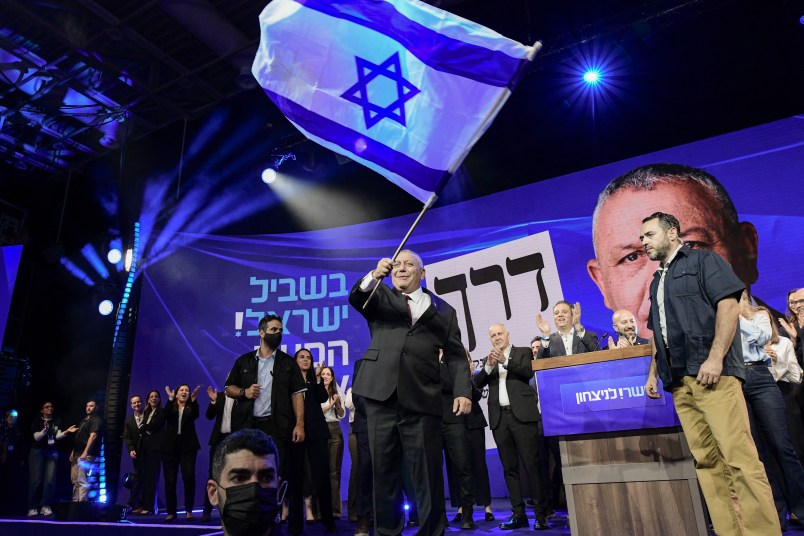
My best guess is that this is all heading toward a second election sometime in the spring. And if that’s the case Netanyahu remains “caretaker” prime minister in the interim. In theory that should be a government that doesn’t take any major policy actions. But of course Netanyahu, being a Trump-like figure, won’t care about that. So if no one wins, Netanyahu wins — at least in the short run. If you look at Netanyahu’s “victory” speech last night it was clearly an election speech anticipating that second spring election and framing it explicitly around legitimacy solely coming from a coalition of Jewish/Zionist parties.
Netanyahu of course is a hyper-nationalist but even more an opportunist. Back in 2021, in a similar situation, he tried to bring the non-Zionist Arab Ra’am party into his coalition and failed. Ra’am joined the opposition and that was the basis of the brief non-Netanyahu government in 2021 and 2022.
The final piece in this puzzle of absurdity is that for all this hyper-exclusionist Zionism a cornerstone of the Netanyahu bloc isn’t even Zionist at all. It’s the ultra-orthodox “haredi” community (13% or 14% of the population) which doesn’t accept Zionism or even the state itself. (In the provisional numbers I noted above they have 14 of Netanyahu’s 54 seats.) Their tie to the Netanyahu or national bloc is that he is protecting and actually enshrining their special privileges which are evading universal conscription for army service and living on public subsidies. It’s a complicated question but absent those privileges or bribes it’s not obvious what their connection to the Netanyahu bloc would even be, though over the last 25 years or so its become increasingly ingrained in their political identity. And it has become a cornerstone position of the “change” bloc to remove or at least dramatically curtail those privileges.
How this absurd situation came about is a topic for another post. But the simple version is that they were ad hoc and contingent decisions made in the 1940s and 1950s when they made up a tiny percentage of the population and no one really cared. They generally joined whatever bloc was in power to preserve these privileges.
In any case, that’s basically where we are. The simple reality is that Israel isn’t really governable on a sustainable basis by anything but governments of the far right as long as the country’s Arab population remains outside the governing process. As Yair Golan, the head of The Democrats (the current rump incarnation of the historic Labor Party), put it on Twitter last night, “anyone who tries to erase the votes of Arab citizens is surrendering to Netanyahu and giving up on Israel.” As I explained in this post yesterday, one of the two predominantly Arab parties — Ra’am — very much wants to sit in a “change” government. The Joint List is explicitly anti-Zionist and at least historically has not wanted to sit in any Zionist government. So the democratic Zionist opposition and the Joint List have some big decisions to make, either in this election — with the coalition negotiations that follow — or the one in the spring or perhaps the one after that.
