


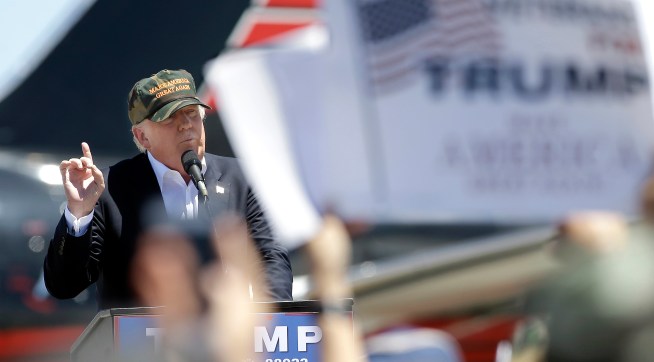
Since Clinton’s speech on Thursday I’ve been trying to gauge Trump’s response. But making sense of Trump is no easy thing. He’s like no politician who has reached the pinnacle of the electoral stage in perhaps a century, maybe ever. His public appearances are like a fugue of impulse and aggression, overlapped with charisma and humor and a searching for the spirit of the crowd, a sometimes frantic, sometimes slow mix of neediness, divination and dominance.
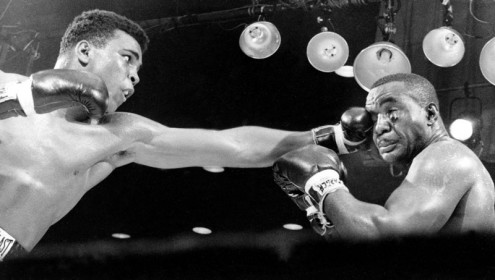
I am a generation older than Josh so I have a different, earlier memory of the guy who was then called Cassius Clay. I saw him win the Olympics as a light heavy weight, and listened to the first Liston-Clay fight on the radio in 1964. It wasn’t televised. It was in theater TV. Liston, who was a Mike Tyson in his prime type – one punch and you were out, and he’d never been knocked down — was a prohibitive 7-1 favorite. I couldn’t believe what I was hearing. My friends and I speculated afterwards that Liston must have taken a dive. But if you watch the fight on video, Clay was so quick he was unhittable, and destroyed Liston with his long left-handed jabs. (The second fight, where Liston got knocked out in the first round, still looks to me as if Liston didn’t want to fight. The right-hand that took him out was not even extended. It was more like a hard jab.) When Clay turned Ali and refused to go to fight in the Vietnam War, he was sent to jail in the middle of his career.
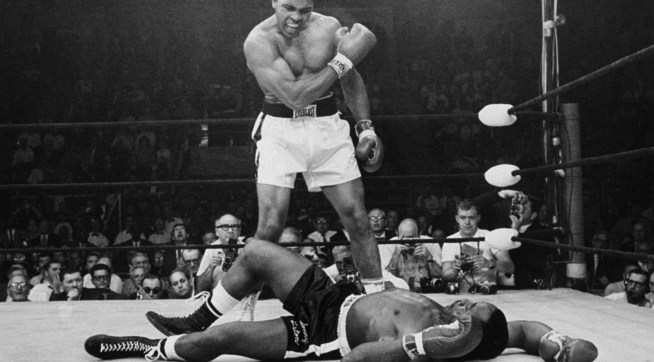
Boxing has fallen so far in public esteem, so far off the cultural map of the American landscape (for the most part rightly so) that it may be difficult for anyone under 40, certainly under 30, to fully grasp the scope of Ali’s greatness or importance on the American scene. Sport but so much more than sport, one of the iconic, transformational figures of the second half of the 20th century. A beautiful black man, a Muslim, a titanic athlete, the embodiment of a certain vision of America – and with that smile. And despite the near universal esteem he enjoyed later in life, a genuine rebel who gave up his peak years as an athlete in a fight over the Vietnam War and racism in America. Beautiful, punishing, genius.
The titanic confrontations with Frazier, Foreman and others were etched into my childhood, written into my relationship with my father. Taking the banished TV out of the closet to watch the big fight. Frazier, who became, ironically, the black champion of a certain part of white America in those fights of the early 70s against an Ali who refused to keep his head down, bowed. I was only really old enough to appreciate at the time the majestic, almost operatic fights with Leon Spinks in the late 70s. Ali already well past his physical prime, fighting, losing to Spinks and then summoning a mix of power, wells of character, brilliance and canniness that allowed him to reclaim the crown for the final time. For every cliched cinematic boxing epic you’ve ever seen, with spirit, drive, determination and character besting pure and unbridled power, this was it, the real version. It actually happened. Truly The Greatest, one of those 360 degree heroes, the likes of whom will not walk among us again.
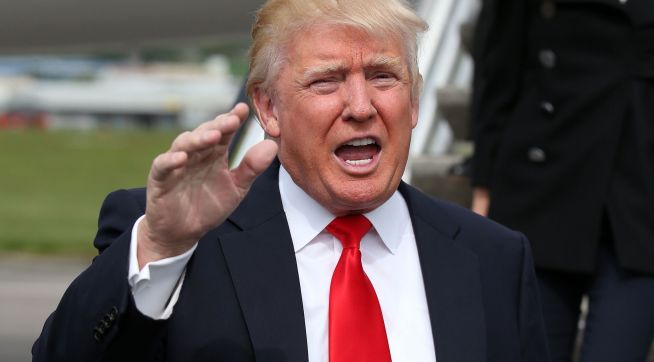
We’ve seen Trump building this argument for a while now. But in an interview yesterday with The Wall Street Journal he made it yet more explicit. Trump says that Judge Gonzalo Curiel has an “absolute conflict” in presiding over the Trump University case because of his “Mexican heritage.” The fact that Curiel was born to immigrant parents in Indiana in 1953 is relevant, according to Trump, because Trump’s been so vocal against illegal immigration. “I’m building a wall. It’s an inherent conflict of interest.”
This New York Times article says that Judge Curiel’s father Salvador arrived in the United States in the 1920s, eventually becoming a citizen and working as a steelworker. Trump’s mother, Mary Anne MacLeod, arrived in the United States from Scotland in 1930. Mary Anne became a US citizen in 1942.
Since Trump and his parents have been major public figure for decades, we have more details about them than the Curiels. But even a brief bit of research says that Judge Curiel’s father’s immigration to the United States predates that of Trump’s mother.
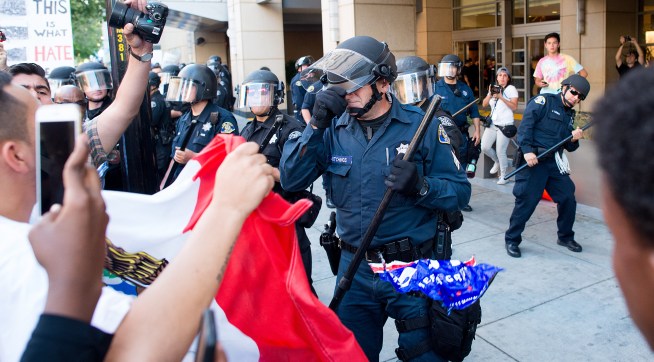
The rule of law is the only way to fight the bacillus Trump and Trumpism represents in this campaign. Trump introduced the violence and eliminationism into the campaign. His enemies are now following suit, indeed in significant ways expanding it. That’s not protest; it’s mob violence. The one saving grace of last night’s free-for-all and earlier ones is the sheer prevalence of social media. We’re seeing smartphone videos mainly from journalists who were on the scene. But if you look in the background of these videos, almost everyone who isn’t hitting, getting hit or actively taunting is holding up a hand cam of some sort. Everyone involved is readily identifiable, from multiple angles. They should all be identified, tracked down and prosecuted, not primarily as punishment but as deterrence.
The Dallas Morning News reports that Texas state prosecutors built a $4.5 million fraud case against Trump and Trump University. But the case never went forward because it was deep-sixed by then-Attorney General and now Governor Greg Abbott (R). The former deputy director of Abbott’s Consumer Protection Division, John Owens, tells the DMN: ““The decision not to sue him was political. Had [Trump] not been involved in politics to the extent he was at the time, we would have gotten approval. Had he been just some other scam artist, we would have sued him.”
I’m not sure if anything captures the weirdness and moral vacuum of this campaign better than this. Today, South Carolina Gov. Nikki Haley said that divisive, racially charged rhetoric like Donald Trump’s led to last year’s horrific mass killing at an African-American church in Charleston. That’s quite a statement. (The Justice Department recently announced it will seek the death penalty against Dylann Roof, the 22 year old who has been charged with the crime.) She wishes Trump would be more civil. And yet, as our Trump Endorsement Scorecard shows, Haley, like virtually every other elected Republican in the country, says she will support Trump as the nominee of her party.
South Carolina Gov. Nikki Haley says racially-charged, divisive rhetoric like Donald Trump routinely uses can lead to lead to horrific mass race-killings like that of Dylann Roof. “I know what that rhetoric can do,” said Haley. “I saw it happen,” referring to the murders of 9 African-American parishioners last June at a historically black church in Charleston.
Over the last decade and a half I’ve become relatively proficient at running a small business with the mix of record-keeping and spreadsheets, forecasting and cash flow management. I have no competence to analyze the wealth of an extremely rich person like Donald Trump with all the mixes of assets, leverage, advantageous tax structuring, rates of return in different businesses, etc. But I can read what those who do know these topics very well have written about Trump’s wealth and disclosures. And I can apply simple logic and numeracy.
The following is a list of things I’ve learned about Trump over recent months that make it clear he is worth dramatically less than he claims and think it is a real possibility that he has a net worth of less than $1 billion. None of the ten is definitive or proves he is worth a certain amount now or even that he could not be worth the $10 billion he claims. But taken together they show a chronic exaggeration of his wealth, repeated instances of financial reports that include almost comical efforts to inflate the numbers (like reporting gross revenues as income) and various points where his net worth was estimated with some precision and make it hard to credit how he could now be worth so much today.
So with that, here’s the top 10.