


In his heart of hearts, would Chief Justice John Roberts prefer a conservative successor to Antonin Scalia even if that means the court is hobbled with eight justices until 2017? We talked to experts on Roberts and the court to find out.
Every human system has both formal and informal rules. US presidential nominating processes are no different. But it’s often not clear what the informal rules are until a dramatic change of circumstances leads to their being violated. One of those is coming up now in the GOP nominating process. There was a very interesting AP piece today showing that while Donald Trump is in a commanding position he’s not yet winning a high enough percentage of delegates to win the nomination. As Stephen Ohlemacher and Steve Peoples explain, Trump is currently winning only 46 percent of the available delegates, a big plurality but not a majority.
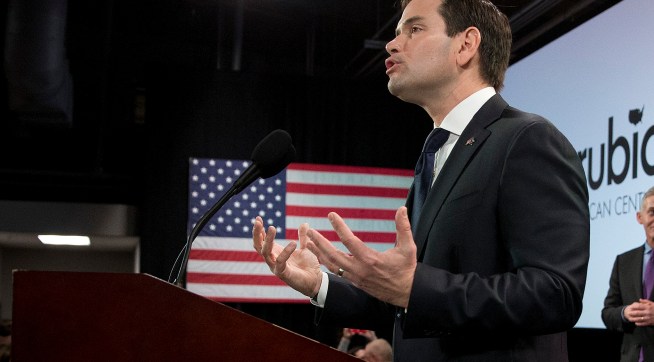
Rubio events in Lexington, Kentucky (notice) and Baton Rouge (notice) canceled.
It is important to recognize that a candidate can only be in so many places on a given day. As the campaign progresses and more contests come at a more rapid clip, campaigns will narrow their focus on the most important races and the ones where they can garner the most delegates. All that said, that doesn’t sound like a great sign for the Rubio campaign. In fact, it sounds a lot like what the other evidence tells us: that the Rubio campaign is shifting from a plan to win to a plan to hold on as long as possible in the hopes of some dramatic shift in the dynamics of the race. In that context, fighting everywhere makes no sense: better to find a few states where a win seems plausible and focus resources there.
I confess it is difficult to take reporters seriously when they write things that suggest they don’t understand the difference between what David Petraeus was indicted for and what Hillary Clinton, even by the most maximal interpretation, is accused of. What David Petraeus did was not mishandling classified information. No one ever suggested those were the facts of the case; it was lesser charge that grew out of a plea deal.
As people were voting yesterday, white Trump supporters attacked a black protestor at a Trump event in Louisville. Story and video here.
I saw a few pundits saying last night that Donald Trump had ‘underperformed’ in the Super Tuesday primaries. That strikes me as laughable unless you’re using some metric that forced him to win every contest to meet some nonsensical expectations game. But the more I thought about last night’s results the more it became clear to me that it was about the worst possible mix of outcomes for Marco Rubio and the even worse for the GOP.
Numerous Republicans and pundits are now predicting a contested GOP convention. Everybody was noting last night that … well, sure Trump is winning most of the primaries but delegates are distributed on a proportional basis so “not Trump” has more delegates than “Trump.” So open convention, baby!
No. In this election, certainly anything – truly anything – is possible. Despite my headline, I would not even say that a contested convention is impossible. But this ‘contested convention’ talk is just a compressed phase of denial, bargaining and anger as GOP stakeholders rush to make sense of what’s happening to them.
CNN Trump surrogate Jeffrey Archer explains to Van Jones that the KKK thing really isn’t a problem because it’s a leftist organization and also Dixiecrats. Watch.
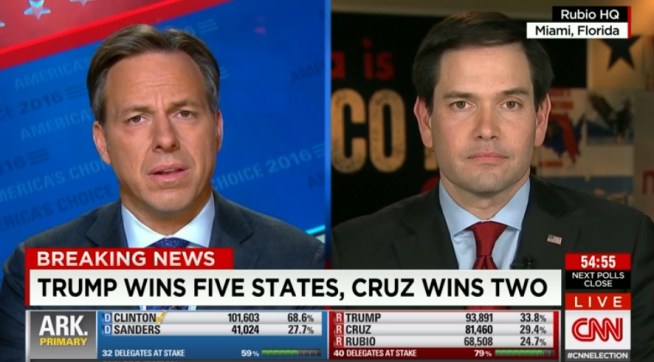
Last night I flagged this poignant moment when Jake Tapper’s interview with Marco Rubio turned into an impromptu grief counseling session. Tapper tried to gently but compassionately edge up to the subject: “I’m wondering if there’s a certain amount of denial that you’re in about this race?” Now Caitlin MacNeal has the video. Watch.
Marco Rubio has now officially won a state: Minnesota, which holds a caucus. The discussion of the win on the cable networks though gives a sense of how much the image of his campaign is calcifying into a metaphor for humiliating defeat. On the cable nets, the announcement was treated with a mix of amused surprise and the sort of fulsome pride grandparents show when a toddler says their first word. That and a lot of ‘finalys!’