


I want to return to a subject that has been pushed a bit out of the headlines over the last few days: the DOGE story at the Treasury’s Bureau of Fiscal Service (BFS). Late yesterday afternoon the government filed a series of declarations from Treasury Department civil servants providing details to a federal judge in New York about what happened. The biggest news turns on USAID payments.
We’d heard from the Times a few days ago that what was motivating this whole effort at Treasury was that they wanted to block USAID payments. We’d first heard almost two weeks ago that a senior Treasury civil servant, David A. Lebryk, had resigned rather than assist in blocking payments. But everything we’d heard to date is that intentions notwithstanding, no blocking or interfering had actually happened. But according to these new documents that’s not true. The declaration of Treasury civil servant Vona S. Robinson says that in fact multiple payments were temporarily put on hold before being reviewed at the State Department and eventually cleared for payment and one was rejected altogether (see Robinson, paragraphs 13 and 14).
Read More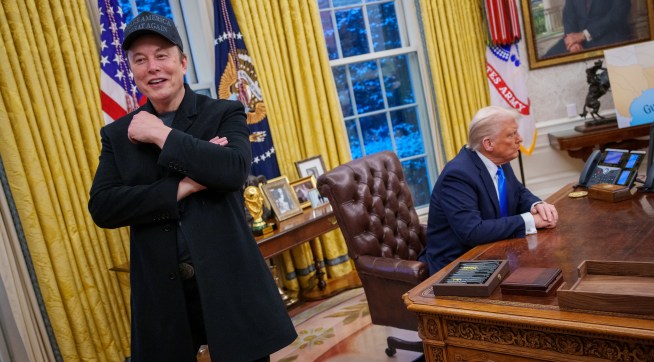
These are wild times at TPM because they’re wild times in the American government. It’s hard to keep up with everything happening from one moment to the next. I had not had a chance to look at the new DOGE executive order the President signed this afternoon with Elon Musk standing beside him. I don’t think it’s too much to say that it puts Musk functionally in control of the U.S. government. I know that sounds pretty wild. And that may not apply to high-profile policy — two budget bills or one on Capitol Hill, plans for Gaza. But let me explain what it does.
Read More
I want to take a moment to address a few questions I’ve gotten about a potential standoff between congressional Democrats and President Trump over the DOGE wilding gangs he’s allowing to run free through the executive branch. The most frequent and very reasonable question is: Let’s say Trump agrees to a deal of some sort. How do you enforce the agreement? More specifically, after Democrats help pass either a continuing resolution or a debt ceiling hike, what prevents Trump from reneging on the deal a week later after the Democrats have ceded their leverage?
Let me answer this on two levels, the first attitudinal and the second concrete. If I were in such a negotiation and the person on the other side of the table absolutely needed what only I can give I’d say, you figure that out. You need me. I don’t need you. So you come up with something binding, some mechanism that doesn’t require me to trust you. If it seems meaningfully binding to me, cool. Then we can talk. Otherwise find your own votes. I’ve never been involved in a negotiation beyond the finances of a tiny perpetually cash strapped small business. But those were always hugely important negotiations to me. And this is always the position I’ve taken when the person on the other side needed or wanted something more than we did. The fundamental issue in any negotiation, especially adversarial negotiations, is properly assigning whose problem it is.
So how do you make sure Trump doesn’t renege on the deal? His problem to figure that out because he’s the one who wants the deal. Never get fooled into taking on a problem that isn’t yours.
Read More
Yesterday the Bulwark posted a very interesting article which showed that while basically every Republican is bowing down to the High Lord Elon in Washington, they’re singing at least a slightly different tune in letters to constituents in their states and districts. The Bulwark rightly notes that this suggests a nascent discomfort with the headlines Musk’s operation is creating, enough that even some pretty stalwart Republicans are reacting to it. The Bulwark received letters which readers had sent in from twelve different members of Congress and published four of them — from Sen. John R. Curtis of Utah, Rep. Daniel Webster of Florida, Rep. Mike Flood of Nebraska, and Sen. Deb Fischer of Nebraska. The members are certainly not turning on Musk. But it’s not the standard DC “sucks to be you” discourse we’re seeing in Washington. The letters say they’re monitoring the situation closely to make sure there are no conflicts of interest. They’re particularly sensitive to reports of people’s private information being compromised. A number of them say clearly that Musk is only making recommendations and that Congress will have the final say about spending.
Join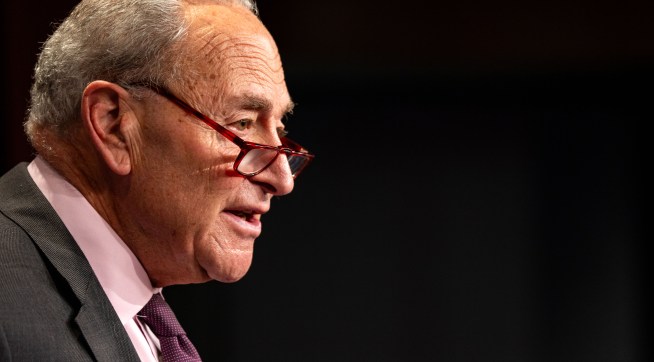
I’ve written clearly a few times that Democrats have one key leverage point with a plausible shot of ending the spree of criminal and unconstitutional conduct Trump has unleashed through the federal government. That comes with the expiration of the current “continuing resolution” which funds the government along with the need to again raise the debt ceiling. I’ve argued that Democrats’ position needs to be this: no discussions, no negotiations until the law breaking stops. After that, if there is an after that, they can negotiate on actual budgetary issues, but not before.
Today Sen. Schumer sent out a “Dear Colleague” letter to his caucus setting forth Senate Democrats’ position. Congressional leaders put these out as a combination of advice and guidance to members as well as public messaging. Politico and I assume others are interpreting the letter as taking that budgetary cudgel off the table. They have good reason to interpret it that way. Schumer makes no mention of the condition I note above. He says: “Democrats stand ready to support legislation that will prevent a government shutdown. Congressional Republicans, despite their bluster, know full well that governing requires bipartisan negotiation and cooperation.”
Read More
Here’s an interesting little detail behind the headlines. The medical news website StatNews has a whole package of pieces out today about the new NIH policy restricting so-called “indirects” (see this post) to 15%. One of their pieces is about 22 states going to court today to block that new directive. Unsurprisingly, the 22 states are all either blue states or ones that currently have Democratic governors or AGs. Again, no surprise. But as I discussed over the weekend, those grants are very important, for example, not just to the University of Alabama but the State of Alabama generally. The state’s junior senator Katie Britt talked to local media over the weekend saying, albeit in the politest terms to President Trump, that it’s super important to keep these funds flowing and that she looks “forward to working with incoming HHS Secretary Robert F. Kennedy, Jr., to accomplish this vital mission.”
Join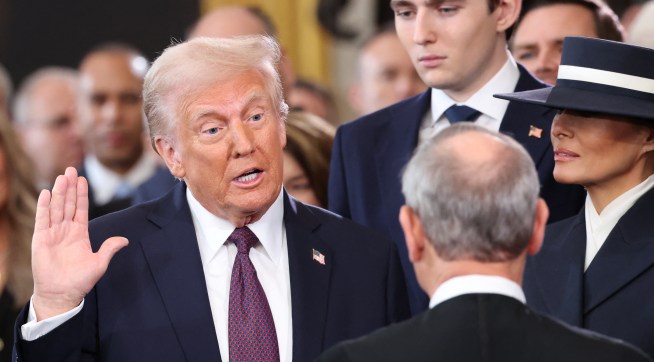
I suspect this will just end up being something Old Man Trump said on a plane and we won’t hear about it again. But after recents, who are we kidding? Anything is possible. On Air Force One today en route to the Super Bowl, Trump told reporters that DOGE analysts (whatever that means) had found “irregularities” in U.S. treasuries and that the U.S. may not be obligated to pay some of them. “Maybe we have less debt than we thought,” he said.
Needless to say, this is quite literally violating the express language of the 14th Amendment which says: “The validity of the public debt of the United States, authorized by law, including debts incurred for payment of pensions and bounties for services in suppressing insurrection or rebellion, shall not be questioned.”
If financial markets actually thought Trump was serious about this, that he would follow through on this, they’d probably go completely haywire. As I said, I think — unless and until we hear more — they will think this is just the old man ranting.
Read More
Yesterday I made the point that while research universities and academic medical centers may be coded blue in many ways, they’re far from limited to blue states. Indeed, overall they tend to be more crucial to regional economies in red states and districts than in blue ones. And sure enough, Alabama’s junior senator Katie Britt (R), who inherited the seat from one-time boss Dick Shelby, has chimed in to support my argument. She ran to the local paper to promise to she’s going to work super hard with RFK Jr. to make sure her state doesn’t lose all its funding. “While the administration works to achieve this goal at NIH, a smart, targeted approach is needed in order to not hinder life-saving, groundbreaking research at high-achieving institutions like those in Alabama,” she told AL.com
Read MoreLast night I noted news which has spread like wildfire through the American scientific and medical research communities. The NIH released a seemingly down-in-the-weeds new directive which has the effect of drastically reducing the federal funds that go to institutions doing basic medical research. Put as briefly as possible, NIH medical research grants are divided into funds for this specific study (“direct”) and funds that go to the institution which houses the lab conducting the study and the infrastructure that makes it possible (“indirect”). That latter category is a major funding source for research universities and academic medical centers. Last night’s directive reduces that stream of funding somewhere between 50% and 75%. The precise breakdown ranges from institution to institution. But that’s a good measure of the level of funding cuts we’re talking about.
Read MoreLet us say that TPM Readers are almost unimaginably over-represented in the country’s colleges and universities, and perhaps even more so in the research arms, which are of course primarily in the sciences and medical research fields. So we’re getting quite a lot of you writing in with various details and context for this new NIH directive that went into effect overnight which drastically reduces federal support for university research arms and academic medical centers. I’m going to be publishing more of them but I wanted to start with this one from TPM Reader RM …
Read More