


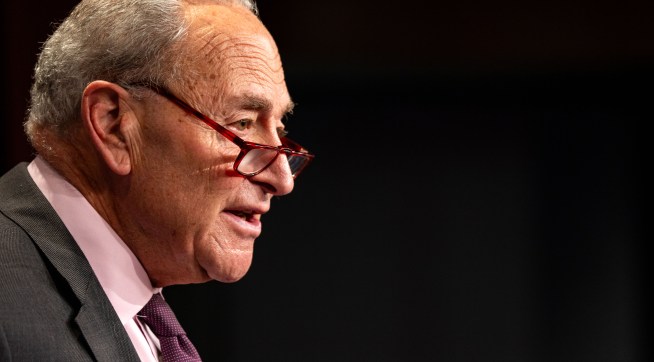
I’ve written clearly a few times that Democrats have one key leverage point with a plausible shot of ending the spree of criminal and unconstitutional conduct Trump has unleashed through the federal government. That comes with the expiration of the current “continuing resolution” which funds the government along with the need to again raise the debt ceiling. I’ve argued that Democrats’ position needs to be this: no discussions, no negotiations until the law breaking stops. After that, if there is an after that, they can negotiate on actual budgetary issues, but not before.
Today Sen. Schumer sent out a “Dear Colleague” letter to his caucus setting forth Senate Democrats’ position. Congressional leaders put these out as a combination of advice and guidance to members as well as public messaging. Politico and I assume others are interpreting the letter as taking that budgetary cudgel off the table. They have good reason to interpret it that way. Schumer makes no mention of the condition I note above. He says: “Democrats stand ready to support legislation that will prevent a government shutdown. Congressional Republicans, despite their bluster, know full well that governing requires bipartisan negotiation and cooperation.”
Read More
Here’s an interesting little detail behind the headlines. The medical news website StatNews has a whole package of pieces out today about the new NIH policy restricting so-called “indirects” (see this post) to 15%. One of their pieces is about 22 states going to court today to block that new directive. Unsurprisingly, the 22 states are all either blue states or ones that currently have Democratic governors or AGs. Again, no surprise. But as I discussed over the weekend, those grants are very important, for example, not just to the University of Alabama but the State of Alabama generally. The state’s junior senator Katie Britt talked to local media over the weekend saying, albeit in the politest terms to President Trump, that it’s super important to keep these funds flowing and that she looks “forward to working with incoming HHS Secretary Robert F. Kennedy, Jr., to accomplish this vital mission.”
Join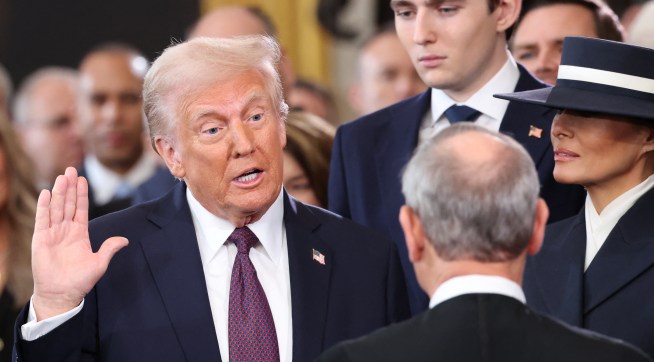
I suspect this will just end up being something Old Man Trump said on a plane and we won’t hear about it again. But after recents, who are we kidding? Anything is possible. On Air Force One today en route to the Super Bowl, Trump told reporters that DOGE analysts (whatever that means) had found “irregularities” in U.S. treasuries and that the U.S. may not be obligated to pay some of them. “Maybe we have less debt than we thought,” he said.
Needless to say, this is quite literally violating the express language of the 14th Amendment which says: “The validity of the public debt of the United States, authorized by law, including debts incurred for payment of pensions and bounties for services in suppressing insurrection or rebellion, shall not be questioned.”
If financial markets actually thought Trump was serious about this, that he would follow through on this, they’d probably go completely haywire. As I said, I think — unless and until we hear more — they will think this is just the old man ranting.
Read More
Yesterday I made the point that while research universities and academic medical centers may be coded blue in many ways, they’re far from limited to blue states. Indeed, overall they tend to be more crucial to regional economies in red states and districts than in blue ones. And sure enough, Alabama’s junior senator Katie Britt (R), who inherited the seat from one-time boss Dick Shelby, has chimed in to support my argument. She ran to the local paper to promise to she’s going to work super hard with RFK Jr. to make sure her state doesn’t lose all its funding. “While the administration works to achieve this goal at NIH, a smart, targeted approach is needed in order to not hinder life-saving, groundbreaking research at high-achieving institutions like those in Alabama,” she told AL.com
Read MoreLast night I noted news which has spread like wildfire through the American scientific and medical research communities. The NIH released a seemingly down-in-the-weeds new directive which has the effect of drastically reducing the federal funds that go to institutions doing basic medical research. Put as briefly as possible, NIH medical research grants are divided into funds for this specific study (“direct”) and funds that go to the institution which houses the lab conducting the study and the infrastructure that makes it possible (“indirect”). That latter category is a major funding source for research universities and academic medical centers. Last night’s directive reduces that stream of funding somewhere between 50% and 75%. The precise breakdown ranges from institution to institution. But that’s a good measure of the level of funding cuts we’re talking about.
Read MoreLet us say that TPM Readers are almost unimaginably over-represented in the country’s colleges and universities, and perhaps even more so in the research arms, which are of course primarily in the sciences and medical research fields. So we’re getting quite a lot of you writing in with various details and context for this new NIH directive that went into effect overnight which drastically reduces federal support for university research arms and academic medical centers. I’m going to be publishing more of them but I wanted to start with this one from TPM Reader RM …
Read MoreMajor news out of NIH tonight, which I’m told will have a dramatic impact on all academic medical centers and research universities generally. Anyone familiar with the sciences knows that scientists bring in grant money for various research projects and the grant money is split between the grantee, who might be a researcher or a lab, etc., and the host institution. So the hospital or the university, etc. The new directive limits what goes to the institution for “indirect costs” to 15%. I don’t know this area well enough to get into the precise rationales for which rates make the most sense in the abstract. But that’s not really the point. From what I can tell this directive slashes the kind of government research funding available to these institution by as much as 60% or 70%. (I want to keep those percentages vague because this isn’t my area but I think that captures at least the general scale.) So these sound like huge budget shortfalls for academic research institutions, academic medical centers and so forth. And this is above and beyond the “freezes” that are still mostly in effect, albeit in many cases unofficially.
Read More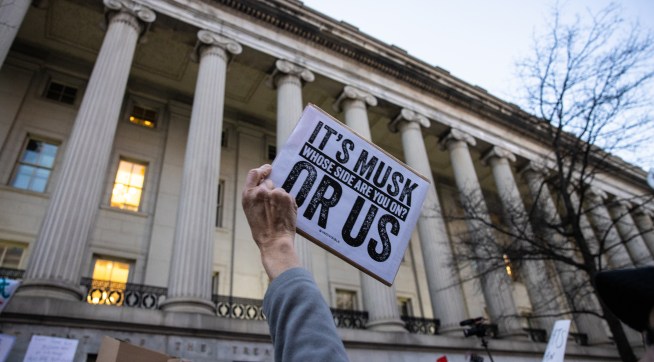
One of the continuing mysteries about the DOGE intrusion into the super sensitive payments computer system housed at the Treasury Department is just what Treasury Secretary Scott Bessent as well as other administration officials and lawyers mean by “read-only” access. For starters, it’s not clear that “read-only” is actually a privilege level on the systems in question. But that’s kind of a technical detail. More importantly, both Wired and TPM have independently reported that now-defenestrated DOGE operative Marko Elez in fact had administrator-level privileges on the same system. In other words, not “read only,” but full access to do pretty much anything if they chose to. And that’s not what people are thinking when they hear “read-only.” So what is it? Are the Treasury Secretary or the DOJ lawyers who went into court lying? Is there some technicality we’re not thinking of?
Read More

I’ve made this point a few times in passing in other posts. But as events develop I wanted to explain it succinctly and with emphasis. Democrats are out of power and have very few actual levers to impact what’s happening. Yelling is important. Driving opposition in what is ultimately a battle for public opinion is important. Contesting everything through the courts is important. But there is only one hard lever of power currently available: that’s the help the White House needs from Democrats on a budget and the debt ceiling. This morning explainer from Punchbowl makes clear why that help is essential. It’s not just helpful. It’s essential. The GOP majorities are simply too small, especially in the House. The GOP is simply too fractious.
JoinA new episode of The Josh Marshall Podcast is live! This week, Kate and Josh discuss Elon Musk’s running roughshod over the federal government, along with some signs of life from the Democrats.
Read More