


To me, the biggest concern that’s not getting talked about are the delays to implementation contained in most potential versions of the legislation. Great stuff that gets implemented in 2014 may get snuffed out in 2010 or 2012. Here’s where the politics becomes inseparable from the policy. And I do fear there’s too little recognition of that.
From TPM Reader TD …
As fed up as I am with this blundering HCR process, I agree that “burning it down” is not a viable option. That’s the one sure path to electoral punishment. However, I am worried about the equally dangerous idea that “if we just pass something” everything will be okay. The truth is we’re not going to have much to sell to the public in 2010 since whatever we pass is going to be defined by triggers and thresholds and formulas and so forth. This strikes me as politically foolish. I’d rather see a less ambitious bill with more immediate impact than a more ambitious one with delayed impact. It looks like what we’re going to get the worst of both worlds: an unambitious bill with delayed impact. In the end, this is a pocketbook issue with unusual urgency given economic conditions.
To follow up on my earlier post, I should make it emphatically clear that I’m not saying people should sit on their hands or keep their mouths shut and settle for what the sixty senate solons can manage on Health Care Reform. Activism and volume on the outside are hugely important. But reading reader emails at a highly interactive news and opinion site like TPM does give you a front row seat on the political junkie and progressive activist id in real time. Read More
Sens. Al Franken (D-MN) and John Thune (R-SD) had a surprisingly sharp and entertaining exchange yesterday on the Senate floor during debate on health care reform. We’ve whittled the video down to just the highlights. Watch.
Go read Dahlia Lithwick on how the Obama Administration may be handing Dick Cheney and the pro-torture crowd the perfect test case.
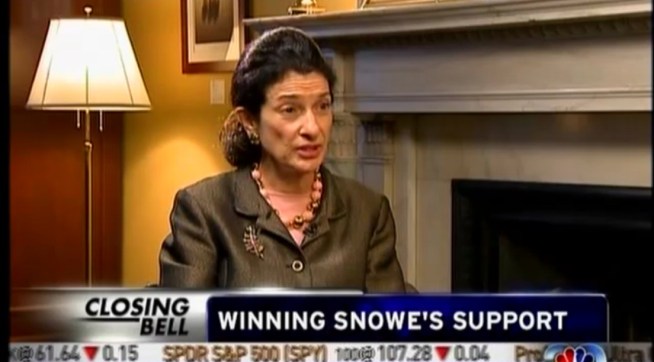
With public option seemingly gone and a Medicare buy-in presumably thrown out, too, what is left in the health care bill for Olympia Snowe to object to? That may be the question Harry Reid had for her when the two of them huddled together today.
There’s a rising chorus of progressive Democrats saying: with the bill so denuded and watered down it’s better to scrap the whole thing and try for real reform at a later date. In other words, no bill is better than the bill on offer now. But there’s a different pattern that I’ve seen over the past months.
I know a lot of people who’ve followed health care reform issues for years from the progressive side. And from what I can tell very few of these people feel this way. That’s not to say they aren’t very disappointed that various key policies likely won’t be included. Half a steak is always a big let down when you thought you might get the whole steak. But there seems to be a clear correlation between people who have followed health care policy closely for years (and know it inside and out) and those who think that even the scaled down reform bill is very worth passing. I wouldn’t say that I have a stronger grasp of the policy implications than most of the folks in the “Burn It Down” camp. But most of the arguments I hear from them some down to sloganeering with a weak grasp of the mechanics of the bill.
The one thing that’s not as clear to me is whether the health care policy experts have a clear read on the politics. In other words, how do mandates play politically absent stronger cost control? That’s a good question that I don’t necessarily expect the policy wonks to have a good read on. On the other hand, I’m confident that scraping the process now would likely be catastrophic for the Democrats.
But on the substance, that pattern has been the most revealing and important to me in terms of making sense of the pros and cons of the bill.
From TPM Reader JM …
I carry no brief for Joe Lieberman, but I’m getting mighty pissed at the netroots crowd (Kos, Atrios*) that wants to dump HCR just because Lieberman is vetoing parts of the Senate bill. I’d love to see a public option or Medicare buy-in, but even without those elements the Senate bill would represent a substantial step forward – one that could be pushed back for a decade or more if progressives “kill the bill,” as some are suggesting.
Majority Leader Steny Hoyer: The House will accept health care reform bill without a public option.
The Health Care Reform story is changing from moment to moment. So be sure to keep checking in on our live-updating Health Care Reform wire with updates from our news team and reporters on Capitol Hill right here. Or see the most recent updates below the feature story on the front page of TPM.