


The best argument I’ve heard from people who say the emerging bill isn’t just insufficient but just bad law is this: If you’re going to force people to buy coverage (mandates), you need to provide them an alternative to buying private sector health insurance to prevent them from getting gouged by the insurance companies. In the abstract that makes a lot of sense. And it even makes a decent amount of sense in the non-abstract, real world.
Here’s the problem though. The fantasy Public Option would have served this role and put a lot of downward pressure on private sector insurance premiums. And at the beginning of this debate I thought that’s what was being discussed. In fact, though, none of the Public Options that had any support in Congress really accomplished this. They were all designed to keep most people from being able to buy in. That’s why the scoring from the CBO showed very few people actually buying into it (2 million for the senate bill and 6 for House bill, if memory serves) and relatively little downward pressure on premiums. Why they were so feeble-ized is a good question — for which I’ve heard some good and some bad answers.
My point though is that if you are worried about mandates now (and I think that’s a very legitimate worry) you should have been worried about them with a Public Option too.
At a Capitol Hill tea party rally a short time ago, Rep. Michele Bachmann (R-MN) compared the tea partiers to the “charge of the Light Brigade,” although presumably she’s hoping for a better outcome.
To me, the biggest concern that’s not getting talked about are the delays to implementation contained in most potential versions of the legislation. Great stuff that gets implemented in 2014 may get snuffed out in 2010 or 2012. Here’s where the politics becomes inseparable from the policy. And I do fear there’s too little recognition of that.
From TPM Reader TD …
As fed up as I am with this blundering HCR process, I agree that “burning it down” is not a viable option. That’s the one sure path to electoral punishment. However, I am worried about the equally dangerous idea that “if we just pass something” everything will be okay. The truth is we’re not going to have much to sell to the public in 2010 since whatever we pass is going to be defined by triggers and thresholds and formulas and so forth. This strikes me as politically foolish. I’d rather see a less ambitious bill with more immediate impact than a more ambitious one with delayed impact. It looks like what we’re going to get the worst of both worlds: an unambitious bill with delayed impact. In the end, this is a pocketbook issue with unusual urgency given economic conditions.
To follow up on my earlier post, I should make it emphatically clear that I’m not saying people should sit on their hands or keep their mouths shut and settle for what the sixty senate solons can manage on Health Care Reform. Activism and volume on the outside are hugely important. But reading reader emails at a highly interactive news and opinion site like TPM does give you a front row seat on the political junkie and progressive activist id in real time. Read More
Sens. Al Franken (D-MN) and John Thune (R-SD) had a surprisingly sharp and entertaining exchange yesterday on the Senate floor during debate on health care reform. We’ve whittled the video down to just the highlights. Watch.
Go read Dahlia Lithwick on how the Obama Administration may be handing Dick Cheney and the pro-torture crowd the perfect test case.
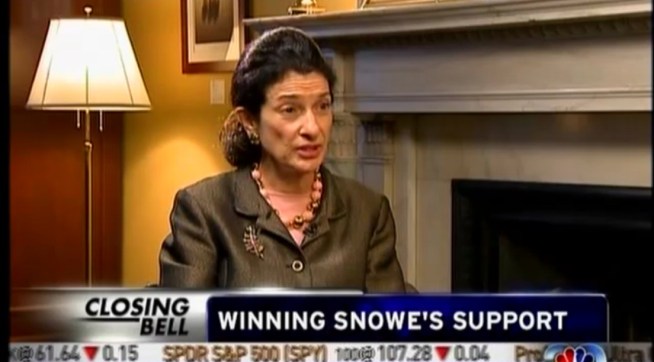
With public option seemingly gone and a Medicare buy-in presumably thrown out, too, what is left in the health care bill for Olympia Snowe to object to? That may be the question Harry Reid had for her when the two of them huddled together today.
There’s a rising chorus of progressive Democrats saying: with the bill so denuded and watered down it’s better to scrap the whole thing and try for real reform at a later date. In other words, no bill is better than the bill on offer now. But there’s a different pattern that I’ve seen over the past months.
I know a lot of people who’ve followed health care reform issues for years from the progressive side. And from what I can tell very few of these people feel this way. That’s not to say they aren’t very disappointed that various key policies likely won’t be included. Half a steak is always a big let down when you thought you might get the whole steak. But there seems to be a clear correlation between people who have followed health care policy closely for years (and know it inside and out) and those who think that even the scaled down reform bill is very worth passing. I wouldn’t say that I have a stronger grasp of the policy implications than most of the folks in the “Burn It Down” camp. But most of the arguments I hear from them some down to sloganeering with a weak grasp of the mechanics of the bill.
The one thing that’s not as clear to me is whether the health care policy experts have a clear read on the politics. In other words, how do mandates play politically absent stronger cost control? That’s a good question that I don’t necessarily expect the policy wonks to have a good read on. On the other hand, I’m confident that scraping the process now would likely be catastrophic for the Democrats.
But on the substance, that pattern has been the most revealing and important to me in terms of making sense of the pros and cons of the bill.