


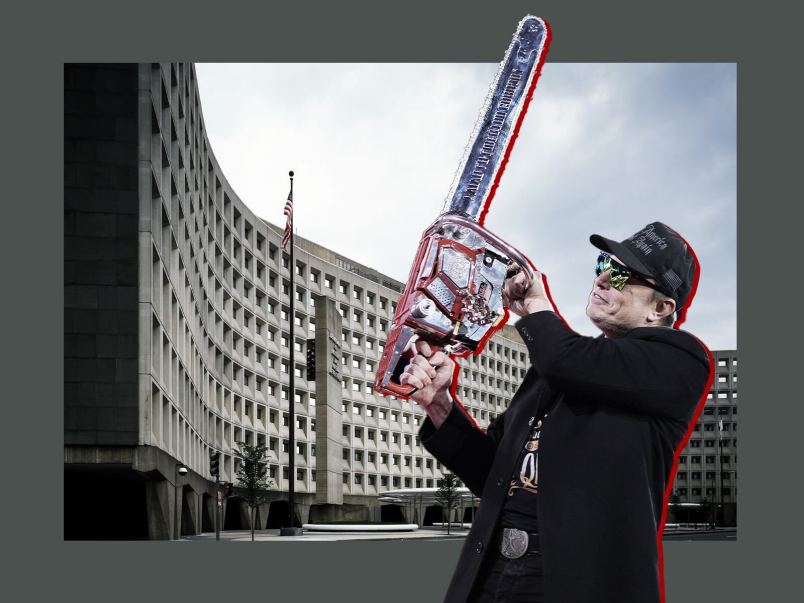
Since late in Donald Trump’s first term as President something called “Schedule F” has figured high in his plans to gut and/or make the federal workforce personally loyal to him as opposed to the constitution. The gist of it is that Schedule F would allow Trump to redefine large numbers of civil servants as the equivalent of “policy-making” political appointees who are fireable at will. After he was forced to leave the White House in 2021, Schedule F played a big role in plans for a second term. For a long time I hadn’t looked that close at the specific legal details of Schedule F as opposed to its potential impact. It was usually presented to me as a kind of ingenious bit of lawyering which allowed Trump to undo the Civil Service system from the inside. And I don’t mean Trumpers calling it ingenious I mean either by supporters of non-partisan federal employment and/or journalists who cover these matters.
But as I was reporting this spring on DOGE and other aspects of the assault on the federal government I realized this was all false. There was nothing ingenious about Schedule F beyond the assumption (quite possibly right) that the federal judiciary would dispense with the plain meaning of the relevant federal workforce laws and substitute novel definitions of key phrases put forward by Trump administration lawyers. This should have been more obvious to me and I partly excuse myself because I simply hadn’t focused on the specifics of that question. But if you think about it, it’s absurd to think that Congress would create the Civil Service system in such a way that a President could simply reclassify people and suddenly the whole system of protections would disappear.
After all, the heart of the Civil Service system is precisely and almost exclusively a bar against the actions of the President, restrictions on the President or his assigns ability to fire people at will, and especially fire them over viewpoints or belief. Unlike almost every other part of the modern American state the Civil Service system doesn’t originate with the New Deal, Progressive Era reforms or the post-war national security establishment. It goes all the way back to the 1880s. To think that the President could simply pull out a bottle of white out and change “cannot” to “can,” and that would be fine, is absurd since the whole point of the evolving system is to place limits on the President’s actions.
We come here to the key point we discussed a few days ago with respect to the Alien Enemies Act. If judges will consistently accept facially absurd factual claims or facially absurd interpretations of statutes then there is no law. The entire CECOT saga is based on the claim that the US has been invaded by Venezuela and is currently in a state of war because a Venezuelan street gang has some limited presence in the US. Without that factual predicate everything about interpretation of purported gang tattoos and all the rest just disappears. I raise all this because in today’s Morning Memo David Kurtz references a BlueSky thread by Roger Parloff which discusses a similar absurdity at the heart of DOGE’s rampage through the federal government as well as some signs that, as with the Alien Enemies Act, judges may finally be making their way to “No.”
Let’s start with some basics.
Almost no one thinks that a President can simply abolish a department or agency Congress has created. The President through his or her appointees is, however, charged with managing the agency and directing its actions. That can of course mean reorganizations, hiring for additional responsibilities or phasing out units that have become redundant. So there’s some legitimate grey area over the scale of changes a president can undertake through legitimate executive authority.
But again and again Trump and/or DOGE (who are we pretending is in charge now?) have blown right past any legitimate restructuring. Indeed, they’ve not only blown right past it they’ve giddily embraced and extolled their actions on the assumption that if they operated within the technical terms of administrative law the substantive nature of their actions weren’t anyone’s business but their own.
In fact, again and again, Trump’s executive orders speak of downsizing this or that target agency to the greatest extent possible under law. This is a nice phrasing intended to make clear that the President is not explicitly telling anyone to break the law. From there what happens is usually taking an agency or office with 10s or 100s or 1000s of employees and ramping it down to a handful. So the legal theory is that Trump isn’t abolishing … say, the Consumer Financial Protection Bureau. He’s simply moving it in a new direction in which it employs five people who focus on counting paperclips. You get the idea.
Ideally you wouldn’t have judges deciding where to draw this line. But ideally you wouldn’t have Presidents routinely violating the constitution and attempting to set themselves up as presidential dictators. Until now judges dealing with various DOGE actions have either dealt with procedural questions or questions of standing or refused to look at the broader substance of what the President is doing. So you take the RIF system, which stands for ‘reductions in force’ and is the formal procedure by which the executive branch does lay-offs. ‘Are the Ts being crossed and the Is dotted? Then great,’ federal judges have mostly been saying. But what if you’re laying off 90% of employees and effectively destroying the agency? That’s not something for the judges to look at.
Parloff focuses on our attention on the fact that there are now two cases where federal judges have begun to review that question. Once you ask that question and a judge properly puts it under review, in many cases the question answers itself. Because of course they are effectively abolishing USAID or the CFPB or Radio Free Europe or whatever else. Indeed, the Trump administration has made little effort to conceal what they’re doing. The assumption has simply been that law and Constitution don’t apply — an assumption and a fact the federal judiciary (and not exclusively the conservative legal movement) bear the overwhelming, if not the exclusive, responsibility for.
Perhaps now that’s starting to change, along with what seems to be a tightening hand on White House actions across the federal judiciary. If so that is a very big deal. So this DOGE related set of cases bears very close watching.