


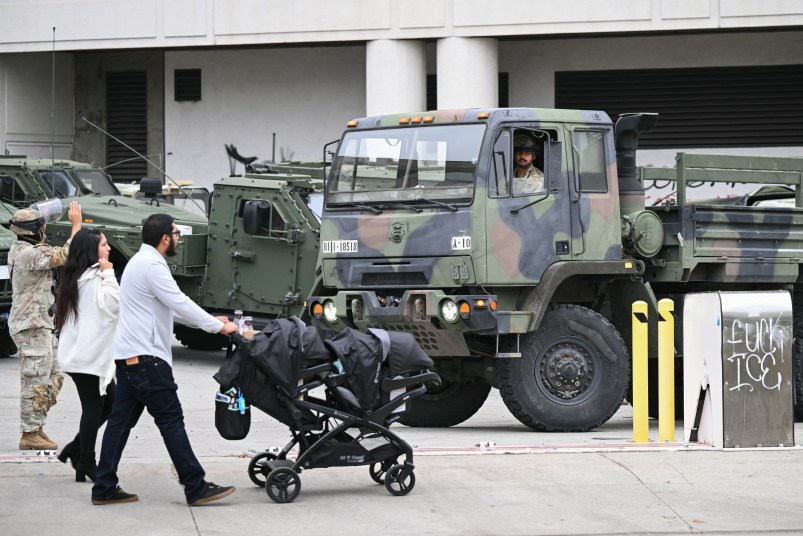
We’ve discussed in a number of posts over the spring that Donald Trump’s effort to build a dictatorial, autocratic presidency is fundamentally a battle over public opinion. I’ve also noted in a series of posts that the states and their separate sovereignties are a key, defensive source of strength in the effort to defeat Trump. Since they are a source of strength, they are by definition also a target. We’re seeing both these realities play out in the chaotic situation in Los Angeles.
Let me start with a few observations about the general situation.
Undocumented immigrants are concentrated in cities for various reasons but by no means only in cities. Cities have communal and ethnic aid networks. They have labor demand. But agro-business is also heavily dependent on undocumented labor. Agro-business is often located in red areas, even within heavily blue states. California is a key example of this. So too is Kristi Noem’s South Dakota. The state has a relatively small immigrant population, but the dairy business is heavily dependent on undocumented labor. In general, we’ve seen very little of these raids in the agricultural sector, which is mostly run by Republican business interests. This isn’t a huge surprise. But it’s worth noting explicitly. There’s been reporting that the White House has given explicit assurances to political leaders or business leaders in these areas that they won’t be a target of enforcement. But those reports are hard to interpret. Regardless of that, it’s clear that these raids aren’t happening in areas where they could be disruptive for Republicans or Trump’s political supporters.
I’ve noted several times that Democrats need to start thinking creatively and aggressively about how to leverage the separate sovereignties of the states. The Constitution guarantees a republican form of government to the states, something that is not compatible with a rogue President depriving “enemy” states of their right to self-government. There’s also the critical issue of taxes. The U.S. government works on a system of federal tax collection with much of those collected revenues spent within the individual states in which the money was raised. Trump has already begun illegally cutting off the flow of those funds back into states which he deems enemy jurisdictions. He was particularly targeting California in this way even before the militarized escalation at the end of last week. There is the additional fact that most of the blue states already pay much more to the federal government than they get back. The same in reverse is true for most red states. (This is one of several reasons why progressives are wrong to oppose the SALT tax deduction even though it’s true that the biggest beneficiaries are wealthy taxpayers in blue states.)
Gavin Newsom was the first politician to put this issue squarely before the public, noting that California already pays in much more in taxes than it receives back in federal spending and now President Trump is threatening even to cut off those funds. Newsom tweeted that it might be time to “cut off” the flow of taxes to the federal government. Treasury Secretary Bessent immediately responded that Newsom would be guilty of “criminal tax evasion.” In other words, a standard Trumpian in-your-face escalation.
But the whole exchange sidestepped the real issue which is that this isn’t how federal taxation works. By design the federal government raises income taxes through its direct relationship with individuals — citizens and residents. The state governments aren’t part of the transaction. So the state can’t really do anything about it. And individuals boycotting federal taxes are liable to all the standard coercive power of the federal government, from criminal prosecution to garnishment, seizure of property to exclusion from the financial system. It’s simply not workable because the states aren’t parties to the transaction. The money doesn’t flow through them.
But the states and the federal government are bound together in many ways. So it’s of the utmost importance to find other points of connectivity where state governments can exert leverage through various means. What those are I’m not sure of yet. But it can’t go only one way. Trump’s system is one where the national power is used to prey upon what he considers enemy states. The states can’t be defenseless against that illegal activity.
G. Elliott Morris was the editor of 538 before ABC shuttered it on short notice. He’s now running a substack called Strength in Numbers. I recommend it. Definitely check it out and subscribe if it looks interesting. He’s got a piece up this morning which notes that the initial polls don’t match the conventional wisdom that escalating in response to protests works to Trump’s advantage or that his relatively high numbers on immigration get applied to this conflagration. There’s some initial data out from a YouGov poll and they show that the public doesn’t like the moves to escalate.
38% approve of his decision to federalize the National Guard and only 34% support deploying Marines. (45% and 47% disapproved, respectively.) People don’t think highly of the protesters either. The protesters themselves got 36% approve vs. 45% disapprove. But I don’t think that’s surprising considering that the vast majority of the images people see are of people standing atop burning cars or getting into violent interactions with police. My own view and hope is that people don’t like this kind of militarization and escalation. It feels unAmerican and scary. And I think people can see that it’s an escalation without real justification or even cause. These initial numbers seems to back that up. The support is down to the hard core of the Trump base.
This reminds me of a related issue. The D.C. political sheets this morning were filled with reports that the White House thinks it has a winner with its militarized escalation in Los Angeles. The reporters in pretty much every one of these reports seem to agree. Why? Because White House aides told them so. It’s a common pattern. Republicans are both optimistic and know how to work gullible reporters. Democrats are wary and scared. So the narrative courses down through the path created by these two personality types. But Trump aides saying something doesn’t make it true, even if they might think it’s true.
I’ll repeat the point. This is a battle over public opinion, one that won’t end in a day. While the public virtually never likes video of public disorder — something that is almost inevitable in any large-scale public protest because you’re going to have at least a tiny minority committing acts of violence or vandalism and they’re going to be what’s in the video. But they also don’t like having soldiers deployed in American cities on what seem like flimsy or obviously bogus pretexts.
Trump isn’t on the ballot next year. And he almost certainly never will be again. What’s more, he has — there’s no second-guessing it now — a curious and unmerited veneer of protection which certainly doesn’t make him invulnerable but shields him from the full opprobrium which often hits other Republicans for Trump’s own actions. Among everything else going on, the logical political targets in California are Republican members of Congress. There aren’t many and there are none in LA proper. But there are a scattering in Southern California generally, from the outer edges of the Greater Los Angeles sprawl where vast population concentration gives way to the desert in the east and, to a degree, to the south. A number of these seats are only marginally Republican. These certainly aren’t areas where there will be any kind of reflexive support for the protesters, but Trump’s heavy-handed drama-hounding should and I think will weigh heavily on them.