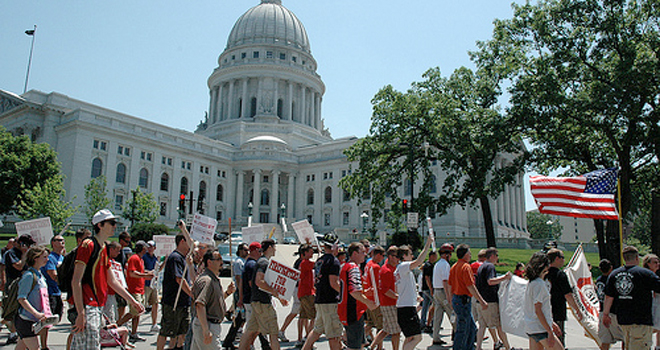
Wisconsin Republicans won big this week, with their newly-passed law curtailing public employee unions overcoming a court challenge brought on the procedures used to pass it. Now that months of wrangling over its passage are behind us, what will the law’s impact actually be?
As readers might recall, the law was passed in the name of fiscal austerity, requiring public employees to make greater contributions to their health care and pensions. But much more than that, it has removed most collective bargaining rights for public employees, exempting only police and firefighters. It also now requires public employee unions to win certification elections every year, with 50%-plus-one support of all eligible voting employees (not just those participating in the election), and bars automatic collection of union dues from employees’ paychecks. So overall, it is a powerful tool for the Walker administration to break the unions.
The legal challenges aren’t done yet, though as the state AFL-CIO is already going into federal court and claiming the law has violated their First and Fourteenth Amendment rights. But absent any drastic action from federal courts, the law is ready to go — if state and local officials can figure out how to implement it in an orderly fashion.
First off, there is now an argument in the state about when the law is even to take effect — immediately, or in about two weeks? The key here is that under normal legislative procedures in the state, the Secretary of State (Doug La Follette, a Democrat) publishes the act in the Wisconsin State Journal, which acts as the state’s official newspaper for the purpose of giving the public official notice of new laws. This is normally to take place 10 business days after passage. However, the ruling by Dane County Judge Maryann Sumi, which has now been overturned by the state Supreme Court’s 4-3 majority, actually prevented La Follette from publishing the act in March.
Now, the State Journal reports, La Follette is going to start another 10 business day period, and publish the act on June 28, with it then taking effect on June 29.
But state Republicans — who had previously attempted to disregard Sumi’s ruling, published the act within a state agency, and declared it in effect, before ultimately backing down — are publicly saying that the relevant ten-day period already expired long ago, and the act should be published and take effect immediately.
The Milwaukee Journal Sentinel reports:
Steven Means, an assistant attorney general, told the Journal Sentinel in an email that the high court’s decision vacated Dane County Circuit Court Judge Maryann Sumi’s decision to halt implementation of the controversial law.
“We believe the Secretary of State’s 10 days to publish notice of publication has passed and that he must perform his statutory duties immediately,” Means wrote.
Reached for comment, La Follette said he took what he felt was a logical approach in deciding what to do in the wake of Tuesday’s high-court ruling.
“There is no precedent about what to do,” La Follette said. “This has never happened before.”
And as for the delay in implementation, whether the law starts immediately or in two weeks, there is now confusion among local government officials as to whether the increased deductions/contributions from employees for their health care and pensions are to be taken out retroactively going back to March, or only going forward — though it should be noted that state Republican legislative leaders have initially said that it would not be retroactive.
The Associated Press reports:
There are no plans to apply paycheck deductions retroactively, said Rep. Robin Vos, co-chairman of the Legislature’s budget committee; Walker’s top aide, Department of Administration Secretary Mike Huebsch, said the ruling was being reviewed.
Joe Blair, president of the American Federation of State, County and Municipal Employees Locals 1287 and 1287CH in Wausau, said it is possible union employees could see three months’ worth of insurance and retirement contributions taken from one paycheck. The union represents nearly 150 public works and city hall employees.
“The city gave us advance notice that if it’s retroactive, they’re going to take (the increased contributions) out in one lump sum,” he said.