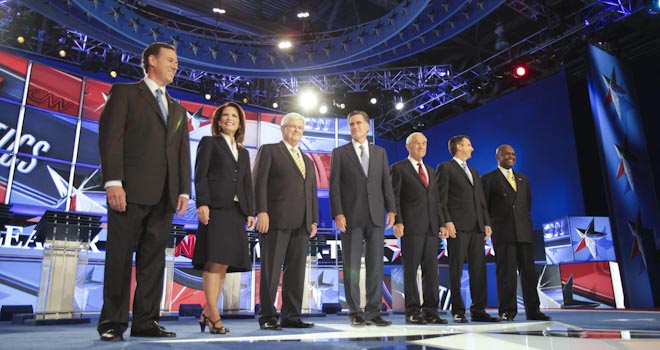
In last week’s debate, Republicans got their first look at a GOP field much more openly hostile to the environment than in recent elections, with several candidates openly calling for an end to the Environmental Protection Agency (EPA). But many of the top contenders have also flirted with eco-friendly policy in the recent past, even if they aren’t too quick to proclaim it these days. Making matters more confusing, here’s even some overlap between the two camps. So where do the big players stand right now?
On the far end, you have the “Abolish the EPA” crowd. These were the loudest and most noteworthy voices at the New Hampshire debate.
“What we need to do is pass the mother of all repeal bills, but it’s the repeal bill that will get a job killing regulations,” Michele Bachmann said at the event. “And I would begin with the EPA, because there is no other agency like the EPA. It should really be renamed the job-killing organization of America.”
She’s not the only one who’s called for dumping the EPA. Gingrich made it a central part of his CPAC speech this year, saying that that the agency had become too flawed to save and represented a “fundamental threat to freedom in this country.”
“I want to replace, not reform EPA, because EPA is made up of self-selected bureaucrats who are anti-American jobs, anti-American business, anti-state government, anti-local control, and I don’t think you can reeducate them,” he said.
And this is a guy who used to record climate change PSAs with Nancy Pelosi on behalf of Al Gore.
With the EPA gone, Newt would create an “Environmental Solutions Agency,” which appears to be a do-over on the EPA with way more input from big business this time around.
Also on board with ending the EPA is Ron Paul, although it’s not too high on his to-do list. Herman Cain has proposed an indirect route to abolishing it — set up a pro-business regulatory commission with the authority to kill the EPA.
“They come back with an analysis that says, we think we can move these responsibilities over to this agency and eliminate this agency, you are absolutely right that’s an option I would consider,” he told reporters at this weekend’s RightOnline conference.
By these standards, Tim Pawlenty is the hinge point for what you might call the moderate wing. He previously touted a cap on carbon emissions to combat climate change, but recently renounced his support and frankly called himself “stupid” for having ever even considered it. And he’s toughened up his rhetoric on the EPA as well, calling for a sunset on new federal regulations and a tough review of existing ones.
“We don’t need the unelected officials at EPA to do what our elected officials in Congress have rejected,” he said in a speech this month. “We need less EPA monitoring of our economy. And more monitoring of EPA’s effects on our freedom.”
Mitt Romney and Jon Huntsman are probably nowhere near as green as, say, John McCain was in 2008, but they definitely are left with the most relatively pro-environmental records out of the group. Romney recently reaffirmed his support for climate science, saying that he believes climate change is real and man-made — that alone sets him apart from much of the pack. But he’s long been against a national cap and trade system.
Huntsman, however, was an enthusiastic backer of Utah’s participation in a regional cap-and-trade system and called on Congress to come up with a broader solution. He has since renounced the state compact and cap and trade, but negotiating on climate issues was a key priority for as Ambassador to China and he recently told TIME that the issue is still a serious concern. What he’d do about it is an open question, however. He’s said until the economy improves, new environmental regulations should be a low priority.
But the toughest environmental foe may be yet to come. Texas Governor Rick Perry has actually walked the walk when it comes to battling the EPA, waging a unsuccessful court battle against the federal government to prevent his state from complying with new rules on emissions for power plants. He’s on the fence about a presidential bid, but if he runs the issue could be a centerpiece of his campaign.