The stark differences between Democrats and Republicans on the oil industry and rising gas prices are on vivid display in Congress this week, as Democrats continue to demand an end to tax subsidies for the big-five oil giants while House Republicans pushed through a bill to expand offshore oil drilling.
A group of Senate Democrats gathered at an ExxonMobil station a stone’s throw from the Capitol to call on the top five oil producers to voluntarily swear off $25 billion in industry incentives and tax breaks over the next decade.
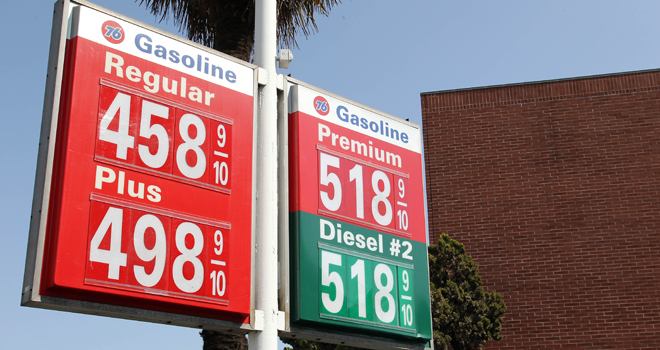
Against the backdrop of a sign displaying $4.29 for regular unleaded, Sen. Chuck Schumer (NY), Bob Menendez (NJ) and Debbie Stabenow (MI), said oil companies have made a record $125 billion profit, and in tough budgetary times, don’t need the tax breaks in order to create incentives for more oil and gas exploration.
“It’s time for the big oil companies to give up the subsidies and pay their fair share of the deficit reduction,” Menendez said.The divergent views on oil also demonstrate a radically different approach to deficit reduction. The House Republican 2012 budget provides most of its deficit cuts by creating a private voucher program for Medicare and reducing payments to seniors, while Democrats argue Congress should start cutting down the deficit by eliminating tax breaks for the largest oil companies.
“Enough is enough,” Stabenow said Wednesday. “People are struggling to pay for gas, for healthcare and for the groceries. … This is truly a handout for the oil companies.”
The comments come one day before executives for the top five oil companies — Exxon Mobil, Chevron, ConocoPhillips, Shell and BP — will head to Capitol Hill for a grilling Thursday morning by the Senate Finance Committee about the record profits they’re reaping while gas prices skyrocket.
Schumer, Menendez, Stabenow, as well as Sens. Bill Nelson (D-FL) and Ben Cardin (D-MD) wrote the executives Wednesday to ask them to admit the taxpayer subsidies are no longer necessary.
“We urge you to publicly admit that, given your companies’ prodigious profits, you no longer need taxpayer subsidies,” they wrote. “We hope you will do the right thing for our country’s fiscal health and endorse their discontinuation.”
Schumer, and vulnerable Democrats up for re-election such as Menendez, Stabenow, as well as Sens. Sherrod Brown (D-OH) and Claire McCaskill (D-MO), clearly believe they have an issue that will resonate with voters at the polls and have signed onto a bill that would end $21 billion in projected taxpayer subsidies for the five largest oil companies over 10 years. Democrats have a 53-47 Senate majority but are defending 23 seats in 2012.
Their proposal, which Senate Majority Leader Harry Reid (D-NV) plans to bring up for a vote next week, would close several long-standing tax loopholes, yielding roughly $2 billion a year in savings to be applied to lowering the deficit. It would focus on only the top five largest oil companies and exclude smaller producers.
Oil companies have complained of being unfairly targeted while other industries receive similar types of tax breaks.
“Targeting a specific industry or even a segment of that industry is what we would consider punitive and unfair tax policy, and it is not going to get us increased energy security, increased employment and certainly not going to lower the price of gasoline,” Charles Drevna, president of the National Petrochemical and Refiners Association, told the Washington Post.
The big five oil companies also continued to spend millions of dollars to lobby Congress on the tax subsidies and drilling issues. In the first quarter alone, ExxonMobil spent $3 million on lobbying Congress, Chevron spent $2.8 million; ConocoPhillips spent $6.28 million; BP America spent $2 million and Royal Dutch/Shell spent $3.88 million, according to lobbying disclosure records. Those numbers only include the amounts the companies spent directly on lobbying and do not include money the company paid outside firms to lobby on their behalf.
With Republicans in control of the House, the bill repealing oil subsidies has virtually no chance of getting through Congress, but Schumer and other Democrats are demanding it be included in the debt-reduction portion of the upcoming must-pass measure raising the debt ceiling.
Republicans scoff at that notion. Speaker John Boehner’s spokesman Michael Steel said ending tax breaks for oil is a non-starter in the House, arguing any increase in taxes on companies will be passed on to consumers and result in still higher prices a the pump.
“It’s batty,” Steel said, to raise taxes on an industry and expect lower prices for consumers as a result.
House Republicans on Wednesday were busy passing the “Reversing President Obama’s Offshore Moratorium Act,” which would require the administration to allow drilling in at least 50 percent of the Outer Continental Shelf areas known to contain the most oil and gas, specifically, southern California, the Arctic, mid-Atlantic and Eastern Gulf of Mexico.
Minority Leader Nancy Pelosi (D-CA) denounced the drill-only GOP solutions.
“Drill-only bills will do nothing to bring down prices,” she told reporters Wednesday.
House Democrats also used some dramatic visuals to convey the differences between GOP and Democratic priorities.
Rep. Ed Markey (D-MA) brought a huge poster of an oil rig juxtaposed over a Medicare healthcare card.
“They’re working to put an oil rig on top of grandma’s Medicare card and drill down into it” to extract deficit-reductions, Markey said, referring to Rep. Paul Ryan’s 2012 budget’s Medicare provisions.
“Republicans have turned themselves into the gas and oil party and the get old people party, which is political suicide,” he added.
The House Democrats’ plan would also end tax breaks for the five largest oil companies, and devote a portion of the tax revenue to reducing the deficit and investing in alternative fuel sources and jobs.
In addition, House Democrats plan to lower gas prices and reduce U.S. dependence on foreign oil include: transitioning the country to greater use of natural gas, which is a cleaner and less expensive form of fuel than oil; building alternative fuel pumps and charging stations for new fuels and electric cars; investing in vehicle technologies that improve fuel efficiency and lowering public transit costs through fare reductions.
House Democrats also want to encourage companies to drill on the 79 million acres of public land they already control.