


This excerpt is part of TPM Cafe, TPM’s home for opinion and news analysis.
There is still so much confusion about what antifa is and isn’t. Listen to President Donald Trump, and you’d think antifa is a “domestic terrorist organization.” Listen to many liberal pundits and you’d think antifa doesn’t really exist at all; that it is just an “idea,” a simple shortening of the word “anti-fascist” — a label most Americans would use to self-identify.
But the truth about antifa is something far more interesting. Antifa is real, and refers to an underground network of anarchists, socialists and communists dedicated to destroying the far right “by any means necessary.” Although its activists sometimes punch neo-Nazis, its violence is rare, and equating antifa with “domestic terrorists” is absurd. The bulk of the work antifa does is nonviolent but nevertheless extraordinary. Over the last decade, antifa deployed spies to go undercover into the new generation of white supremacist groups organizing in the Trump era. These spies gathered intelligence that would eventually unmask thousands of pseudonymous neo-Nazis, revealing them to be your local police officer, your local high school teacher, your college professor, your pastor, and your local elected official.
This great unmasking helped destroy multiple “alt-right” groups. Yet time and time again the anti-fascists doing this work were dismissed as radicals or leftist “extremists,” somehow the photo inverse, or the moral equivalent, of the very neo-Nazis they worked so hard to destroy. The story of American antifa is a Cassandra story: few listened when its activists sounded the alarm about rising fascism in America.
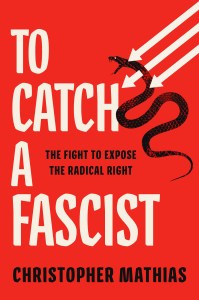
My new book, “To Catch A Fascist: The Fight To Expose The Radical Right,” is based on exclusive access to this underground anti-fascist network. It begins, as you’ll read below, with one of my main characters beginning a five-month spy mission, going undercover into the white supremacist group Patriot Front.
Chapter 1: Those Guys Aren’t My Friends
Five white guys squeezed into a high-backed leather booth at 13 Coins, an upscale diner just across International Boulevard from SeaTac Airport. The restaurant had an open kitchen, and the sounds of clattering plates and servers barking orders at line cooks felt like a reprieve from the constant drone of jets taking off and landing nearby. The guys didn’t know each other’s real names, only the pseudonyms they used online. Normal American white guy names. John, David, Vincent, Charles, Anthony. Four of them were ardent white supremacists. One of them was just pretending to be.
This group was led by John, the director of Network 8, the Pacific Northwest chapter of the organization to which they all belonged. Less than a year earlier, four members of the Joint Terrorism Task Force — a Seattle police officer, two Kings County sheriff’s deputies, and an FBI agent — had knocked on John’s door. They had questioned him about Network 8 and some related vandalism in the area, but John had kept his mouth shut, opening it only to ask for an attorney. He’d still caught charges, but the prosecutor dropped them, prompting John to brag to Network 8 about beating the rap, reminding members to always mask up during missions. “No face, no case,” he’d told them.
John was feeling emboldened. Only two weeks earlier, in late July 2021, he and four other masked men, under the cover of darkness, had defaced a mural down in Portland, Oregon, that had honored the lives of George Floyd, Breonna Taylor, and Ahmaud Arbery — all Black Americans murdered by white cops and vigilantes. Afterward, to the organization’s delight, the crestfallen artist behind the mural had lamented that there could still be so much “hate and ignorance” in the world. Newspapers published the quote in stories about the vandalism — the kind of stories the organization often proudly posted in a chat group devoted to its “trophies,” news article after news article documenting its hate crimes and flash-mob-style marches. Cops were investigating the Portland incident, maybe hot on John’s trail again, but he didn’t seem worried, just indignant.
“Funny how BLM and Antifa can get away with literal riots, murder, and arson, but some white guys put paint on the side of a building and it’s suddenly a big deal . . .” he’d written in a message.
Here and now at 13 Coins, John was determined to make Network 8 one of the best in the nation. He wanted to gather as many “trophies” as possible, to ensure more and more Americans knew their organization by name. He wanted to recruit more and more white men to meetings like this.
John was also desperate to get back in the good graces of national leadership down in Texas. He’d run afoul of the organization’s rules about firearms, designed to prevent unwanted attention from the feds — no online discussion of guns, no guns on missions, no group trips to the shooting range — and had served a one-month suspension as punishment. But he was back now — even if he and Network 8 were still flagrantly breaking the firearms rules. (One member had recently posted a video of himself using a shotgun to blast a stolen Black Lives Matter sign to bits).4 He trusted his subordinates to keep these transgressions a secret.
Subordinates like David, hopelessly loyal and devoted to John, who sat quietly at the table. A baby-faced twentysomething, he lived with his parents a couple hours east across the Cascades and kept a copy of Eastern Front: Memoirs of a Waffen SS Volunteer in his car. Rumor had it he once peed into a bottle on the highway rather than be a few minutes late to a Network 8 meeting. Anxious and intensely shy, he hated talking to people with a passion, a passion equal only to the way he threw himself into missions, the kind they often carried out while wearing gaiter masks pulled up over their pale faces. The three other men at the table were newer to the organization. Vincent was taller and a little older than the rest, with glasses and a shaved head. He did mixed martial arts, he’d said during the vetting process, so he knew how to handle himself. He wasn’t worried about clashing with antifa, if need be, dismissing them as a bunch of “skinny or fat trans people.” Vincent believed other races were “parasitic,” and he hated that society wanted him to feel guilty about being white.
Charles, from Bellingham, was too young to be at this table. Just seventeen years old. The rules were clear on this point: You had to be eighteen to join up, but John needed new recruits so had looked the other way. There was another problem with Charles, though: his skin was suspiciously dark, owing to some traces of Filipino heritage, he explained. The rules were clear here, too: You had to be at least 75 percent white. Charles had assured everyone he was, tossing in some anti-Asian slurs for good measure, and quipping, “At least I’m not part Black.” He’d kill himself if he was part Black, he said.
Anthony was a 100 percent white college-aged kid from Mount Vernon. He didn’t think Charles belonged at this table. He didn’t want to work with anyone with any Asian phenotypes whatsoever. He had no time for ch*nks or go*ks, he’d said. He griped to John about this privately, and John was mulling whether Charles should take a DNA test.
Sitting here now, staring down at their menus, their muscles were sore. The organization they belonged to was always training for violence, so earlier that day, before reassembling at the diner, they’d gathered at Pat Ryan Field for a group workout.
John [oversaw] it all in black Adidas pants and a black T-shirt emblazoned with the words Free Our Political Prisoners: Rise Above Movement, a reference to some other white men he admired, part of a fight club, who’d been arrested by the feds for roughing up lefties at rallies across the country. John had the guys do burpees — jumping with arms outstretched, dropping to the grass for a push-up, then rising to their feet again. They would surely get in fights, too, ones in the street during their missions, but also maybe that grand Manichean fight one glorious day soon, that final battle imagined in their favorite novels, when everything went to shit and they got their chance to vanquish their enemies, take absolute power, make a nation reborn. They needed to be prepared, so for now John was setting some bare minimum standards for Network 8: They each had to be able to do five pull-ups, a plank for three minutes, and run a mile in under ten minutes.
After the workout, they’d walked back to their cars and put on masks — time for a quick mission before heading to the diner. They drove to a nearby highway overpass, parked, and removed a large piece of cloth from John’s car. They quickly got to work fastening the cloth to the pedestrian railings on the overpass with string, then tossing it down toward the highway.
Driving back to the highway, they had gotten a good look at their work. It was glorious: a massive banner, twenty feet by ten feet, declaring Reclaim America in red and blue lettering, with the URL for the organization’s website visible for all of Seattle rush-hour traffic to see. Vincent snapped photos as they drove past — John was auditioning him to be the Network 8 photographer. Leadership was going to love these.
Sitting at 13 Coins, waiting for their food, they shot the breeze. Anthony had a proposal: He thought national leadership should make a rule requiring every recruit to say “n***er” during the vetting process. He said the word loud and clear, rising above the clatter of the crowded restaurant, maybe loud enough even for their Latina waitress to hear.
The requirement, Anthony explained, would help weed out any infiltrators. The sheer force of that word — those two syllables that, when spoken in succession from a white man’s tongue, instantly invoked centuries of slavery, lynchings, and burning crosses — would make any “anti-fascist” spy squirm in their seat, he argued.
The fear of infiltrators was real. It was why national leadership encouraged members not to know each other’s real names, to stick to pseudonyms. Were an infiltrator to discover anyone’s actual identity, they’d be liable to lose their jobs, their scholarships, their girlfriends, be kicked out of their homes. Some might go to prison. Every member knew they stood to lose it all. “The enemy cannot attack you if they do not know who you are,” leadership had stressed. There had been spies in their midst before, anti-fascists who posed as patriots to gather intelligence about the organization. Twice, in 2017 and 2018, anti-fascists had gone through the vetting process before gaining access to the group’s online chat server, which they then hacked, exposing members’ unseemly private messages to the public. Messages like “gas the kikes race war now,” and another that argued raping women is fine “as long as you’re raping, like, people in your own race.” One of the hacks had even exposed the identity of an erstwhile member, his real name ending up in the news: He’d been arrested for shooting a Black man in Maryland. “Go back to Africa!” he’d screamed before opening fire.
There’d also been the infiltrator in 2019 who national leadership had trusted enough to bring to Europe, to be the photographer for their meetings with far-right groups in Italy, Germany, Sweden, and Latvia. This infiltrator had even joined them in Warsaw for Poland’s Independence Day celebration, snapping photos as these American fascists marched alongside thousands of their European counterparts, lighting red flares and chanting in the streets. But leadership never got many of the photos and videos he had taken, which would’ve been used for the group’s propaganda reels. The spy had handed off that footage to journalists instead.
And then finally, in 2020, there’d been “Gabriel” in California, the infiltrator who everyone really liked. They had been heartbroken to learn Gabriel, an Iraq War vet built like a brick shithouse, was a secret anti-fascist. Looking back, it made some sense: Gabriel, after all, had always insisted on leading combat trainings, using group sparring sessions as a ruse to beat the shit out of different members, giving some concussions.
The legacy of these anti-fascist infiltrations ran deep, sowing mistrust in the organization — everyone always on the lookout for the next mole. Leading to this moment, with Anthony again insisting that everyone at this table — John, David, Vincent, Charles — take turns saying the word. A little test, for fun.
There was no hesitation. One by one, everyone at the table obliged, saying the word loud and clear.
They finished eating and asked for the bill, prompting Anthony to launch into a rant about tipping. He refused to tip non-white waitresses, he said, like the waitress they had now, the one who had sweetly served them cheeseburgers and fries, and who, if she’d heard them using racial slurs, hadn’t done anything about it. When it came time to pay, everyone agreed with Anthony: no tip. Satisfied with their decision and exhausted from their training, the group then walked out of 13 Coins and bid farewell to one another. They got into their cars and drove away, back to their homes across the Evergreen State, where their neighbors and coworkers and family members were none the wiser to what they were a part of.
A short time later, though, one of these white men circled back to 13 Coins, parked, and walked inside. His demeanor was different. Something gentler than before. He looked for the waitress, but she wasn’t anywhere to be found, so he found the manager instead.
“Please give this to the waitress,” he told the manager, who was Black, pressing $300 into his hand. “Please make sure she gets all of this and tell her I said sorry.”
He started to leave but then stopped himself, asking the manager to pass along one more message.
“Please tell her that those guys I was with,” he said, “please tell her those guys aren’t my friends.
Copyright © 2026 by Christopher Mathias. From the book TO CATCH A FASCIST by Christopher Mathias, published by Atria, an Imprint of Simon & Schuster, Inc. Printed by permission.



That sounds like quite the book! Looking forward to learning more.
I liked the part where the mole was running the physical exercises and used that “training” to beat the crap out of the would-be Nazis.
Can’t wait to read the book. The major advantage those who fight these massholes have is the paradox of their organization’s goals
On the one hand they insist on secrecy to prepare for the race war they know is coming. OTOH when there is no race war, socialist government takeover or other such bullsh*t they attempt to start one, thus revealing themselves to be the pathetic losers that they are.
Stephen Miller is just a more open version of these fascist, convinced that the vast majority want a whites only civilization. When ordinary People showed up in the thousands in Minnesota to protest, in his mind they had to be paid antifa agitators.
Suspenseful! Looking forward to reading the book.
Begorrah, what a collection of sad sacks they are, too.
Funny how the “master race” always seems to be composed of losers who can’t get a date.
Look at that sign! Beautiful, brand new wood! Who paid for that??!!!?!