

This article is part of TPM Cafe, TPM’s home for opinion and news analysis.
The U.S. is in an information war with itself. The public sphere, where Americans discuss public issues, is broken. There’s little discussion – and lots of fighting.
One reason why: Persuasion is difficult, slow and time-consuming – it doesn’t make good television or social media content – and so there aren’t a lot of good examples of it in our public discourse.
What’s worse, a new form of propaganda has emerged – and it’s enlisted us all as propagandists.
Persuasion versus propaganda
I teach classes on political communication and propaganda in America. Here’s the difference between the two:
Political communication is persuasion used in politics. It helps to facilitate the democratic process.
Propaganda is communication as force; it’s designed for warfare. Propaganda is anti-democratic because it influences while using strategies like fear appeals, disinformation, conspiracy theory and more.
Since there are few examples of persuasion in our public sphere these days, it is difficult to know the difference between persuasion and propaganda. That’s worrisome because politics is not war, so political communication isn’t – and shouldn’t be – the same as propaganda.
The manufacture of consent
Mass propaganda techniques emerged with mass communication technologies like posters, pictures and movies during the first World War.
That old propaganda model was designed by political elites to “manufacture consent” at home so that citizens would support the war, and to demoralize the enemy abroad.
According to linguist and social critic Noam Chomsky, the manufacture of consent was believed by elites to be necessary because they thought “the mass of the public are just too stupid to be able to understand things…We have to tame the bewildered herd, not allow the bewildered herd to rage and trample and destroy things.”
During World War I, George Creel’s Committee on Public Information, a federal agency, oversaw the production of pro-war films like the 1918 silent film “America’s Answer.” When Americans went to see the film in theaters, they would often encounter a speech from one of the “Four Minute Men” – the local citizens whom Creel enlisted to give patriotic speeches during the four minutes it took to change the movie reels.
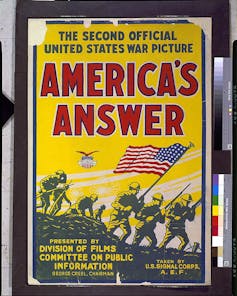
Library of Congress Prints and Photographs Division Washington, D.C.
After World War I, according to Herman and Chomsky, all sorts of elites turned to propaganda to “tame the bewildered herd.” The old propaganda was good at taming citizens. But there was a nasty side effect that played out over almost a century of its use: disengagement. Political communication scholars in the 1990s and early 2000s worried about what they saw as the crisis in democracy, which was civic disengagement characterized by low voter turnout, low political party affiliation and rising distrust, cynicism and disinterest in politics.
The manufacture of dissent
The elite-controlled old vertical propaganda model couldn’t withstand the changes in communication brought on by the new participatory media – first talk radio, then cable, email, blogs, chats, texts, video and social media.
According to recent Pew research, 93% of Americans are connected to the internet and 82% of Americans are connected to social media. We now all have direct access to communicate in the public sphere – and, if we choose, to create, circulate and amplify propaganda.
A lot of people use their social media connections and platforms to knowingly and unknowingly spread misinformation, disinformation, conspiracy and partisan talking points – all forms of propaganda. We’re all propagandists now.
Rather than the elite manufacturing consent, a new propaganda model has emerged in the 21st century: what I call the “manufacture of dissent.”
New crisis in democracy
The “manufacture of dissent” model takes advantage of our individual abilities to produce, circulate and amplify propaganda. It sets us in motion to, in Chomsky’s words, “rage and trample and destroy things.”
The new propaganda can emerge from anyone, anywhere – and it is designed to create chaos so no one knows whom to trust or what is true.
Now we have a new crisis in democracy.
Citizens are called upon and trained by political parties, media, advocacy organizations, platforms, corporations – and more – to become propagandists, even without realizing it. Though both sides of the political spectrum can and have used the new propaganda, it has been embraced more on the right, largely to counter the old manufacture of consent model embraced by the mainstream.
For example, the slogan topping daily emails sent by ConservativeHQ, a longstanding and influential conservative news blog, says, “The home for grassroots conservatives leading the battle to educate and mobilize family, friends, neighbors, and others to defeat the anti-God, anti-America, Marxist New Democrats.”
From this perspective, politics is a “battle,” it’s warfare and ConservativeHQ’s readers can fight by educating and mobilizing – by spreading ConservativeHQ’s propaganda.
Likewise, the conspiracy website InfoWars tells its audience “there’s a war on for your mind.”
Social media platforms train users to communicate as propagandists: Recent research shows that platform users learn to express polarizing emotions like outrage through “social learning.” Social media users are taught through app feedback – positive reinforcement through notifications – and peer-learning – what they see others do – to post outrage even if they don’t feel outraged and they don’t want to spread outrage.
The more outrage we see, the more outrage we post.
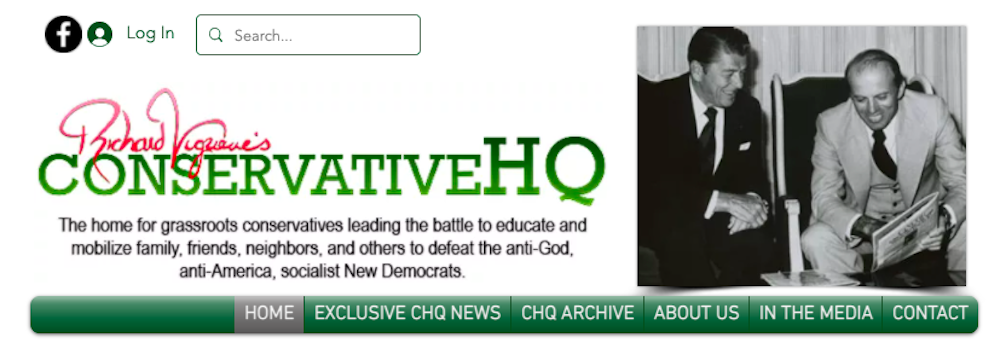
https://www.conservativehq.org/
Dissent and distrust
Today’s new model of propaganda has dangerous consequences.
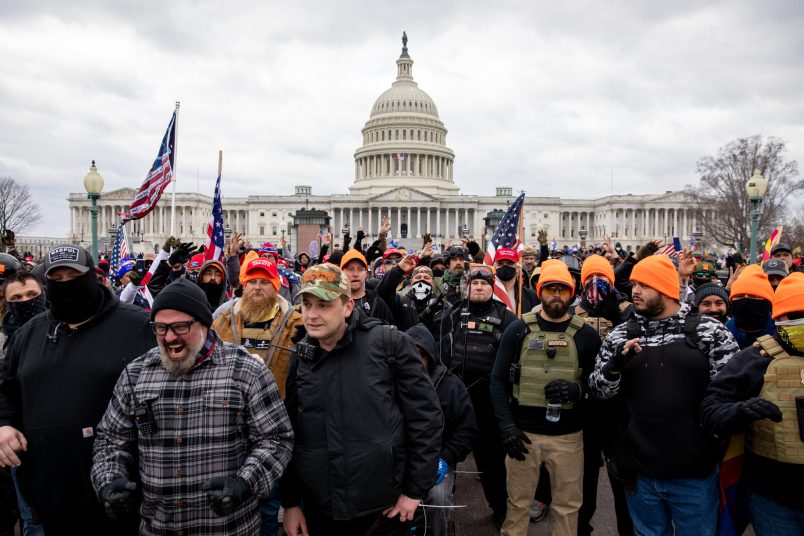
The Jan. 6, 2021 insurrection was a direct result of the manufacture of dissent. Right-wing politicians, citizens and media used disinformation, misinformation, conspiracy, fear appeals and outrage circulated via the old and new propaganda to cast doubt on the nation’s electoral process.
President Trump primed his followers to believe that the election would be “rigged,” which led people to look for and circulate so-called “evidence” of fraud.
Courts and election officials certified the integrity of the election. Conspiracists saw that as further evidence of the “plot” and supported Trump’s Big Lie that the election had been stolen.
Trump’s supporters amplified the conspiracy via posts on social media, videos, text messages, emails and secret groups – spreading doubt about the election to their friends, neighbors and audiences.
When Trump told people to march on the Capitol to defend their freedom, they did.
Politics is war
But the Big Lie that led to the Jan. 6, 2021, insurrection was merely part of an even bigger lie.
Since the 1990s and the emergence of the manufacture of dissent, right-wing propaganda’s major premise has been that “politics is war and the enemy cheats.” Every news story from that perspective is an elaboration on that theme, including those about the 2020 election.
When politics is seen as war and the enemy can’t be trusted, then every election is seen as dire and the electoral process that denies your side victory is seen as unfair. According to a recent Monmouth University poll, 30% of Americans still believe Trump’s Big Lie.
The legitimacy of the American political system requires the actual consent of the governed, and its vitality and health requires we allow actual dissent. But our broken public sphere has neither.
Both come from persuasion, not propaganda.
This isn’t about nostalgia for traditional propaganda. Both the old propaganda and the new propaganda are anti-democratic. The old propaganda manufactured Americans’ consent, using communication as force to keep people disengaged and compliant.
The new propaganda manufactures dissent. It uses communication as force to keep people engaged and outraged – and it sets us in motion to trample and destroy things.
[The Conversation’s most important politics headlines, in our Politics Weekly newsletter.]
Jennifer Mercieca is a professor of communication at Texas A&M University.
This article is republished from The Conversation under a Creative Commons license. Read the original article.


Bothsiderism to say Dem’s are propagandists. The GQP have every single one of those slots filled.
The Big Lie? GQP
COVID Hoax? GQP
AntiVax? GQP
1/6 Tourists? GQP
Hillary’s Pizza Dungeon? GQP
The growing trend:
“Don’t modulate the key then not debate with me!” - Hamilton
I always heard it as “to” (as in in order to) rather than “then”. If only iTunes purchases came with little booklets showing the actual lyrics.
But it is one of my favorite lines either way
“There are not two sides to every argument when one side is a load of crap”, Bill Maher. I think the media’s decision to treat all information as equal when much of it is a load of crap, has left Americans not knowing what to believe. If anything good has come out of Trump, it is the the mainstream media has finally been force to declare a big lie as a big lie. Yet the media has yet to declare those who continue to espouse the big lie as big liars,which is what they are.
That is the real problem causing everything to be propaganda is the total failure, in fact refusal, by the mainstream news media to tell the truth, thinking it either two complicated, to harmful, unpatriotic, to partisan, goes against the media’s longstanding narrative or against the media’s own interests like admitting to a mistake and and replacing real reporting with bothsideism where by all things uttered by a member of a political party are presented as being of equal truth.
I mean Al Gore did win the 2000 election, race is still the biggest issue in American politics and “values” in front of the word voter has always been code for race, the media including the New York Times did lie America into a disastrous war, furthermore when Bush invaded Iraq he also lost the war in Afghanistan, America’s current Supreme Court is Republican and not conservative, the Democratic Party is far tougher on Russia then is the Republicans as evidenced not just from Trump but from Bush seeing into Putin’s soul versus Russia suffering the biggest defeat in its history on Obama’s watch by losing the Ukraine which Putin blamed on Obama and is why Russia interfered in elections for Trump, just off the top of my head.
The decision of the media which long ago put bothsideism over objective journalism caused said media to totally fail its responsibility to provide a factual basis or be the factual referee in debates has left most Americans not having any idea what or whom to believe.
One of the great examples of this was Romney/Obama’s first debate. Obama sure enough looked asleep but got all his facts right, Romney on the other had told so many lies that his own campaign the next day had to come out with 6 retractions. In my debate days if you got caught in one lie, you lost. Yet the media refusing to comment on the facts declared Romney the big winner because of style. We saw it again in the VP debate between Harris and Pence whereby Pence ignored every question instead going into a canned campaign speech which the media called “normal”.
The refusal of the media to hold anyone to facts and answering questions and instead giving style points and treating everything a politician says regardless of its factual value as being equal has left Americans not knowing what to believe and has made all information propaganda.