

This book excerpt is part of Cafe, TPM’s home for opinion and news analysis.
For most of human history, trying to identify an oligarchy has been difficult. Part of that has to do with the definition of the term “oligarchy” in the first place. Aristotle first popularized the word thousands of years ago, pointing out that an oligarchy — which literally means “rule of the few” — is indeed all about a small number of individuals steering a given country, nation, or empire. But even then, Aristotle added, it wasn’t just about the number of individuals that mattered, but also about how much wealth they controlled. In order to have an oligarchy, a state had to be run not just by the few, but by the wealthiest few.
The other part that’s made “oligarchy” such a tricky thing to define is that, for centuries, oligarchic figures tended to operate out of sight, or by playing down their impact on politics. Not always, necessarily; the so-called “robber barons” of the Gilded Age — oligarchs by another name — were front and center in American society in the late 19th and early 20th century. But by and large, oligarchs tended to downplay their influence, and even their wealth. Since they could operate as the powers behind the throne, they tended to keep themselves (and their wealth) out of the spotlight, making it even trickier to nail down who an oligarch actually is, or what oligarchy looks like when it’s taken over a democracy.
Those two factors — the difficulties in defining “oligarchy,” and the struggles in identifying oligarchs themselves — made analyzing the topic, let alone writing a book about it, an uphill battle.
And then, in January 2025, all of that changed. Because there, in the U.S. Capitol, as President Donald Trump once more swore the oath of office for the presidency, stood a suite of men, just off to the side, all standing in a row. They looked out over the audience, smiling in their suits. In that moment, those figures — Elon Musk, Mark Zuckerberg, Jeff Bezos, and a small number of others — made oligarchy impossible to miss. Looking out at a man they’d propelled back to office — at a man who would usher in not only the most corrupt administration in American history, but who is himself oligarchy made flesh — they forced Americans to an inescapable realization. We’d once, as a country, had a Gilded Age. But now, with more wealth inequality than ever prior, and with more power concentrated in the hands of a small number of select men, we have something else: the Age of Oligarchy.
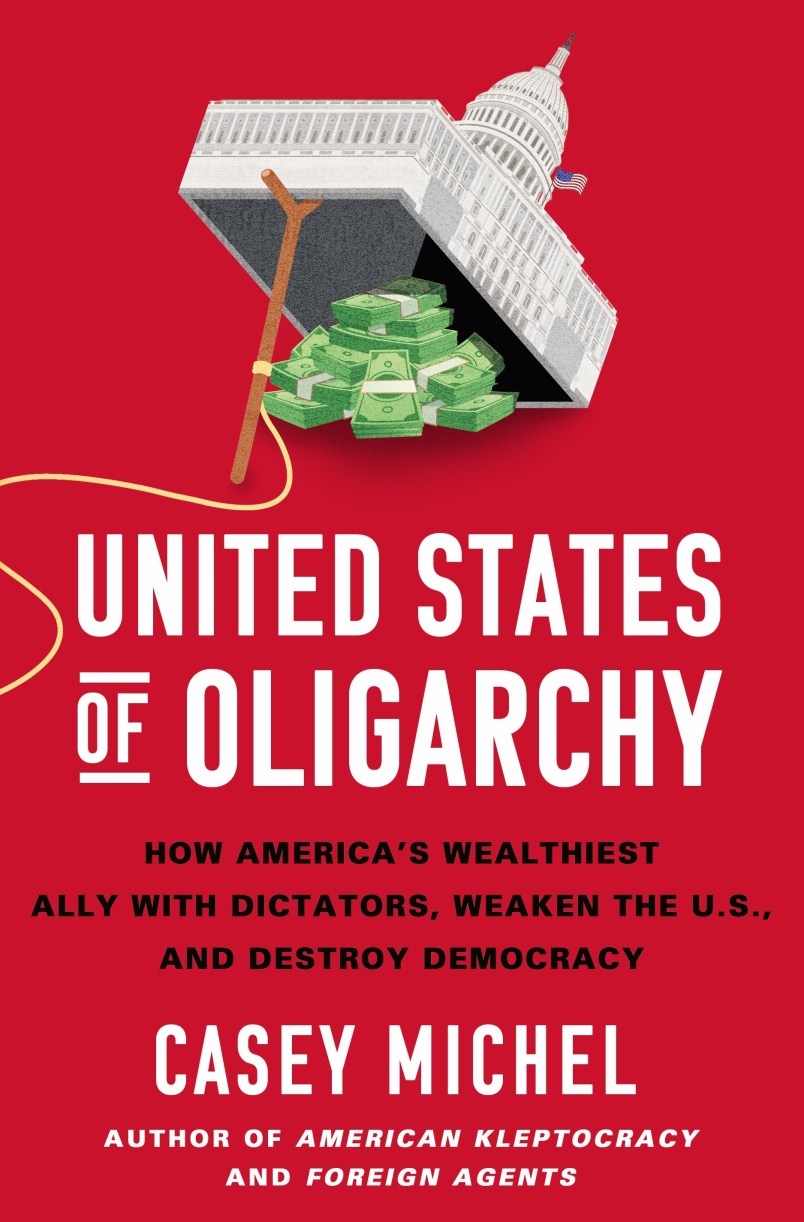
All of which is why I wrote my new book, United States of Oligarchy, which is out in bookstores now. As a former Talking Points Memo alum (and as someone who met my wife at TPM all those years ago!), I’m exceptionally excited to share an excerpt with you today. The snippet below looks at not just how we got here, but on what it will take to bring these oligarchs to heel and to escape this Age of Oligarchy while we still have time.
There was a moment, sometime back in the early 2020s, when it felt like the US had finally turned a corner in its fight against a nascent oligarchy. That for the first time since the post-Watergate period, or perhaps even since the days of Teddy Roosevelt, a new era of reform was dawning.
Truth be told, there were many moments that made it seem like that new era had arrived. There was, for instance, the passage in early January 2021 of something called the Corporate Transparency Act.
The text itself was a jumble of legalese, clauses and subclauses running page after page, tucked in the middle of a far more sprawling defense bill. But the core of the legislation was simple: For the first time in American history, the US would finally outlaw anonymous shell companies, which had been for years the key ingredient in money-laundering networks both near and far—and the key tool for oligarchs to build out their empires of secrecy, dark money, and offshore finance writ large.
It was a thunderclap of a development. After serving for years as the world’s greatest source of anonymous shell companies, open to any oligarch or kleptocrat or dictator who’d come calling, the US was shutting down its untraceable shell corporation services once and for all. It was the single greatest anti–money laundering step the US—or any other nation, given the scale of the American economy—had ever taken. Most remarkable, it was done with bipartisan support, and even overcame Trump’s efforts to veto the legislation. At long last, the basic component of innumerable money-laundering networks around the world was no more.
It was a burst of momentum that the Biden administration, working to slough off all the breathtaking corruption and abuse of power of the Trump years, eagerly built upon. A few months into his tenure, President Joe Biden issued a formal memo “establishing the fight against corruption” as a “core [US] national security interest.” For the first time in American history, a US president had elevated corruption alongside terrorism and great power rivalry as central threats to American security, and even American stability. “When leaders steal from their nations’ citizens or oligarchs flout the rule of law, economic growth slows, inequality widens, and trust in government plummets,” Biden announced. Corruption had now joined things like the Confederacy or communism among the pantheon of great anti-American threats—and it would now be treated as such.
Not long later, Biden’s administration published a thirty-eight-page strategy document laying out the president’s vision. As the text outlined, “[B]y effectively preventing and countering corruption and demonstrating the advantages of transparent and accountable governance, we can secure a critical advantage for the United States and other democracies.” It was a wide-ranging view of all the things the administration could, and should, do: ways to launch anti-corruption programs across government, to pressure and strong-arm international offshore havens, to patch up all the rampant loopholes shredding the US’s anti–money laundering efforts. It was, in many ways, the single-greatest document the US had ever authored about the threats of corruption, both internal and external—and a blueprint for what an administration with a competent president at the helm could accomplish.
Nor did the Biden White House stop there. Almost overnight, new task forces popped up, directed by the White House to target all facets of modern oligarchy. There was a new group out of the Department of Justice, dubbed KleptoCapture, with the express writ to go after all the assets of crooked oligarchs abroad, especially out of Russia. All the yachts, the luxury jets, the pilfered artwork and gilded mansions and other symbols of their crass consumerism—all of it was now fair game. The FBI likewise launched its own new task force, hitting upon many of the same oligarchs, with many of the same results.
All that momentum continued in Congress, when the legislative branch picked up the anti-corruption mantle once more. After cracking down on the kinds of corporate bribery that had once been routine—the kinds that led directly to the passage of the FCPA, just after Watergate burst—Congress realized that their solutions were only half-baked. After all, while the FCPA criminalized the paying of bribes to foreign officials (and foreign oligarchs), it did little to actually stop the foreign officials (and foreign oligarchs) from demanding the bribes in the first place. The supply side may have shuttered, but the demand side remained wide open. And time and again, crooked foreign actors felt no compunction about turning the screws on American companies, seeing how far they could lean on them until they broke—until they were willing to break the law, opening the spigots of bribery once more.
In 2023, though, Congress hit upon a solution. Passing a new bill called the Foreign Extortion Prevention Act (or FEPA), the legislation effectively closed the circle of criminalizing bribery. Where the FCPA made it a crime for American companies and businessmen to pay off crooked foreigners, the new bill made it a crime for those foreign actors to even demand a bribe in the first place. Prosecuting would theoretically be more difficult—could the US really extradite a crooked Laotian or Gabonese or Sri Lankan official trying to wheedle some extra money out of an American business?—but that wasn’t necessarily the point. Suddenly, for the first time, the US provided both a shield for businesses trying to do honest work and a potential sword to go after oligarchs trying to enrich themselves that much further. For the first time in American history, the entire process of bribery was treated as the criminal act it’s always been.
All these developments—the new shell company registry, the new task forces aimed at oligarchic yachts and jets and other baubles, the new legislation closing the circle on criminalizing bribery—were all nominally focused on threats outside the US. On the Russian oligarchs acting as foot soldiers for the Kremlin, the Nicaraguan and Egyptian and Malaysian kleptocrats launching their illicit wealth directly into the US, the crooked officials in autocracy after autocracy looking to American corporations to fuel their own corruption. There would be, of course, knock-on effects for domestic American oligarchs, who could no longer hide behind American shell companies or construct their own networks of money laundering with foreign counterparts. But as with so much else in recent American history, these developments all crossed the finished line because they were pegged to external threats.
There was one development, however, that directly arose from the internal threats of American oligarchs. And it had to do with rescuing perhaps the only body that could successfully target, investigate, and even unwind American oligarchs’ financial empires: the IRS.
As we saw back in chapter 5, the IRS had by the late 2010s become a ghost—an empty shell that turned phrases like “white-collar prosecution” into an oxymoron. (Is tax evasion even a crime if there’s no one to actually investigate and enforce tax laws?) It hadn’t died, so much as it had been murdered, purposely gutted by those who wanted to give a leg up to the oligarchs now paying lower tax rates than farmers or miners or engineers—all while bankrolling their pet legislators in Congress (and elsewhere).
But in 2022, that all changed. When Biden signed the Inflation Reduction Act (IRA) into law, he not only launched a range of infrastructure funding projects across the country, but further allocated an additional $80 billion in IRS funding, parceled out over the following decade. It was a staggering injection, effectively doubling the agency’s total budget. It was as if the White House had taken a defibrillator to the IRS, shocking it back to life.
Nor was this just funding for administrative costs, or upgrading computers and call centers. As part of the new funding package, over half the allocation—nearly $50 billion total—would go toward “increased enforcement” of rules and regulations. It was far and away the greatest single allotment for enforcing American tax laws in US history. And as both the White House and the IRS said, the focus would be on one group in particular: the oligarchs, and the white-collar tax cheats who’d spent years driving down their tax burden and wrenching American wealth inequality beyond anything ever before. As the IRS announced, the new funding would specifically be used to “restore fairness in tax compliance by shifting more attention onto high-income earners,” and on all those “abusing the nation’s tax laws.”
It didn’t take long for the IRS to put the new funding to use. Almost immediately, the agency sent compliance letters to tens of thousands of Americans who hadn’t even bothered to file tax returns in years. “Twenty-five thousand of these [targets] earned more than $1 million,” The New Republic’s Timothy Noah noted, “and more than 100,000 of these scofflaws earned more than $400,000.” The IRS also announced it would be amping up its audits—but only against the wealthiest Americans, who’d watched their own audit rates plummet in the previous decade alone, making tax fraud for American oligarchs “almost risk-free,” as journalist David Cay Johnston said.
As part of its new campaign to finger wealthy tax cheats, the IRS announced it would assign nearly a thousand officers to specifically target millionaires. Thanks to this single funding allocation, the Biden administration had single-handedly willed a new fleet of anti-oligarch investigators into being, tasked with targeting the richest Americans piling their pots of wealth higher and higher.
The response from opponents—from those who wanted the IRS to continue atrophying, or even disappear outright—bordered on the ludicrous. Senator Ted Cruz whinged about a supposed “shadow army” of IRS agents coming to “hunt you down and take your money.” Another senator, Iowa Republican Chuck Grassley, even suggested that IRS workers would suddenly come strapped with assault rifles, as if semiautomatic weapons were somehow an effective tool to peel back shell companies and other offshore tools. The rhetoric was overheated, borderline farcical, and arguably did more to make a mockery of Republicans’ lust for destroying the IRS than anything else.
But not even Republican caterwauling could slow the IRS’s resurgence. While Congress eventually sliced off a chunk of the funding the White House allocated to the IRS, the agency nonetheless emerged from the Biden era with a kind of robust energy it hadn’t seen in decades. If the IRS had entered the Biden years looking like a scrawny, hesitant middle schooler, it emerged as a meaty, muscle-bound Barry Bonds—one focused not on fastballs, but on oligarchic tax cheats.
As the Congressional Budget Office estimated, the funding increase would pay for itself multiple times over, bringing in hundreds of billions of dollars that the American people were rightly owed, in addition to slowing the rate of offshored finance and mitigating wealth inequality.
Call it a shadow army if you’d like. But far better to call it a new push—of investigators and forensics specialists and, yes, even prosecutors—fighting to end oligarchy, and to finally enforce the tax laws that America’s wealthiest had been blowing past for decades.
By the early 2020s, something else—something broader, something more intangible—seemed to shift. It was an understanding that there was some kind of link between not just kleptocracy and national security, but even between wealth inequality and national cohesion more broadly. That a country couldn’t have the kind of thriving, the kind of promise of an American dream, if it also had the kind of spiraling, stratospheric levels of wealth inequality the US was barreling toward. That democracy could stretch to a breaking point, and rip beyond, if too much wealth pooled in the hands of too few people.
It was a reality and a realization that the US hadn’t truly considered in over a century, since the waning days of the Gilded Age. And it was certainly something that hadn’t been directly addressed since the days of President Teddy Roosevelt, hitting the oligarchs directly where it hurt: their pocketbooks. Back then, thanks in massive part to Roosevelt’s leadership, America had launched two salvoes—both the income tax and the inheritance tax—aimed squarely at plutocrats’ pockets.
Perhaps, a few decades into the twenty-first century, the time had come for something similar. Perhaps the time had come for something new.



The first order of business, once Trump is out of office and democrats are back in charge, must be legislation confiscating every dollar President Trump, his family and organizations made during both terms. (See the illegal IRS immunity deal for all 418 entities)
Such legislation should be based on the Emoluments Clauses in the constitution, and include a special non-reviewable by the Supreme Court rider.
This is the only way to prevent the ransacking of the public treasury by future administrations. Let them know that you can earn it, but we’ll take it back, even if you’ve pardoned yourself.
He can appeal it, but take the money away first and wait for a resolution before returning it.
(edited to fix typos)
I’m with you on that, entirely.
However, the stollen [sic] funds are in off-shore accounts that are more likely entirely untraceable. The First Felon knows the new government will waste no time trying to do that re-capture, only to find out (like most extradition laws) that there is no mechanism available to do this, even if the money can be found.
I suspect the new government will need to perform a full audit on the Treasury and the result may end up being very close to the idea that there is no money anywhere - it’s all been absconded by this administration.
Lots of good info in this chapter, and maddening, with the knowledge of how the election results of 2024 threw away all this progress.
I’ve seen descriptions / explanations of the 2024 election as the revenge of the oligarchs. Maybe that’s addressed elsewhere in the book. At any rate, it makes a lot of sense to me. Biden broke the bipartisan tolerance or encouragement of corruption, and the oligarchs came after him hard to preserve what they now had at risk.
Instead, we had an election about inflation and about women using women’s restrooms.
I share your concern about there being nothing in the Treasury by 2028, but modified by my view of what money is.
The important thing about money in this context is that it’s a social arrangement, not a physical reality.
If you have, say, a petroleum reserve, you’re storing a physical thing. If you add oil to it, there’s more; if you take oil out, there’s less. You need oil to do all sorts of physical things, and if the oil you were counting on isn’t there, you can’t do those things.
Money is a set of social agreements that gives you command over physical things: oil, land, machines, and people’s time.
If someone steals oil and spirits it abroad, the oil is gone, and no change in the law can conjure it back.
If someone steals money and spirits it abroad, it is in principle possible to just create new money to replace what’s missing.
“If someone steals money and spirits it abroad, it is in principle possible to just create new money to replace what’s missing.”
Isn’t that almost a definition of inflation"? Think it out, and you might see who gets hurt in this solution.