

This book excerpt is part of Cafe, TPM’s home for opinion and news analysis.
The story of modern gun culture is partly about how reactionary forces worked lawmakers and the judiciary to transform America’s relationship with firearms. Congress granted extraordinary liability protections to the gun industry, while the Supreme Court reframed the Second Amendment, ignoring the long-held view that its reference to “a well-regulated militia” was not a fusty preamble but a commonly understood restraint.
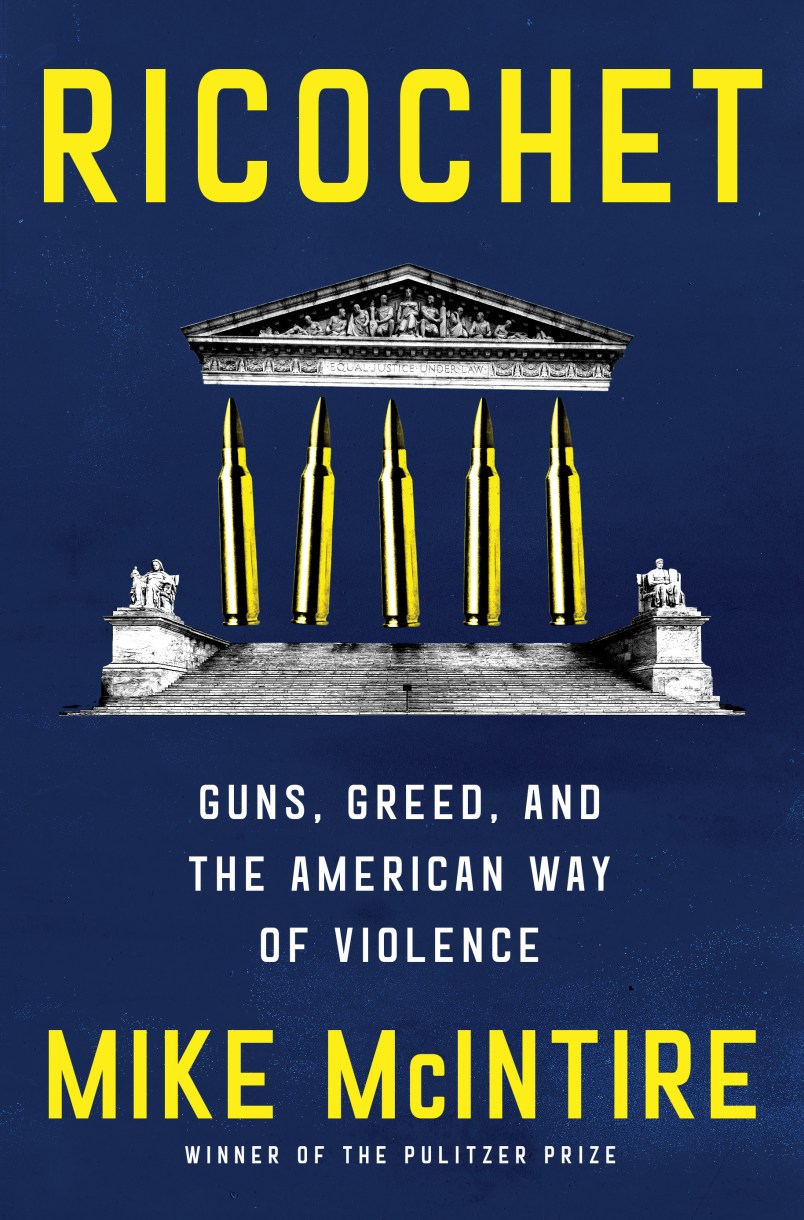
In Ricochet: Guns, Greed, and the American Way of Violence, I explore how these legal victories freed politicians, businesses, and Wall Street players to seek power and profits by making gun ownership a cultural identifier. And the gun lobby worked especially hard to cultivate a younger generation of gun owners by making rifle shooting a school physical education activity and conducting social research on how to get kids interested in firearms.
The heedless integration of firearms into American life is not solely explainable by historical undercurrents, such as the grand schemes of the NRA and the gun industry to inculcate pro-gun attitudes in young people. Larger cultural and social forces have also become increasingly important.
As I began exploring them more deeply, it quickly became apparent that modern-day gun culture has entered a phase akin to the late-stage Roman Empire, when success and power devolved into selfish extravagance. No longer was it enough to argue that sports shooting, hunting, and self-defense justified an expansive interpretation of the Second Amendment—simply having fun with guns was now a God-given right.
On a 550-acre desert expanse in the unincorporated township of Pahrump, Nevada, you can pay for Rolling Thunder, an “adrenaline-fueled experience” of high-speed tactical shooting from an off-road vehicle, offered by Staccato Vegas, an offshoot of the Staccato gun company. A marketing brochure shows a blond woman wearing mirrored shades blasting away with a semiautomatic rifle painted like an American flag.
For a $1,000 annual Patriot membership plan, you get 50 percent off on “run-n-gun” courses, free firearms cleaning, and unlimited monthly guest passes. If you’re willing to pay $3,000 to upgrade to the Freedom plan, you get additional perks such as concierge services, on-demand food and beverage, preloaded magazines for your pistol or rifle when you arrive, and exclusive access to the Staccato 368 Lounge (368 supposedly was a code used for the word liberty by Revolutionary War patriots).
If all of this sounds rather silly, Staccato wants you to know that it is their solemn obligation as red-blooded Americans. At Staccato, you see, “We believe in protecting freedom and celebrating liberty: “It’s a part of who we are as Americans, allowing us the freedom to be individuals and for each of us to pursue our own unique happiness.” To join this assembly of patriots, you must buy at least one Staccato Pistol.
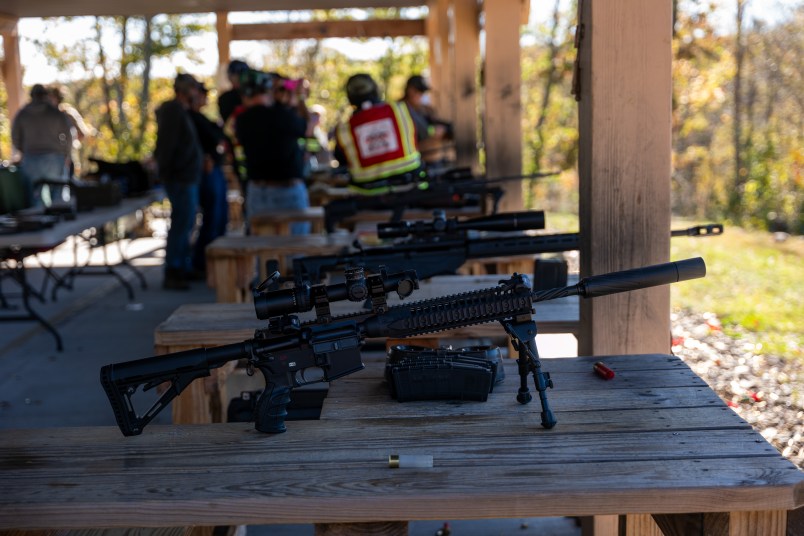
Sport-shooting clubs have been around for at least a century. In olden days, they mostly entailed well-to-do men gathering at some secluded retreat to drink, smoke, play cards, and occasionally shoot bolt-action rifles at targets or maybe go out for a hunt. They were genteel affairs. In recent decades, entrepreneurs have taken this concept and jacked it on steroids. Numerous oases of controlled violence dot barren landscapes in Nevada, Arizona, and Texas, with indoor facilities as well in Los Angeles, Chicago, and Philadelphia. In Las Vegas, the Range 702 offers bachelorette parties, where ladies can shoot machine guns and get a free shot glass, followed by drinks and a “limo to Larry Flynt’s Hustler Club.”
Luxury is a defining theme. An NRA blog post from 2017 explained the emergence of a new name to describe the phenomenon: guntry club. Acknowledging that “gun culture could inspire thoughts of dark and cold ranges, dusty or muddy outdoor environments or even loud, brash and unforgiving crowds,” guntry clubs sought to combine the shooting experience with luxury accoutrements of traditional country clubs.
Some of these places are fashioned as family theme parks, combining sightseeing, swimming, and horseback riding with shooting machine guns and grenade launchers. “Drive a tank! Crush cars!” blares an ad for Bullets and Burgers, an apocalyptic playground of sorts in Arizona. If you’re willing to part with $2,300, the Super Platinum Shooting Package gets you access to eight machine guns of your choice, a flamethrower, and a gigantic .50-caliber tripod-mounted sniper rifle “used in several Hollywood hits including Jumanji and Rambo II.”
In 2014, Alex MacLachlan, an Ivy League-educated investment banker from New Jersey, and his wife, Alison, visited Bullets and Burgers. Their nine-year-old daughter was allowed to shoot an Uzi submachine gun, but lost control of it, accidentally killing the shooting instructor who was guiding her.
The relative wealth and professional status of the tragedy-struck MacLachlan family came as somewhat of a surprise to me. I suppose that betrays my own biased assumptions about the type of person who would want to go to a place such as Bullets and Burgers. Part of my preconception was based on my experience in the 1990s visiting gun ranges such as the one in Kentucky where you could pay to blow up gas-filled barrels—“Machine gun and flame thrower rentals available Friday, Saturday and Sunday!” It was the epitome of “loud, brash and unforgiving.” Since then, it seemed, the audience had expanded to include a demographic
I had not thought would be as interested in it. When I learned about the MacLachlan incident it immediately brought to mind an eerily similar case I knew of involving a physician from Connecticut. In that tragic incident, the doctor’s eight-year-old boy was accidentally shot in the head when he lost control of an Uzi submachine gun he was given at a range in Massachusetts (unlike the Arizona case, this one led to criminal indictments and changes in the law). Well-educated, well-off parents with the freedom to choose any number of healthy, memorable adventures for their children gravitated to ones centered around instruments of lethal violence as entertainment. Some of this was undoubtedly influenced by the gun lobby’s decades-long effort to position firearms as an acceptable way to teach responsibility to kids by making shooting a family-friendly pastime.
But there were deeper societal currents working as well. Legally purchasing and maintaining a decent firearm has never been cheap. One consequence of restricting imports of expensive guns such as so-called Saturday night specials—which in the 1960s and early ’70s could be bought for as little as $10—is that it allowed American-made guns to be sold at even higher prices. Gun control advocates such as Sen. Thomas Dodd were often accused of pushing import bans, in part, to protect homegrown manufacturers, such as Colt, Winchester, and Sturm, Ruger in Dodd’s state of Connecticut.
Import restrictions under the 1968 Gun Control Act required firearms to be for “sporting purposes” and go through licensed dealers. The foreign-made guns that continued to be imported, such as the Beretta, tended to be higher quality and thus more costly. And as the AR-15 took off as a cultural icon, the money required to partake in the fun increased exponentially. Gun industry marketing adjusted to target higher earners, who could more easily afford the advanced weaponry they were selling.
By 2014, households earning more than $90,000 were nearly twice as likely to have guns in the home than those earning less than $50,000. A 2019 study found that “slightly less than half of US guns were owned by persons whose household income was $100,000 a year or more.”
At the same time, the typical education level of the people buying these weapons was also on the rise. In 1994, 29 percent of gun owners had some college education. By 2017, that figure had risen to 34 percent, and by 2022 it was 40 percent. Of course, educational attainment for Americans in general has been trending upward, but the concentration of gun ownership among wealthier households outpaced the extra income that accompanies higher levels of schooling.
There is no better window into this phenomenon than the history of the Staccato Vegas gun range in Pahrump, Nevada. The place actually began under a different name and ownership. It started as the vision of Ignatius Piazza, a chiropractor from California, who founded a firearms training program he called Front Sight. But it wasn’t just about shooting.
From the beginning, Piazza imagined more than dusty target ranges nestled in the desert canyons. He obtained a development agreement with the county to build a “vacation club and resort” that would include thousands of time-share condos, single-family homes, a hotel, and a recreational park, among other amenities—a veritable town dedicated to gun lovers.
To join Front Sight required paying membership fees that could reportedly exceed $200,000 at the topmost “lifetime” tiers, which included a luxury home site. I had a hard time believing anyone would actually pay that much, but fortunately there was a way to find out: Front Sight filed for bankruptcy protection in 2022, and buried in the thousands of court records I found a list of close to three thousand members and the amounts they were said to have paid. The membership costs ranged from $500 to $350,000.
There was the real estate sales and investment consultant from California who paid $165,000; an oncologist and vineyard owner, also from California, was in for $148,000; a corporate lawyer in Illinois paid $106,000; for a physician in Arizona it was $50,000; a tech consultant in New Jersey, $48,000. And on and on.
The chief operating officer of Front Sight once described the Clientele this way: “We’ve got people that are college students to Forbes 400 guys. The economic spectrum is quite broad, but what we find is there’s very few, like forty or fifty, who actually want a residence. What they want is an upscale place to stay for the week or two that they’re out here.”
What motivates them? Bruce, a “gold status” member and CEO of a tech company in Orange County, California, explained why he brought his fourteen-year-old son and members of his family’s church group to the range: “The feeling of security that I come home with, that I’m able to protect my family with all the craziness going on in this world.”
Michelle, a tax accountant from Liberty, Missouri, spent weeks at Front Sight with relatives and “girls from my office” learning to shoot and “be ready to defend our family.” Grant, a software-company executive from Bloomington, Minnesota, came with friends because “it’s really important to be able to defend myself and defend my family if I ever got into that situation.”
As much as self-defense may be the practical, mature rationale participants offer when asked, many also gravitate to these guntry clubs for entertainment. The industry has been remarkably successful at selling the eat-your-spinach objective of skills training in a sugary wrapper of fun, comfort, or excitement. And for that, the lure of cool “forbidden” stuff comes in handy.
Desert Wolf Tours in Arizona offers packages for bachelor and bachelorette parties and corporate retreats that combine off-road ATV driving with shooting machine guns, which they are licensed to operate. One of them, priced at $314 per person, is the Machine Guns and Suppressors Adventure, which is cosponsored by a company that makes silencers or, in the industry’s preferred parlance, suppressors: “Shoot REAL, Federally-Restricted Machine Guns and Suppressors! These are the REAL DEAL!”
The use of guns for entertainment and over-the-top recreation may be all in good fun (the wisdom of it notwithstanding), but a darker element to the modern idolization of firearms and violence can be found in our political discourse. Here, the societal effects are especially profound because, for better or worse, our elected leaders both reflect and set the tone for what’s considered “normal.”
For schoolchildren, a visit to their class by a politician once conveyed a sense of seriousness and civic duty. Students today could be forgiven for confusing it with professional wrestling.
To be sure, American politics has a long history of bare-knuckle excesses. The 1828 presidential campaign featured accusations, circulated in dueling handbills, that Andrew Jackson was a cannibal and John Quincy Adams a pimp. In modern times, negative attacks on opponents have tended to emphasize fear as much as slander and innuendo. Democrats can lay claim to one of the most notorious examples — The “Daisy ad” of 1964, showing a little girl plucking flower petals followed by a nuclear blast, the unsubtle message being that a vote for Republican Barry Goldwater meant the end of the world.
At the same time, as the NRA made support for gun rights a potent political signifier, it became increasingly common for candidates from both parties to flaunt their love of firearms. Traditionally, they struck relatively tame poses—hunting ducks or shooting at targets—just enough to reassure voters for whom guns were important. But in the 2010s, political messaging around guns took a sharp turn. Conservative opposition to President Obama and the rise of the Tea Party movement propelled a class of antiestablishment Republicans to the fore, along with increasingly agitated campaign ads of a different caliber—literally.
In Arizona, there was Pamela Gorman bragging about her NRA rating in 2010 by firing a machine gun, an AR-15, and a semiautomatic pistol. Another Arizona candidate, Jesse Kelly, promoted a campaign event that year where supporters could “shoot a fully Automatic M16” with him. Around the same time, Christina Jeffrey in South Carolina ran an ad in which she brandished an AK-47 while asserting that gun rights were necessary “to ensure that our limited government stays limited.”
Will Brooke, who unsuccessfully sought the Republican nomination for Congress in Alabama in 2014, ran an ad in which he used a small arsenal of semiautomatic weapons to blow holes in a printed copy of the “Obamacare” law. He was mimicking a milder ad from four years earlier showing West Virginia Sen. Joe Manchin, a Democrat, shooting a bolt-action rifle at a different bill.
In the 2016 Missouri governor’s race, Eric Greitens, a Republican and former Navy SEAL, took gun imagery to new heights in two ads, one showing him firing a mounted machine gun while pledging to “fight Obama’s Democrat machine and their corrupt attacks.” In the other, he shot an assault-style rifle at an unseen target until it blew up. And in 2018, there was the not-so-subtle ad for Republican Kay Ivey, the governor of Alabama, showing two men loading pistols at a range while saying they are “sick of those DC politicians” and that Ms. Ivey “protected our monuments.”
What was different about these is that the political messaging featured a firearm but, unlike in the past, the focus was neither progun nor pro–gun control. Rather, the gun itself was a prop used as a sort of ominous exclamation point for some other argument. The careless flaunting of firearms by these twenty-first-century pols stood in stark contrast to earlier generations of elected leaders, who may have supported gun rights but didn’t shove it in people’s faces. The discourse had become so militant that even John Dingell, the archetype of the pro-gun politician, was having doubts.
In a memoir published shortly before he died in 2019, Dingell recounted watching his wife, who had succeeded him in Congress, give a speech pleading for reason and a spirit of compromise to address gun violence. Thinking about it the next day, he said he found himself regretting that “the gun debate had gotten too polarized.” “As Debbie had said with such passion the night before, ‘Can’t we have a discussion?’” Dingell wrote. “And I thought about the role I know I played in contributing to that polarization.”
Compromise, however, does not sell as well with certain constituencies as performative antics, which have only gotten more extreme in the years since Dingell’s ruminations. Republican Congressmen Thomas Massie of Kentucky and Andy Ogles of Tennessee sent out
Christmas cards in 2021 showing their families posing with assault rifles. A Republican Senate candidate in Georgia, Josh Clark, held weekly giveaways of AR-15s in 2022 to ensure voters are equipped to “fight tyranny and evil” and filmed himself with his kids shooting one of the rifles. And in 2024 in Missouri, Republican attorney General candidate Will Scharf fired a grenade launcher at a stack of documents from Trump-related court cases.
Watching these ads, I found myself thinking of another politician from a bygone era, Robert F. Kennedy, and his remarks about gun ownership after his brother, the president, was assassinated: “We have a responsibility to the victims of crime and violence. It is a responsibility to think not only of our own convenience but of the tragedy of sudden death. It is a responsibility to put away childish things, to make the possession and use of firearms a matter undertaken only by serious people who will use them with the restraint and maturity that their dangerous nature deserves and demands.”
Copyright © 2026 by Mike McIntire. From Ricochet by Mike McIntire, published by One Signal/Atria Books, an Imprint of Simon & Schuster, Inc. Printed by permission.




Are they really “new”? Remember DIck Cheney and his trigger happy buddies? Not to mention “big game hunters” the Trump boys.
If this makes you feel like a real killer, none off this is available if you go to war.
A lot of ink has been spilled of what God meant by subdue and dominion over. Americans better hope God meant it was our jobs to drive thousands of species into extinction each year, destroy ecosystems and enslave, violate or kill others. We are such pious people after all.
As someone who enjoys shooting, is good at it, served 22 years active duty with marksman awards from both the USA and Germany, I think these sound fun if more money than I’m personally interested in spending. Remember there are liberals who enjoy shooting. While I support “well regulated” things like mandatory training, I think people who want to shoot should be allowed to with minimal interference.