

This article is part of TPM Cafe, TPM’s home for opinion and news analysis.
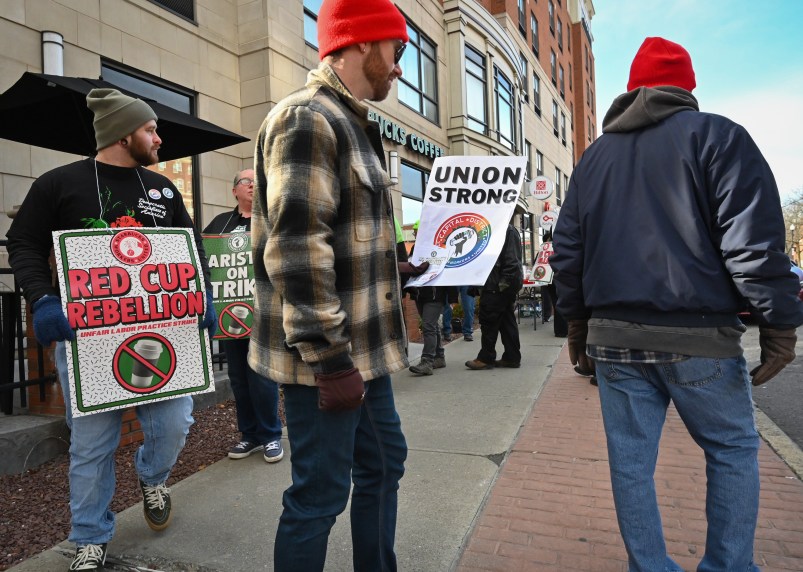
For nine decades, the National Labor Relations Board (NLRB) has stood as the federal government’s primary guardian of workers’ rights to organize and bargain collectively. Created in the depths of the Great Depression, the NLRB was designed to be a buffer between workers and the concentrated economic power of employers, ensuring that the fundamental right to unionize could not be crushed by intimidation or retaliation. Its enabling legislation, the National Labor Relations Act (NLRA), is unambiguous in its purpose: to encourage and protect collective bargaining and to level the playing field between employers and employees.
And yet, in one of the most striking ironies of recent years, under the Trump administration, the NLRB itself is suing states like California and New York that have asserted the right to protect their workers when the NLRB fails to do its job.
How did it come to this? Almost immediately after taking office, President Trump illegally fired board member Gwynne Wilcox — the first time a president has removed a board member before the end of their statutorily required term in the 90 years of the board’s existence. Wilcox’s removal left the board without the required quorum of at least three members to advance certain business. Without a quorum, the NLRB General Counsel can continue certain activities related to processing complaints and managing ongoing court cases. However, instead of using the Board’s full authority to protect workers, the quorumless Trump NLRB has paused all active investigations — including 24 into Trump megadonor Elon Musk’s companies — and cannot open any new investigations when employers violate their workers’ rights.
With an underfunded, understaffed, and ideologically hostile NLRB failing to enforce the law, some states have stepped into the gap. Since Wilcox’s firing, New York and California have passed so-called “NLRB trigger laws” allowing their state labor agencies to monitor union elections, investigate charges of workplace retaliation, and address other issues in the event the federal labor board is unable to decide cases.
These efforts were not attempts to override federal authority — they were attempts to preserve the core guarantees of the NLRA in the face of federal abandonment. However, while the Trump NLRB is unable to do its actual job of protecting workers, it has found time to make sure that the states don’t either. Acting General Counsel William Cowen has filed lawsuits against New York and California attempting to invalidate their NLRB trigger laws under the doctrine of federal preemption.
Under the U.S. Constitution’s Supremacy Clause, federal law is the “supreme law of the land.” The Supreme Court has interpreted this clause to mean that when Congress either explicitly or impliedly intends to create a uniform regulatory scheme where state-level regulations could create conflicting requirements, the federal law preempts the state law and renders it unenforceable.
This is not a legal technicality. Normally, preemption prevents overlapping regulation, but here, the Trump NLRB’s claim is both sweeping and deeply cynical. They say that states cannot protect workers in areas that could fall under NLRB jurisdiction, even when the NLRB declines to exercise that jurisdiction. In other words, the NLRB is asserting the exclusive right to not protect workers.
This runs contrary to both the spirit and the letter of the NLRA. Congress explicitly stated that the purpose of the Act was to promote collective bargaining and minimize industrial strife by empowering workers. There is nothing in the statute that suggests Congress intended the federal government to block states from acting when the NLRB is unable–or unwilling–to fulfill its mission.
The Trump Board’s theory of preemption effectively weaponizes federal inaction. Under this view, a hostile or incapacitated NLRB can unilaterally shut down federal labor law enforcement while also preventing states from taking action, ensuring that workers have no substantive rights at all. It creates a regulatory vacuum in which employers face neither state nor federal accountability.
The Supreme Court has long recognized that states serve as “laboratories of democracy.” Nowhere is that more important than in labor law, where federal enforcement has been chronically underfunded and increasingly politicized. States are often the first to identify emerging problems, from wage theft and workplace safety violations to misclassification in the gig economy, and they are often the first to craft innovative responses.
California’s AB 5, for example, sought to address systematic misclassification of workers as independent contractors — an issue the NLRB had done little to address. New York established new remedies for wage theft, a crisis affecting hundreds of thousands of low-income workers. Both states acted because workers were falling through the cracks of an NLRB that had abdicated its responsibilities.
The Trump NLRB’s lawsuits attack these efforts not because they conflict with federal law, but because they succeed where the federal government has deliberately sided with corporations over workers. What makes these lawsuits particularly alarming is the contradiction between the NLRB’s posture and its statutory mission. The NLRA was not written to create a single, exclusive federal bureaucracy; it was written to empower workers. The Board’s role was always intended to be supportive of worker rights.
The Trump NLRB’s approach turns that logic on its head. It treats the NLRA as a ceiling rather than a floor, arguing that workers should have only the protections the Board acknowledges on any given day. And during an administration openly aligned with corporate interests, that ceiling has been set perilously low. The result is an agency using the very authority designed to protect workers to prevent anyone else from protecting them.
If the NLRB succeeds in asserting exclusive authority to deny protections, workers in hostile or underfunded jurisdictions could find themselves without meaningful rights for years at a time. Every change in administration could lead to dramatic swings in worker protections, leaving millions of workers in legal limbo. More broadly, the NLRB’s position undermines the basic logic of cooperative federalism. States have always played a vital role in protecting their residents when federal institutions falter. Preventing them from doing so erodes the resilience of the entire labor rights ecosystem.
At stake is not only the future of state-level labor innovation but the future of the NLRA itself. If an anti-labor NLRB can interpret the statute as a tool for stripping away protections rather than expanding them, the pro-worker foundation of the Act will erode.
States will continue to innovate, because they must. Workers cannot wait for an NLRB that is out of quorum, out of resources, and, under certain administrations, out of alignment with its own purpose. The solution is not to restrict states but to restore the NLRB to its original mission: protecting workers, not preventing their protection.




Working as designed. Pardon the image, but Grover Norquist must be walking around with a permanent pardon. They are not “drowning the government in a bathtub,” just making sure no agency does the job for which it was created. Except ICE, of course. That’s to keep Stephen Miller permanently tumescent.
I would say ICE is a failure, too. Lots of high profile arrests, and terror, but few results. Except contributing to a slowing of the American economy.
It’s now the National Labor Restrictions Board.
The scope of American failure is pretty astonishing, I have to admit. Our system has, effectively, collapsed and we merely laboring (no pun intended) under the illusion that somehow things will be fixed or okay.
We are not the tough people we insisted we are. We are not the hignly ethical people we shoot our mouths off about. All collapses like ours are not sudden things, so yes, the rot has been there for a long time, but the eagerness of soooo many across the federal government to burn things down is surprising even to the most jaded among us.
It doesn’t end with a bang, but with the sheer obseisance of thousands of techno-bureaucratic Little Eichmanns.
It looks like it may take some bloody Labor wars to impress on the oligarchs ( I call them OLEOgarchs, because they are fake and they are slimy) both inside our government and in the Board Rooms that we have had enough of their billion dollar salaries while cheating the workers out of fair wages. The greedy reichwing never learns from history. They keep thinking that they can get away with being greedy assholes forever. WRONG!