

This story is part of TPM Cafe, TPM’s home for opinion and news analysis.
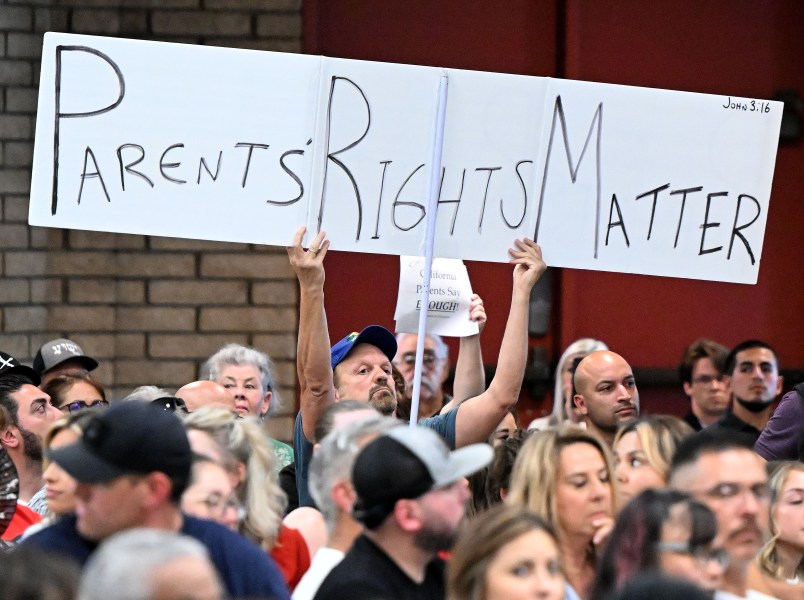
In late February, the Wyoming House of Representatives passed a bill that would significantly change how schools, health departments and child welfare agencies interact with families. The measure would allow parents to sue municipalities and state agencies for financial damages if they believe officials have violated their parental rights. On the surface, this change may sound reasonable, but in practice, it could make public institutions far more cautious about supporting vulnerable children — especially LGBTQ+ students or children in unsafe homes — for fear of triggering costly lawsuits.
Wyoming already has a broad parental rights law, and conservative activists have used similar statutes across red states to challenge LGBTQ+ inclusion, racial equity initiatives, and policies that give minors some measure of privacy in schools or medical settings. Although framed as protections for families, these laws often end up shielding physical and emotional abuse from scrutiny and impeding efforts to address medical and educational neglect. Crucially, in Wyoming the statute requires that any government action seen as intruding into the parent-child relationship must satisfy strict scrutiny, the most demanding legal standard that courts apply. Under that test, the government must show that its action serves a compelling interest and is narrowly tailored to achieve that goal. In practice, that can make it very difficult for public officials to intervene in family matters, even when they believe a child needs support or protection.
Until now, however, the main legal remedy available under Wyoming’s parental rights law has been an injunction — a court order directing a government agency to stop unlawful actions. An injunction can halt a policy or practice, but it does not require the government to pay damages.
What makes Wyoming’s new move so consequential is that it would allow parents to sue for financial damages and attorney’s fees, adding significant financial stakes to every action that teachers, healthcare workers, and others take with children — not only to prevent harm to children but to avoid offending their parents’ political sensibilities.
To allow these lawsuits, the bill would have Wyoming waive its sovereign immunity. Courts across the country ascribe to the idea of sovereign immunity protecting states from damages liability, which derives from English common law related to the legal infallibility of the king, so states can only be sued with their consent. In some cases, even clear harm by the state cannot trigger a lawsuit. For example, if someone is hit by a car, whether they can sue for damages may depend on who was driving and whether they work for the government. Recognizing this problem, some states grant sweeping exceptions to sovereign immunity so that residents can hold them accountable for harm, but many, like Wyoming, permit only narrow waivers of sovereign immunity. Under this bill, an aggrieved parent could sue their child’s teacher for keeping the book “Pride Puppy” in the classroom.
That exact example came up in Supreme Court case Mahmoud v. Taylor, which illustrates what this kind of escalation can look like in practice. In that case, parents challenged the inclusion of certain books in Montgomery County, Maryland public schools, arguing that schools exposing their children to LGBTQ+ content violated their parental rights. When the dispute reached the U.S. Supreme Court, the Court’s conservative majority effectively recognized a parental veto right over some public school library and curricular materials, opening states and municipalities to severe intrusions by individual parents into community education decisions, but in most cases, money damages would still be unavailable. However, after the Supreme Court remanded the case for trial, the judge in Mahmoud awarded the parents $1.5 million in damages, to be paid by Montgomery County schools.
That award was possible because Maryland has legislatively waived sovereign immunity for all tort claims against the state up to $400,000 per incident. Maryland’s policy is a laudable one, providing a pathway for people harmed by state misconduct to obtain compensation. Yet the Mahmoud litigation demonstrates how such waivers can be weaponized to advance a broader political project. A doctrine designed to ensure accountability can, in a different context, become a powerful tool for reshaping public institutions.
It is telling that Wyoming is not advancing a similarly expansive sovereign immunity exception. Rather than allowing damages for a range of government wrongs, the proposed exception would focus specifically on alleged violations of parental rights. Beyond allowing suit in the first place, the bill also eliminates the statute of limitations for bringing a claim — again, only for parental rights cases. By pairing strict scrutiny with a lifelong damages remedy and private right of action, lawmakers would significantly strengthen the enforcement mechanism behind the state’s existing parental rights framework.
The most striking aspect of the proposal is how burdensome these private lawsuits could become for public agencies. Even if a school district or health department ultimately prevails, defending years-long litigation is extraordinarily expensive. Add the possibility of damages and plaintiffs’ attorneys’ fees, and the risk calculus changes dramatically. Most municipalities operate on constrained budgets and are ill-equipped to absorb protracted legal battles. Faced with the prospect of costly litigation, many would likely choose to avoid actions that could provoke a lawsuit, even if those actions are designed to protect vulnerable children.
The chilling effect could be sweeping. School districts might quietly retreat from supporting LGBTQ+ students or remove inclusive materials rather than risk being accused of an “intrusion” into parental authority. Public health providers could hesitate before offering necessary care to minors in sensitive circumstances. Child welfare workers might think twice about investigating abuse if such intervention is reframed as unlawful interference with parental rights. The mere threat of financial liability can be enough to reshape institutional behavior long before any court renders a final judgment.
There is also a structural asymmetry embedded in this approach. Litigation can be expensive for plaintiffs as well, which means that parents whose lawsuits are backed by well-funded conservative legal organizations will have a significant advantage. They can afford to pursue multi-year cases with confidence that their costs will be covered and that they will have practical and emotional support throughout. By contrast, parents seeking to challenge state policies that intrude on parental decisionmaking around conservative priorities — for example, when gender-affirming care is denied to their child — are far less likely to have comparable institutional support. A damages regime tailored to one ideological project effectively empowers the regressive side of the children’s rights debate with greater financial and organizational resources.
Much of the parental rights movement has focused on symbolic clashes and headline-grabbing controversies. Wyoming’s proposal marks something more durable and coercive. By carving out a sovereign immunity exception and creating a private enforcement mechanism with real financial teeth, lawmakers would supercharge the state’s structural support for parental rights extremism in the courts. Public agencies would not simply be ordered to change course; they would be pressured into compliance by the threat of substantial monetary penalties.
In that sense, the bill is less about resolving individual disputes and more about institutional leverage. It is designed to make the cost of supporting children’s self-determination — particularly for LGBTQ+ youth and children in unsafe homes — prohibitively high. The predictable result is not a highly public courtroom victory or bill signing, but anticipatory overcompliance, with schools shelving books, counselors withholding support, health providers declining care, and child welfare workers hesitating before intervening in dangerous homes all to avoid becoming the next costly test case in the conservative war for total parental control.





What happens when upholding one group of parents’ rights infringes on a different group of parents and their rights?
If some parents are successful in banning books, what about a different group of parents who want their kids to have access to those books?
Someone should sue that state for allowing school libraries for having books that talk about Christianity.
Fine.
Can those of us who haven’t bred sue the idiots who have and are raising morons?
Asking for a friend who is tired of self-absorbed, self-important, self-indulgent, selfish parents who expect single people to be constantly inconvenienced at work, on airplanes, restaurants, trains, buses, Target, and on and on, on behalf of their loud, obnoxious, rude spawn.
Yes parents -a lot of you have shitty kids.
The rest of us shouldn’t have to suffer because others are too stupid or were too drunk to figure out birth control.
People have made compelling arguments for banning the christian bible from schools under these kinds of laws. It is crammed with sex, rape, incest, human sacrifice, genocide, and dietary advice that would make Sec Kennedy proud.
What about the rights of the students in the school?Tinker v. Des Moines Independent Community School District - Wikipedia
The Tinker test, also known as the “substantial disruption” test, is still used by courts today to determine whether a school’s interest in preventing disruption outweighs students’ First Amendment rights.
The Supreme Court famously opined, “It can hardly be argued that either students or teachers shed their constitutional rights to freedom of speech or expression at the schoolhouse gate.”[1][2]