

This article is part of TPM Cafe, TPM’s home for opinion and news analysis. It was originally published at Balls and Strikes.
For months, President Donald Trump has been coping with his myriad failures and plummeting approval ratings by trying to make it harder for people to vote his party out of power in the 2026 midterms. To that end, in March, he issued an executive order that would require the U.S. Postal Service to draft a rule that would upend vote-by-mail procedures in dozens of states, and effectively block the agency from processing ballots that do not comply with the rule’s exacting requirements. Trump did not attempt to hide his motives for doing so: Legal restrictions on mail-in voting, he told Republican lawmakers, would “guarantee the midterms” for a party that is otherwise in danger of losing them badly.
A series of lawsuits ensued, given that the Constitution (1) divides the power to administer federal elections between Congress and the states and (2) very much does not allow elderly conspiracy theorists to arrogate that power on account of their fixation with the results of a presidential election they lost more than a half-decade ago. And fortunately for anyone who cares about maintaining some semblance of representative democracy in this country, in a three-sentence order on Monday, the Supreme Court left in place a federal district court order that blocks the Postal Service’s rule from taking effect in time for the 2026 midterms. Only Justices Samuel Alito and Clarence Thomas noted their dissents.
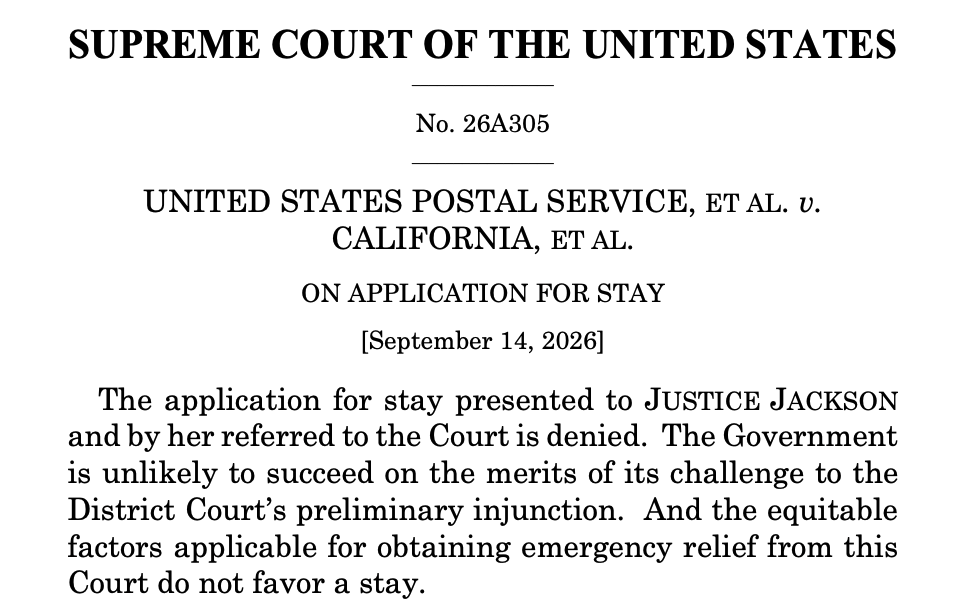
The order in Postal Service v. California is brief because the legal analysis is not complicated. At issue is the Trump administration’s request that the Court “stay” that lower court injunction. When considering such requests, courts are supposed to consider not only who is likely to win the substantive case, but also the practical implications of preserving or disrupting the status quo while litigation continues: for example, whether the party asking for a stay would be “irreparably” harmed without it, and the extent to which a stay is in the “public interest.”
Here, a majority of the Court agreed with the lower court’s assessment that Trump will probably lose on the merits. It also concluded—sensibly, in my view—that preventing the federal government from requiring state election officials to implement a probably-illegal rule that would functionally disenfranchise millions of people less than two months before the midterms would not cause Donald Trump to suffer “irreparable harm,” in any meaningful sense.
Alito and Thomas could not let this conclusion go unanswered. Alito began his opinion by recasting the rule not as an attempt by Trump to regulate elections per se, but as a coincidentally election-adjacent exercise of the Postal Service’s “broad authority to regulate the mail,” which is, for technical reasons I won’t bore you with here, ostensibly harder to challenge in court. Strangely, the facts that the rule is titled “Ballot Mail for Federal Elections,” and applies to the activities of state “chief election officials,” and says that its primary purpose is protecting the “integrity of federal elections,” and does not implicate any class of mail other than mail-in ballots do not appear anywhere in Alito’s trenchant analysis.
Somehow, the second chunk of Alito’s dissent is even less serious. First, he asserted that the injunction would cause the Trump administration to suffer “irreparable harm” because leaving it in place would “deal a serious setback to the Executive’s goals.” As Alito has done with unsettling frequency over the last several years, he also claimed that the government has a “strong interest” in enforcing the rule in order to “better detect election fraud.”
These claims are equal parts nonsensical and detached from reality. First, voter fraud is vanishingly rare, and shrill warnings about its putative pervasiveness—especially in the mail-in ballot context—come exclusively from Republican politicians looking to justify their next voter suppression bill. Second, preserving the status quo for an imminent election is a pretty straightforward example of reparable harm; if the Trump administration wins, its rule takes effect for the next election. Here, a stay only deals a “serious setback to the Executive’s goals” in that it prevents Trump from illegally hijacking an election just because the legal system has yet to formally affirm that it is indeed illegal for him to do that.
To my surprise, Alito did allude to unspecified “practical effects” of changing the rules so “close to the midterm elections,” which is as close as his opinion gets to acknowledging that under the legal test he is supposed to be applying, Trump should lose this case. Just as quickly, though, Alito decided that the public’s interest in participating in democracy is simply none of his business: “I take that problem very seriously, but it is not enough to convince me to deny the application,” he wrote. This is roughly analogous to a boxing referee conceding that allowing one fighter to bring a gun into the ring might entail deleterious consequences for the other, and then shrugging his shoulders and scampering out of the line of fire before the bell rings.
It is of course good that this latest, sloppiest bit of pro-Trump agitprop did not command a majority of the Court. But it does leave unanswered the question of what Donald Trump could possibly do that Alito and Thomas would not obediently launder using random bits of legalese and the occasional Bluebooked citation. For them, there is no test to apply in order to determine whether an executive act is legal. There is just a solemn duty to give their favorite president what he wants, when he wants it.



Despite his protests to the contrary, I fully expect Alito to retire on November 4th or thereabouts, and the GOP to break the speed record replacing him with a newer but equally repulsive model.
Maybe if the Orange Piece of sh*t convicted felon acted out that famous quote from 2016 it would be too much for the terrible twosome?
Never mind. Those two reprobates would call it a “Official Act”.