

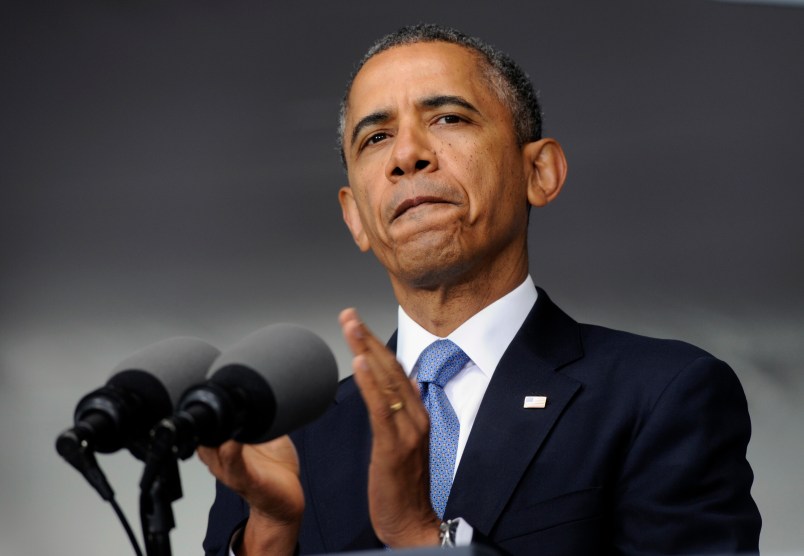
President Obama’s commencement address at the U.S. Military Academy (USMA) at West Point, New York on Wednesday was both a recognition of the complex world the Class of 2014 will face and an acknowledgement that the United States must adjust its foreign policy to reflect a world more dynamic than ever before.
 The President took this opportunity to remind the American people – who he acknowledged as justifiably weary after more than a decade of conflict – that the United States will remain the “indispensable” nation for global stability, relying on an internationalist footing to stay engaged in the world. The President made very clear, however, that an aggressive foreign policy does not mean a policy of military intervention. Rather, his speech was a call to action for a full policy toolkit of the United States to strengthen allies, organizations, and norms abroad.
The President noted that members of the USMA Class of 2014 will be the first since 9/11 who are unlikely to serve in combat in Iraq or Afghanistan – a reminder that received loud cheers from the graduating cadets. With the Afghan National Security Forces leading the campaign against the Taliban and a successful first round of elections – a prelude to a peaceful transition of civilian power – is underway, American focus must shift to a broader range of security challenges. In other words, the United States must not only walk and chew gum, but jump, turn, pivot, and address issues across the globe all at the same time.
In short, the President outlined a four point agenda for continued American leadership around the world:
- Maintain the ability to use military force when the United States is directly threatened;
- Enhance counter-terrorism efforts through a robust partnership with nations where violent extremism is seeking a foothold;
- Strengthen international institutions such as NATO to enhance the ability of the international system to deal with instability and aggression; and
- Continue to support democracy and human rights — not just out of humanitarian concern but because of national security interests.
The President acknowledged that the U.S.’s global leadership is not optional; the adage that “there is no retirement for a superpower” remains true. The technological, demographic, economic, and physical changes wrought by globalization mean that the United States cannot ignore what happens beyond its borders. Proliferation, unchecked regional aggression, violent extremism, and climate change were all cited as present dangers that will “ultimately,” as the President stated, impact the U.S. and its allies. Accordingly, he noted that if the United States is directly threatened then the United States would use military force – unilaterally if necessary.
Perhaps in answer to critics who decry his lack of military action abroad as “weak,” the President made very clear that terrorism remains a threat. He took the opportunity to cite the decimation of core Al Qaeda while acknowledging that its affiliates and other violent extremists remain a threat in South Asia, the Middle East, and across the Sahel. The President then outlined an expanded partnership effort intended to replicate the successes the U.S. military has had in Afghanistan in terms of building the capacity of foreign military and police forces to combat terrorist networks.
In outlining this effort, the President called upon Congress to support a $5 billion “Counterterrorism Partnerships Fund” that would enable flexible and rapid assistance to other nations to help destroy terrorist networks. The President framed the Syrian crisis into this context, taking responsibility for abstaining from a ground force deployment and arguing in favor of providing military support to the Syrian opposition and bolstering partners – Jordan, Lebanon, and Turkey – in their efforts to control the extremism that threatens to spill out of the conflict.
While making it clear that the U.S. will use military force when necessary, the President reminded the American people sometimes the use force is undesirable, inappropriate, or even counterproductive. Breaking from the foolhardy approaches that guided the United States to disaster from 2003-2008, the President praised in turn diplomacy, development, sanctions and the use of the international system to deal with potential threats to stability and security for the United States and our allies. He stressed the need to strengthen the international order and the institutions created in the wake of the Second World War that have continued to enable multilateral approaches to stability.
The President recalled that multilateral approaches and strong institutions allowed the combination of diplomacy, sanctions, and the threat of continued isolation to bring Iran to the nuclear negotiating table. Similarly, he pointed out that NATO and OSCE action had curtailed Russian intimidation in Ukraine and allowed for unfettered elections. The message was clear: without support of international institutions and adherence to norms it will be difficult, if not impossible, for the United States to address the 21st century’s global challenges such as cybersecurity and climate change.
In short, President Obama has challenged, head on, the perception that the United States has stepped back from the world stage. His strategic vision comes from a more nuanced understanding of foreign policy and engagement abroad, where a diverse toolset and a multifaceted understanding of allies and enemies replaces the “shoot first, ask questions later” approach of years past. The President rejected the tired claim of isolationists that a desire to focus on a secure and prosperous America at home requires us to spend less time worrying about what happens overseas. He also responded to the critique that the “Obama Doctrine” is not governed by internal logic or strong principles.
Instead, President Obama urged the cadets and the American people to understand the source of the nation’s exceptionalism. The true strength of the United States comes from the principles that our men and women in uniform have died to uphold. American foreign policy must continue to adhere to these principles so that we can lead by example. Supporting human rights must remain a matter of practice, strengthening international institutions must remain the priority, and taking military action must remain the last resort.
Dr. Mark R. Jacobson is a Senior Advisor to the Truman National Security Project. He previously served as the Deputy NATO Representative in Afghanistan and on the staff of the Senate Armed Services Committee.



"The true strength of the United States comes from the principles that our men and women in uniform have died to uphold. "
Take it away, Smedly Butler!:
Thanks. The caption with pic was too much for me - didn’t know where to start. Another day.
BTW, seriously thinking of becoming a Prime Slimer
(only kidding).
Being an Elitist though, that’s the way to go.
True dat, Mr. President. So where’s the example? Whistleblower protection? Secure e-mail? Freedom of information? Freedom of investigative journalism? Accountability for those who undermine these things?
I need to see more detail on #2: Enhance counter-terrorism efforts through a robust partnership with nations where violent extremism is seeking a foothold;
It seems to me that our “robust partnerships” with the Egyptian and Saudi governments, for instance, are exactly what produced this terrorism problem in the first place.
It’s a sound, smart idea, but it’s going to be counterproductive unless it’s tempered by close attention to the human rights goals of #4.
Is any of this supposes to have to do with foreign policy?
Or are you treating this as an open thread to talk about what you’re thinking about instead?