

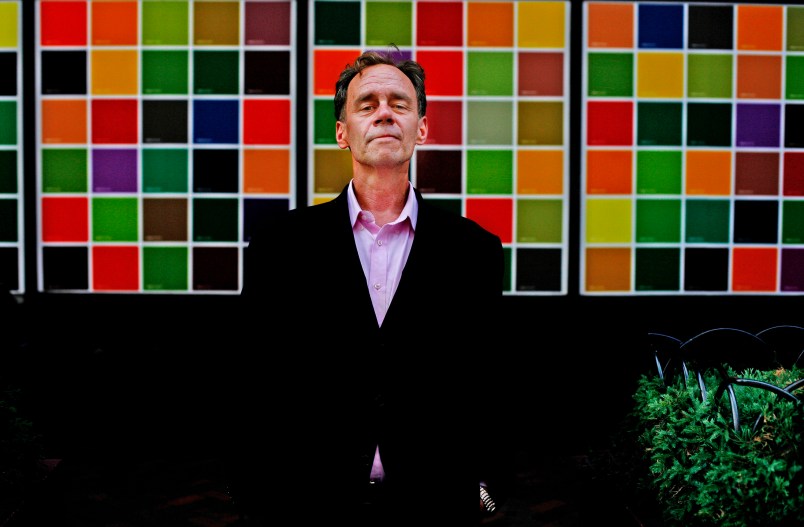
It’s not that we didn’t know what we had until it was gone. No, we all knew what we had in David Carr. We had a compass. As an industry, as a community of media makers, we had a person we trusted to orient us — morally, intellectually, critically, comedically. And we trusted him to be a voice on our behalf, choosing what was important to communicate about the systems and characters that make the press go, and doing so with an absence of bullshit and a fullness of humanity.
Everyone appreciated Carr in the moment, basking in his realness, appreciating his uncanny combination of grace and bluntness. Perhaps what we took for granted — what I took for granted, at least — was that knowing Carr was around gave me a sense of safety. He was our net, I now realize. His steady presence was around and below the rest of the bumbling, sometimes brilliant, sometimes errant members of the media, shielding us from an abyss of negativity or embarrassment or just simple purposelessness. To read the news of David Carr’s passing last night was to feel, suddenly, without a net.
Some of that quality surely came from the well-known story of Carr’s past. I remember reading the excerpt from The Night of the Gun that ran in the New York Times Magazine in 2008. The images are unforgettable. Babies left in a parked car on a frigid winter night while their father made reprehensible decisions under the influence of addiction. The scenes were chilling, but the story, overall, was an ablution.
In the years that followed, my own awareness of Carr as a figure in the media world grew, always tied to my memory of his story, and there was something incredibly powerful and incredibly humanizing about that transparency. Like all deep confessions, his liberated those who learned about it as much as it may have (I assume) liberated him. It was as if, by witnessing him shine light on his own dark shadows, we were being reassured that we, too, could cohabitate with darkness without being its prisoner.
In 2010, when our little upstart project, Longshot Magazine, won an award for journalism innovation, Carr keynoted the ceremony in D.C. I’ll always remember seeing him at one of the round banquet tables across the room and gearing up (with Mat Honan and Alexis Madrigal, now my husband) to go talk to him, feeling awestruck and nervous. It wouldn’t be a stretch to say we were a bit like kids hoping to impress our father. He was, as always, casual and funny, entering into the interaction with the assumption that we were peers. From that point on, as our careers advanced, we probably did feel more like peers than on that first meeting, but that warm feeling didn’t go away. He was the dad you could be totally honest with, who would not judge you, who was proud of your accomplishments but unfazed by your failings.
This was the power of Carr’s media commentary, too. His relationship to the industry was one of deep love with healthy boundaries, and his writing was as meaningful and relatable to media insiders as to outsiders looking for a lucid take on the news. Whatever was happening, we could trust that Carr would know what to say and how to say it. Anyone would give him the last word.
Last night, when the news of David’s passing appeared as a notification on our phones, we were on our bed with our nearly 18-month-old son, reading bedtime stories. The baby was in the midst of performing all his pre-sleep antics, giggling and tumbling, and it took a minute for me to realize that he had stopped, frozen in response to our own sharp intakes of breath. He studied our faces, worried, and I quickly tried to snap back into play mode. I wanted to shield him from the emotion behind the expressions he’d already noticed.
I think it was the right move, but now, as the tenor of the Twitter reactions shifts from “Oh my god” to speculation on how Carr himself would feel about his own social media wake, I can’t help but think he’d endorse allowing our son to witness our honest emotions. That was David’s gift to us: allowing. He showed us it’s acceptable to have scars and valiant to show them; you neither need to disappear them nor let them define you. Maybe it’s presumptuous to say this, and there’s no doubt it was too soon, but I got the sense David had a realistic relationship with mortality. I’ll try my hardest to do the same.
Sarah Rich is an editor at Medium, where this piece originally appeared. She lives in Oakland, California.




While I am sadden at the lost David Carr as memeber of the family of humanity, I do find some of the accolades re him a good example of what’s wrong with today’s journalism. Mr. Carr is mostly remembered as being the NY Times media columnist. Correct me if I’m wrong, but he was not known for covering war, government, medicine, business, politics,etc. Not known for covering any of the major institutions that profoundly effect on ordinary citizens’ lives. He basically covered media–journalism. And this is a good examplre of what is wrong with today’s journalism; it spends inordinate amount of time covering journalism, especially American journalism, which has failed spectacularly in the lead up the Iraq war and the 2008 implostion.
Not, I read Mr. Carr’s column occassionally, but can’t say I was duly impressed. As a matter of fact, I gathered that he was quite proudly smug of being a member of the club: the New York Times.
It is interesting to note that comedy shows such as the Daily Show and the Colbert Report have done better work at “media criticism” that perhaps the likes of Mr. Carr. To be blunt, most of today’s journalism is a very bad joke foisted on the American public., and the fact that most of media, once again, did a bad job on the Iraq war, the 2008 financial implosion, and sat on news aboout Bill Cosby for years says alot.
That Mr. Carr has been cited in numerous newspapers or websites–the Times itself ran a front page, above the fold, obit on him “media champion”–also says a great deal about the insularity of today’s media. It increasingly only cares about reporting on itself.
Mr. Carr being considered a tribune of media is exactly the same sort of media branding that NBC did with Brian Williams. It’ll only be a matter of time that an award for media criticism or some other form of journalism will be given in his name. At the end of the day, both the Times and NBC are concerned with pushing personalities.
A real journalist isn’t one who doing an easy beat of reporting on journalism. A real journalist is 60 Minutes’ Bob Simon, who covererd war and the other activities. He spent his time covering real issues. Mr. Carr, on the other hand, spent a good anount of his time engaging in clubhouse reporting. If Mr. Carr was the media “compass” then that means media is truly lost. More real journalism and less clubhouse reporting.