Updated 11:20 am ET, Thursday, April 12
Reaction to Facebook’s surprise purchase of popular photo-sharing smartphone application Instagram for an eye-popping $1 billion on Monday has been decidedly mixed.
Although many tech bloggers have spent the day after the purchase attempting to decode Facebook’s motivations for throwing down such a momentous sum on a company that has no declared revenue stream, some of Instagram’s 35 million users have come out vocally opposed to the deal, complaining on social media that Facebook will somehow soil their beloved app. Both companies, however, have stated that Instagram will continue to remain an independent product — at least for now.
But Instagram is hardly the only smartphone photo app that allows users to apply any one of a series of vintage-looking, multicolored filters to their shots and share them with friends over social networks. Its competitors are seizing on the monstrously expensive acquisition by Facebook, and the stated dissatisfaction of users, to poach former Instargrammers over to their own platforms.
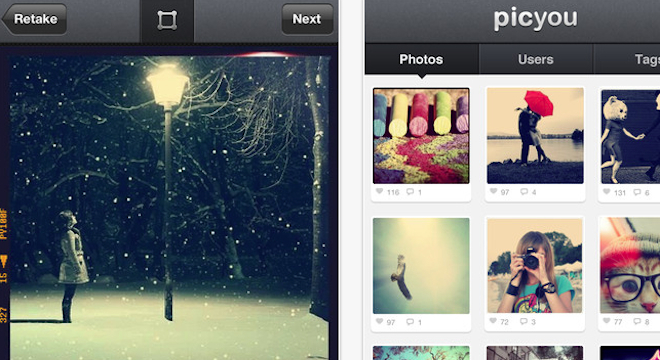
PicYou
One such Instagram alternative is PicYou, a free web-based photo customization platform that launched in July 2011 with a specific focus on providing an Instagram-like experience for brands and businesses. PicYou quickly expanded its user-base to individuals and launched an iPhone app in January.

Now in the wake of Instagram’s recent expansion to Android on April 4, and the sudden Facebook acqusition, PicYou has seen a sudden uptick in downloads, according to a spokesperson, who reached TPM via email.
“On the day of the Android announcement for Instagram we skyrocketed to the top #15 free app and #1 Entertainment app in the iTunes app store,” a PicYou spokesperson told TPM. “The Facebook acquisition has had a similar affect on downloads and Twitter is buzzing with users tweeting trying out PicYou for the first time.”
In fact, PicYou is quite candid about using Facebook’s purchase of Instagram to recruit more users.
“We feel the acquisition provides an opportunity for PicYou to leverage it’s already growing user base with new users who are keen to explore alternatives to Instagram,” PicYou’s spokesperson added. “We look forward to welcoming new users to our app who are disillusioned with the current path Instagram has taken and are looking for a new community to share their photos.”
Further, PicYou told TPM it plans to retain its exclusivity by focusing its resources entirely on its iPhone app (a line previously taken by Instagram, until it finally released an Android version).
“PicYou is an iPhone exclusive app,” PicYou’s spokesperson told TPM. “We have no plans for ever releasing an Android app.”
Jittergram
Meanwhile, in a not-so-subtle dig at the Instagram acquisition, Friends of the Web, the developers behind another recently launched, rival photo-filtering app called Jittergram, retweeted the following tweet by a fan on their account: “Instagram is over. Make rad steroscopic GIFs with Jittergram by @friendsoftheweb,” along with a link to the iPhone-only app.

The official Apple App Store got in on the action, too, tweeting an endorsement of Jittergram just hours after the Facebook acquisition of Instagram was noted, a move that is difficult not to read as a passive agressive swipe at Instagram, which was formerly iOS-only.
Despite a vaguely similar name, Jittergram, which launched in late March, differs markedly from Instagram in that it allows users to create slightly animated, somewhat 3D images, called stereograms or stereographs, also based on a vintage technology.
Hipstamatic
But Instagram’s closest and most popular competitor — Hipstamatic, a photo filter app exclusively for the iPhone that costs $1.99 and is named, like Instagram, after the vintage Kodak Instamatic camera that both apps evoke — has taken the high road, posting a congratulatory note to Instagram on Twitter on Monday night.
Further, a Hipstamatic spokesperson told TPM via email: “We’re happy for Kevin and the entire Instagram team. Mark/Facebook scored a great team and the move makes sense since they are both social networks.”

That’s not exactly surprising, though, given that Hipstamatic announced a business partnership with Instagram in late March, allowing Hipsamatic’s 4 million users to upload their photos directly into Instagram’s stream. It’s the first time that Instagram allowed another app to break into its own tightly-guarded image-based “social network.”
Still, Hipstamatic’s spokesperson did tell TPM that Instagram’s acquisition by Facebook, “definitely presents an opportunity, but our value proposition has always been quite different from Instagram.”
“Hipstamatic is a camera application that helps users beautifully and artistically capture visual stories, and Instagram was always a social network,” Hipstamatic’s spokesperson continued. “As the conversation around mobile photography continues to rise, then it’s a win-win situation for us.”
Hipstamatic declined to comment on any plans to expand to Android at this time, however.
Instagram’s social network, a simple platform that allows users to follow each other’s shots and presents a stream of their and their followers’ photos arranged by recency, is thought to be the reason that Facebook spent so much to buy the app even though it would offer no direct revenue stream.
Facebook, itself the largest repository of photos on the Web, has struggled to create an easy and addictive photo posting experience for its mobile apps, and was previously reported to be pursuing an Instagram-like strategy of letting users apply photo filters. Some tech writers have speculated that Facebook founder and CEO Mark Zuckerberg saw the rising popularity of Instagram, by far the most popular photo-sharing app on the iPhone, and panicked, paying a wildly-inflated valuation just to acquire what could have been a major contendor to his burgeoning Facebook empire.
Still, it’s difficult to imagine that the acquisition won’t have clear benefits for both Facebook and Instagram, at least in the short term. Already, both have dominated the news cycle and inspired passionate commentary from all corners of the Web. Facebook’s 800 million strong user-base, already clearly photo friendly, present a huge new pool of likely Instagram converts, meaning that new Instagram users will likely more than make up for those who defect.
Late update: Friends of the Web designer Andy Mangold emailed TPM to say that he doesn’t see his group’s app, Jittergram, as an Instagram competitor. As Mangold wrote:
We do not see Jittergram as a replacement for Instagram, nor are we trying to make a “dig” or “passive aggressive swipe” at it. We built the app in one weekend as part of a hackathon well before any of this news about Instagram broke, and the “-gram” suffix is the only real similarity between our apps.
Our goal with Jittergram was just to make it extremely simple to create animated gifs, either stereograms or stop motion, on your phone. We think it’s caught on because we kept the UI simple and the end result is often surprising, delightful, or humorous. As I mentioned, we built it in one weekend as part of a hackathon, and right now we have no immediate plans to extend it to other platforms. If the interest we’re seeing right now persists we may look into expanding it.
Indeed, to Mangold’s point, any of these apps can of course be downloaded all on the same iPhone and used for different occasions. It’s not an “either/or” choice, although some Instagram users incensed by the Facebook purchase may feel that way.