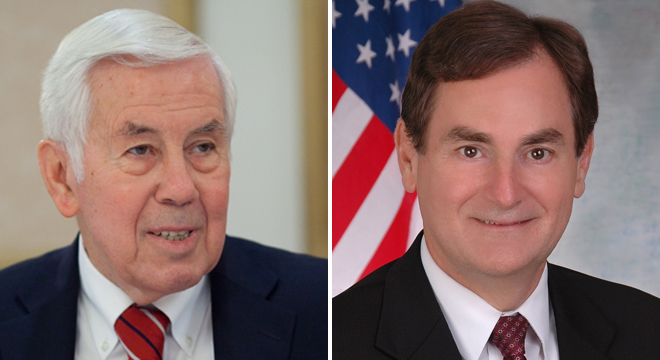
Sen. Dick Lugar (R-IN) and his challenger in the Republican primary, state Treasurer Richard Mourdock, met Wednesday night for their only debate before the primary on May 8. And for a race that has been consumed by a variety of personal attacks, the debate was remarkably calm and issue-centered — but still, with quite a few differences presented between the two.
Mourdock made only one slight reference to a controversy that has dogged Lugar in the campaign, involving the incumbent’s residency in the state. At the end of his final question of the night, Mourdock said that he has been proud to call Indiana his home ever since he first moved there in 1973, and if elected to the Senate he would be proud to represent the state that is his home — and, he noted, “…I’m not moving from. I will always call Darmstadt, Indiana, home.”
Lugar presented himself as a steady hand on foreign policy –Â notably on the issues of nuclear and biological disarmament, in which he has specialized since the 1990’s — and an experienced public servant for Indiana. And for his part, Mourdock called for even sharper conservative efforts to roll back the size of government.
At one point, Mourdock declared that Republicans have to “get the jackboot of regulations off the neck of small businesses.” He further added: “We have to roll back the size of government, we have to be aggressive. We can’t sit back, if we’re in the Congress, and not maintain the oversight role that was intended for our congress by the Founding Fathers.”
Lugar chimed in: “Let me just add that those of us who are now serving each day, try to do the rollbacks and the protest.” He explained that “with the Obama administration we have limited success,” but they have had the opportunity to hold hearings, to get feedback from citizens in the state, and even to sometimes roll back regulations.
Mourdock fired back. “To say we’re rolling back the Obama administration, I don’t see enough Republicans doing that,” adding that he is even more frustrated with Republicans –Â as he expected Democrats over-regulate, but that “I want to see Republicans out making the fight, and making the argument to their districts about why we have to roll back government.”
On entitlements, both candidates praised the proposal by House Budget Committee Chairman Paul Ryan (R-WI) to privatize Medicare. “I voted for the Ryan plan – one of 40 Republicans who did so, seven did not,” said Lugar, also later referring to the plan as a “scholarly way” of laying out the budget choices ahead.
Likewise, Mourdock called for younger workers to be told that there will different expectations for them — that they will have to save more for their retirement and their health care.
On foreign policy, Lugar touted his work on nuclear disarmament in the former Soviet Bloc — a unique time in history when a great power asked for help to disarm itself. As a result, he has traveled to countries such as Russia, Belarus, Kazakhstan and others.
The candidates were asked whether Russia is now a friend or foe of the United States.
“Russia is neither friend nor foe. It is an important country with whom we have to deal,” said Lugar. “I would say that we’ve come a long way since the cold war, and we have had some cooperation in the nuclear business.”
He did concede that Russian leader Vladimir Putin is an “authoritarian,” but he commended the recent protests for greater democracy in the country. “But in the meanwhile, we are going to have very tough negotiations with people who still have weapons of mass destruction, and don’t wish us well on most days.”
Mourdock fired back: “Mr. Lugar said on most days they don’t wish us well, and earlier said they are neither friend nor foe. I think they are more foe than friend, based on the latter part of that statement.”
He also strongly criticized America’s aid to Russia, as part of the disarmament program –Â arguing that because money is fungible, aid to Russia indirectly goes to help Russia’s efforts to prop up the regime in Syria.
He also added: “When the START treaty was being negotiated, it was the Russians who said it had to be signed by December 31 of 2010, or they would walk away from the table. I’ve worked on a lot of contracts in the business world. Any time somebody says it has to be done by that date, it’s usually a better deal for them.”
Lugar, however, insisted: “I managed the START treaty on the floor of the Senate. And thank goodness it passed when it did. Because we had no American boots on the ground, because the last START treaty expired in the Bush administration.”