Updated 12:12 pm ET, Tuesday, April 17
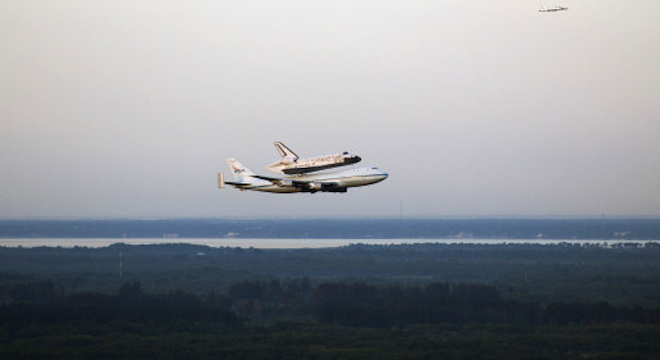
Rooftops across Washington, D.C. on Tuesday morning were crowded with observers eager to catch a glimpse of the final flight of the Space Shuttle Discovery, towed on the back of a modified Boeing 747 on its way to its final resting place: The Smithsonian National Air and Space Museum.
And the flight, which began at the Kennedy Space Center in Cape Canaveral, Florida at around 7 am ET, did not disappoint.
Entering the Washington D.C. era at around 10 am, Discovery flew at an extraordinary low 1,500 feet, allowing Washingtonians to see the amazing sight up close and snap a host of photos on their phones and digital cameras.
Many photos were posted on Twitter and NASA’s official Space Shuttle Discovery Flickr page.
National and local TV news networks were also on hand to catch the flight in progress. Watch a video of their views of the flight here:
Â
Â
Â
Â
The craft landed smoothly at Washington Dulles International Airport in Virginia around 11 am. It will actually be permanently housed for display to the public just outside the airport, at the the Steven F. Udvar-Hazy Center in Chantilly, Virginia, not at the main Smithsonian National Air and Space Museum complex in Washington, D.C.
Discovery’s final flight will be celebrated at the center with a ceremony and other festivities on April 19. The shuttle is the first of the three remaining in NASA’s fleet to be retired, marking the beginning of the end of the three-decade long Space Shuttle program.
Discovery, which was NASA’s oldest working shuttle at the time of its retirement in March 2011, was actually the third shuttle to join NASA’s fleet of “orbiter vehicles,” or “OVs.” (Discovery’s codename is OV103). Before Discovery came the doomed Space Shuttles Columbia and Challenger, both lost in tragic, fatal accidents. Discovery was used as the “return to flight” vehicle to resume the Space Shuttle program after each of those disasters.
Discovery launched on its first mission in August 1984 to deploy telecommunications satellites and flew 39 times during its operational history, including missions to repair the Hubble Space Telescope and transport astronauts and supplies to the International Space Station.
The other two remaining space shuttles that were retired along with Discovery in 2011, Endeavour and Atlantis, are also set to be put on public display, at the California Science Center in Los Angeles and the Kennedy Space Center Vistior Complex in Cape Canaveral, respectively. Endeavour is scheduled to arrive in Los Angeles in “the latter part of 2012,” while Atlantis is set to be put on display in early 2013.
Meanwhile, Discovery itself will occupy the physical space of the prototype shuttle, the Enterprise, which never actually flew in space but paved the way for the rest of the fleet.
Enterprise is scheduled to be moved from its current home at the Steven F. Udvar-Hazy Center to the Intrepid Sea, Air & Space Museum in New York City. Enterprise will be attached to the modified Boeing 747 that transported Discovery to Virginia and flown first to John F. Kennedy airport on Monday.
As for the future of human spaceflight, NASA has now turned its attention to helping private companies, such as Space X, develop their own spacecraft to the point of reliability that NASA is able to use them to transport crew and astronauts into low-earth orbit.
SpaceX on Monday was cleared to attempt the first-ever commercial spacecraft docking with the International Space Station on Monday, April 30.
Ed’s note: Updated throughout to add background.