NEW YORK — Technology is supposed to make life easier for everyone, but that’s not always the case for Americans with disabilities.
Fortunately, there are a handful of researchers who have spent considerable time creating wholly new technologies and adapting existing ones such as the Internet, smartphones and cloud computing — to work better for and help improve the lives of those who have disabilities.
On Monday, the White House specifically shined the spotlight on 14 of these individuals, presenting them with the “Champions For Change” award, an honor that the White House has bestowed every week since late 2011 on leaders in a particular sector of public engagement, from education to energy and environment to diversity.
This time, the White House chose to honor 14 leaders in the fields of science, technology, engineering, and math, specifically for work in those fields benefitting those with disabilities. Many of the award recipients took to the official White House blog to explain their work and what the awards meant to them.
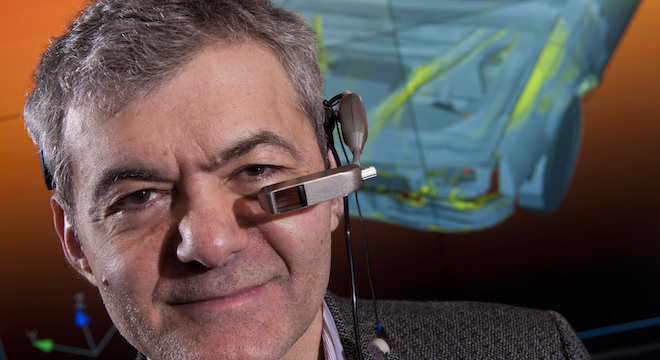
Among those was IBM master inventor Dimitri Kanevsky, a Russian-born scientist with more than 152 U.S. patents to his name.
Kanevsky, who has been deaf since age 3, has developed such useful technologies as an “Artificial Passenger” designed to keep car drivers awake by monitoring eye movements, as well as a separate Web-based realtime transcription service called ViaScribe that quickly captions conversations, auto-correcting words as it goes along.
ViaScribe technology has since been used to capture college lectures complete with multimedia, automatically synchronizing audio transcripts with appropriate slides and graphics.
Kanevsky spoke about his life’s work using a variant of the technology in a telephone interview with TPM.
“Many years ago when I used this transcription over Internet it was very slow, there were big delays,” Kanevsky said. “I was frustrated with this. And I thought about inventions that put priorities on certain information on Internet. So some information that had a higher priority can be passed quickly. For example, like this transcription that you see now…I thought about medical doctor who performs surgery remotely he cannot have delays.”
Kanevsky received a patent for the very technology he used to conduct the interview just a week prior, he told TPM.
Born in the Kiev, Ukraine when it was part of the Soviet Union, Kanevsky was a gifted mathematician as a child, but Soviet policy at the time prohibited him and others with hearing and vision impairments from attending state universities. After his parents vigorously petitioned the government, he was able to attend Moscow State University in 1969.
“At the time that I lived in Soviet Union, it was a very discriminative country,” Kanevsky told TPM. “America is very different in that sense. I don’t know about Russia now.”
Kanevsky told TPM that his career as an inventor didn’t really take off until after he received his Ph.D. at Moscow State and left for Israel to work at the Weitzman Institute of Science in Rehovot, Israel, where he began work on tactile electronics devices. He joined IBM in 1986 and has worked mainly out of IBM’s TJ Watson Research Center in Yorktown, New York.
Despite a lifetime of achievement, Kanevsky believes that the real revolution in technology to help those with disabilities is just beginning to be unlocked thanks to two still burgeoning trends: cloud computing and mobile devices.
“All these abilities of mobile devices will truly revolutionize lots for people with disabilities,” Kanevsky told TPM. “The opportunity to have wireless access everywhere and have cellular phone that immediately transcribes when you are speaking to other people, that would help all people, with disabilities and without.”
Indeed, already, a number of people with severe vision impairments or who are blind have found Apple’s iPhone to be a revolutionary device in their daily lives, coming as it does with a default text reading and action-describing program called VoiceOver. Meanwhile, burgeoning apps developers have begun creating a whole suite of apps specifically tailored for those with vision impairments.
As for cloud computing — the term that refers to storing, accessing and using data and software entirely on remote servers, accessed by a wireless connection — Kanevsky has already begun to make strong inroads there, as he told TPM.
“I have patented an invention for cloud computing,” Kanevsky said. “I am happy to walk in this direction. There is a lot of potential.”