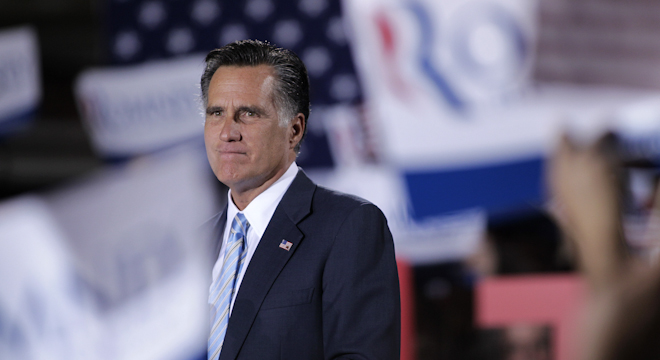
LYNCHBURG, Va. — Mitt Romney directly addressed his religious differences with evangelicals in a commencement address at Liberty University Saturday. But speaking before a staunchly conservative audience placed him back in politically volatile territory, forcing him to focus on both same-sex marriage and “religious freedom,” which has become code in GOP circles for opposition to President Obama’s requirement that employer health benefits include contraceptive coverage for female workers.
“[T]he enduring institution of marriage” is now “topics of Democratic debate,” Romney said, before reaffirming, “Marriage is a relationship between one man and one woman.”
The line drew a standing ovation.
The speech was billed by the campaign as “personal not policy,” according to reports Friday. And for the most part, Romney stuck to his own personal story. But in this evangelical Republican stronghold, Romney dipped his foot into the social policy fights of the past week, casting the election as a battle between those who would protect marriage and advocates seeking to make it open to more couples.
Romney didn’t say the word “Mormon” but he did mention his faith, which is seen as a sticking point between the likely GOP nominee and evangelicals in the party’s the base.
“People of different faiths, like yours and mine, sometimes wonder where we can meet in common purpose, when there are so many differences in creed and theology,” Romney said. “Surely the answer is that we can meet in service, in shared moral convictions about our nation stemming from a common worldview.”
President Obama’s embrace of same-sex marriage has provided Romney a chance to appeal to evangelicals, many of whom doubt Obama is fully committed to his Christian faith in the first place.
Before the speech began, Liberty University chancellor Jerry Falwell Jr. reminded the crowd that voters are “electing a commander-in-chief not a pastor.”
Twenty-one of the 39 commencement speakers have been from outside Liberty’s “traditional doctrinal convictions,” Johnnie Moore, vice president of spiritual programs at Liberty, told reporters before the speech. Past commencement speakers have included Mormon Glenn Beck, Catholic Newt Gingrich and Jewish Ben Stein.
Romney has already addressed Mormonism in front of a crowd of evangelicals, taking on ministers who criticized his religion as a “cult” in his speech before the Values Voter Summit last year. During the primaries, he lost the evangelical vote regularly, just as he struggled with other conservative wings of the GOP base. The most vocal of the critics at the Values Voter Summit, Southern Baptist leader Robert Jeffress, has since endorsed Romney, claiming that he hews closer to the values evangelicals find important than Obama. Chief among those issues are traditional marriage and opposition to legalized abortion.
Romney’s speech leaned heavily on religious themes, including “religious freedom.” Romney name-checked Rick Santorum, who was popular among evangelical Christians on the primary campaign trail, and drew on Santorum’s economic messaging, which held that the nation must embrace the “traditional family” model to fix the economy.
“Culture matters,” Romney said.
The power of these values is evidenced by a Brookings Institution study that Senator Rick Santorum brought to my attention. For those who graduate from high school, get a full-time job, and marry before they have their first child, the probability that they will be poor is 2 percent. But, if those things are absent, 76 percent will be poor.
The speech picked up common evangelical themes and included frequent mentions of the word “Christian.”
“Religious liberty is the first freedom in our Constitution,” Romney said “And whether the cause is justice for the persecuted, compassion for the needy and the sick, or mercy for the child waiting to be born, there is no greater force for good in the nation than Christian conscience in action.”