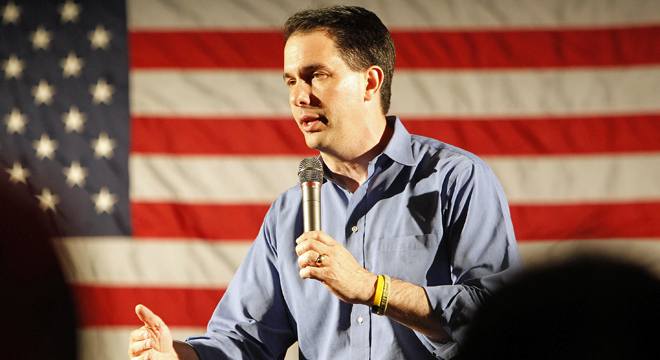
Wisconsin Gov. Scott Walker said Thursday that Republicans should find ways to ensure that people with pre-existing conditions can still purchase health care if the Supreme Court throws out the Affordable Care Act, a critical part of President Obama’s health reforms that experts say is nearly impossible to maintain without mandates.
“Whether it’s done through the Affordable Care Act or done separate from that with Congress and the states — I think that things that allow you to go over state lines, certain things in terms of guaranteed issue and things of that nature,” Walker said at a breakfast in Washington, D.C. hosted by the Christian Science Monitor. “I think there are good elements. I just don’t think you need the federal government to do most of those things.”
Walker said that it was possible to keep “guaranteed issue,” in which patients are guaranteed the ability to purchase coverage, but without a national requirement that Americans maintain health insurance.
“Certainly not a federal mandate,” Walker. “I think those are debates people can have at the state level.”
Mitt Romney’s Massachusetts health care law, which served as a model for the current federal law, used a state mandate requiring residents to purchase health insurance in order to achieve that end. But it’s become a punching bag for Republicans over the last two years thanks to its similarities to Obama’s reforms, and even Romney himself has suggested other states should think twice about adopting the same policy.
Republicans are currently debating what to do if the Supreme Court overturns the law, with many voicing support for maintaining limited provisions like allowing young adults to stay on family insurance plans until age 26. But tackling pre-existing conditions, while one of the most popular aspects of the health care law, is a much thornier issue and would likely provoke a revolt from insurance companies if it were enacted without some means of broadening the pool of customers to include more healthy people. Romney recently confirmed he would not enact a ban on insurance discrimination against people with pre-existing conditions if elected president.