The Supreme Court ruled Monday that states can take only limited steps in crafting their own immigration enforcement measures — a decision that dealt specifically with a crackdown in Arizona but will make waves that reach far beyond, namely in Alabama. Alabama’s immigration law, enacted after Arizona’s measure, is even more harsh, and is also being challenged by the federal government.
The justices struck down most of the law and ruled that states do not have the power to make immigration policy. But to the dismay of SB 1070 opponents, the court allowed the most incendiary clause of Arizona’s law — the so-called “show me your papers” provision — to go forward, while allowing for future challenges once the rules start being enforced.
Alabama’s law, critics say, goes further than Arizona’s when it comes to potential racial profiling. The Alabama law makes it illegal to rent property to illegal immigrants and forces state universities and schools to check the citizenship status of their students.
Advocates opposed to the Alabama law were elated by the ruling. It represents, in their view, a death blow to the legislation they believe is discriminatory and crippling to businesses that rely on immigrant labor.
“I’m jubilant,” said Shay Farley, legal director at Alabama Appleseed, a group that is one of the plaintiffs in a lawsuit aimed at to throwing out Alabama’s immigration law. “The Supreme Court today makes it clear that with respect to immigration enforcement schemes and regulation, that is the federal government’s job.”
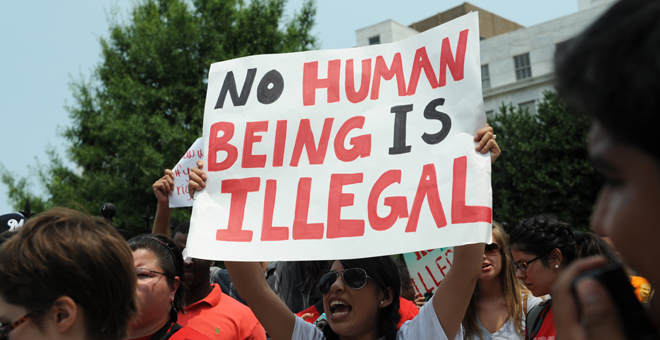
Beyond the implications the ruling has on the law itself, Hispanic advocates told TPM Monday that the ruling could drive Hispanic voters to turn out against Republican legislatures like the one in Alabama.
“Any state legislature that is considering [Arizona-style immigration laws] like this will hear very loudly from the community,” said Marielena Hincapié, executive director of the National Immigration Law Center.
Proponents of the Alabama law — perhaps best known nationally for driving thousands of nervous parents to pull their children out of the state’s public schools — said that it was too early to tell what impact the ruling on the Arizona law would have on the Alabama court challenges.
Republicans who wrote the Alabama law in 2011 and continue to defend it in court are not so sure the Arizona decision is as big a deal as Farley and others suggest. Alabama Gov. Robert Bentley said in a statement that the legislation he signed “has similar provisions as Arizona’s law” but “the laws are not identical.” He said his office “will analyze the Supreme Court opinion” but vowed to push ahead with his defense of the law.
“The people of Alabama want a strong immigration law, and I will keep my commitment to uphold and enforce Alabama’s anti-illegal immigration law,” he said.
Bentley’s view is similar to that of Republicans across the country, who said the Supreme Court’s decision not to strike down “show me your papers” in Arizona was a victory for conservatives who think citizenship verification should be an everyday part of all government interactions.
Alabama Attorney General Luther Strange (R) said in a statement that it was too soon to tell what the Arizona ruling means for for his state, though he acknowledged it will “impact Alabama’s immigration law along with those of several other states.”
“My office will be reviewing today’s decision to determine the full extent of its impact on Alabama’s law and the pending litigation,” he said.
A legal scholar in Alabama suggested the impact could be drastic.
“It’s always dangerous to predict, the matter is under consideration with the 11th Circuit and it’s a matter of how they read the opinion,” said Paul Horowitz, professor of law at the University of Alabama. “But I would say that this decision spells trouble for some of the analogous provisions of the Alabama law.”
There are several similarities between the Alabama law and the Arizona law, including both laws’ architect — Kansas Secretary of State Kris Kobach, the go-to legal mind in the conservative immigration community and an “informal adviser” to Mitt Romney’s presidential campaign.
Horowitz said “key provisions” of the Alabama law “are under threat now given this opinion, but that doesn’t mean all of them and that doesn’t mean that they’ll necessarily be struck down on their face.”
As for Alabama, it will likely be up for the courts to decide what effect the Arizona ruling will have on that state’s law, as well as those in other states with recent immigration laws before the courts. Farey said she’s confident that in Alabama at least, the Supreme Court handed immigration advocates a huge victory Monday.
“When it comes down to the bones, I think that there’s no way to look at the Supreme Court’s rationale and holding and say that Alabama’s immigration law is going to stand tomorrow,” she said.