Ex-Justice Department Official Contradicts Intel Chief
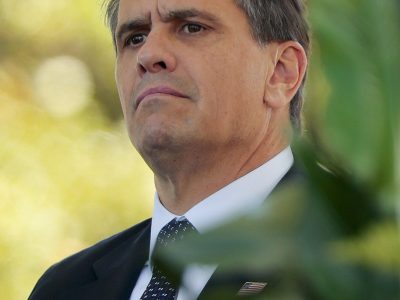
He didn’t get anywhere near the media attention yesterday that Director of National Intelligence Mike McConnell did. (Including from me.) But James Baker (not that James Baker), who until earlier this year helmed the Justice Department office in charge of preparing FISA warrants, testified to the House Permanent Select Committee on Intelligence that the process in place for obtaining FISA warrants “worked during wartime.”
Indeed, the portrait Baker painted of the FISA process doesn’t bear much resemblance to the one on display from McConnell, who’s been aggressively pushing to keep FISA’s oversight role diminished.
Baker described FISA as an intelligence tool rather than a hindrance. The process yielded “information that the intelligence community could use to take action to thwart the activities of our adversaries, including terrorist groups.” It was never the case that foreign-to-foreign communications, even those that passed through the U.S., were considered under the auspices of the act.
Supposedly, earlier this year the FISA Court abruptly ruled that such communications do indeed fall under FISA, prompting the issuance of warrants for foreign-foreign surveillance. (The ACLU has filed a motion with the court to declassify the ruling.) Baker’s description raises questions about why the court would have committed such a stunning legal about-face.
McConnell, in an interview with the El Paso Times, claimed that FISA was a cumbersome process, requiring 200 man-hours for the production of a warrant for a single phone number, a statistic he stood by yesterday. Baker contradicted McConnell there as well.
Here’s an exchange between Baker and Rep. Heather Wilson (R-NM) about how long it takes to produce a FISA warrant.
WILSON: In some of your answers to previous questions, you talked about the timeliness in terms of emergency warrants and the reputation of your office as being the rusty gate and so forth.
You responded that you do those as quick as you possibly can. And it can happen extremely quickly to get an emergency warrant. Have you ever been involved in an emergency warrant or emergency application for a warrant that’s taken more than an hour?
BAKER: Yes.
WILSON: Have you been involved in one that’s taken more than six hours?
BAKER: Well, I guess the question is — let me back up — what do you mean by it has taken more six hours? From the time that the — what I assess that means is from the time that the intelligence agency…
WILSON: Let me clarify that for you. From the time that the intelligence agency says we’ve got a number we need to get up on it, to the time they can turn on the switch, does it take more than an hour.
BAKER: See, I can’t answer that, because all I can control is the time that…
WILSON: Let’s put it this way: From the time you were first informed that one would be required to when they were able to turn on the switch, were there any that took longer than six hours?
BAKER: Well, I’m not trying to be cagey, Ms. Wilson. I just simply — I don’t — we did lots of these things. We did them all the time. We tried not to over-lawyer the situation, so we delegated authority to folks within our organization to take prompt action on these things.
Did some take more than six hours? Certainly possible. I don’t know. I didn’t — we didn’t keep track in terms of — you know, we didn’t keep statistics on that.
What I’m reporting to you, I believe, is that overall, my assessment is that the system was successful. Could the system have done more with more resources? Of course.
Baker conceded that the intelligence community may have been frustrated with the pace of acquiring a warrant. But here he suggested that McConnell is misdiagnosing the problem: it’s not FISA that takes so many hard hours, but the actual intelligence work itself that allows an agent to determine where surveillance should be directed.
Tomorrow McConnell goes before the House intelligence committee. Maybe he’ll be asked to explain the discrepancy between his understanding of FISA and Baker’s.