


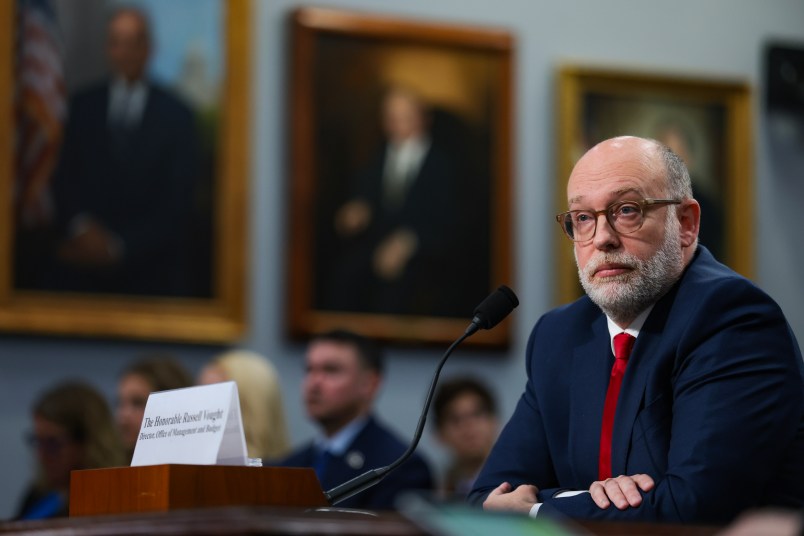
House Democrats grilled Office of Management and Budget (OMB) Director Russell Vought about his refusal to release appropriated funds in a timely manner during his Tuesday morning testimony in front of the House Appropriations Committee’s Financial Services and General Government Subcommittee.
“Have you released all appropriated funding to each intended agency through the apportionment process?” House Appropriations Committee Ranking Member Rosa DeLauro (D-CT) asked Vought during the hearing.
“We are working through the apportionment process expeditiously. I can’t say we have done every single one of them but if you have one that you are particularly interested in —” Vought responded as DeLauro cut him off.
“It is your responsibility to get the money out of the door in a timely fashion, and if you can’t do this, we need to take a look, because Congress provides the authority for this,” DeLauro said.
DeLauro’s questioning comes as the Trump White House’s OMB has been sitting on billions of dollars of congressionally appropriated funds for the current fiscal year, refusing to apportion and send them out into the agencies in a timely manner — including for life-saving programs. It’s a pattern the White House has followed since the beginning of President Trump’s second term: tramplingCongress’ power of the purse by refusing to spend federal funds in the manner Congress appropriates them.
“How much funding has been made available? How much funding have you made unavailable to agencies as of today? If you can’t answer that now, I would like an answer to that,” DeLauro continued.
“Happy to, but again, there’s no concerted effort not to apportion funding for the agencies,” Vought responded.
“It’s not going out in a timely way,” DeLauro pushed back.
“In part, because we’re trying to assess what it’s being spent on,” Vought said.
The purpose of apportionment is to make sure there is a controlled release of funds to agencies and to ensure money is not going out to agencies too fast or too slow. But OMB is instead sitting on appropriated money for long periods of time in order to investigate, they claim, what it’s being spent on — but without following the legal avenue for such a process.
“There is a process to defer or pause money legally and they are simply not taking it.
What they are doing is illegally deferring it,” Bobby Kogan, senior director of federal budget policy at Center for American Progress, told TPM.
“Will you commit to us here today that you will carry out our spending laws as Congress intended through appropriations and reconciliations as they were enacted or not?” DeLauro asked.
“Obviously, we will … make sure that we’re spending money where you intend us to spend money, at the same time, I’m not gonna take any tool off the table,” Vought said while DeLauro interrupted, saying she takes that as a “no.”
DeLauro, seemingly less than happy with Vought’s answer to her question, later added: “The Constitution says that the appropriations process is the power of the purse. You are ignoring that. You flout the Constitution every single day and you have been doing it for the last year and a half … we’re not going to continue to allow that to happen. No president has the right to just violate the United States Constitution, and no member of this committee does that, but the administration is doing it regularly.”
Rep. Mark Pocan (D-WI), another member of the appropriations committee, also pushed back on Vought around the same issue, asking about millions of dollars that have been appropriated by Congress but not released for the The President’s Emergency Plan for AIDS Relief (PEPFAR) program, as well as global health and development programs.
“I think there’s $3.2 billion that came from funds here marked by Congress for global health and development programs,” Pocan said, adding that those have been unobligated. “If it’s not obligated by September, that money will expire and can no longer be spent. Is that going to be spent? That money, it’s not going to be done as a pocket rescission?”
“I’m not going to take any two off the table, but we have no plans to do a rescission at this point, and we will make sure that we are getting the money out the door expeditiously,” Vought responded.
The Trump White House, of course, forced congressional Republicans to authorize a rescissions package last year and championed a pocket rescissions package, which the Government Accountability Office (GAO) found to be outside of the law. And despite Vought’s insistence to the contrary on several occasions, under his leadership, the OMB and the Trump administration were found repeatedly to have impounded federal funds approved by Congress, as documented in several decisions from the legislative branch’s GAO.
It’s part of a broader trend of Trump II as Trump and his administration officials take a sledgehammer to the separation of powers and pressure congressional Republicans into ceding their authority over federal spending to the executive branch.




Russell Vought is going to look great in jailhouse orange.
Rep. Mark Pocan (D-WI) … asking about millions of dollars that have been appropriated by Congress but not released for the The President’s Emergency Plan for AIDS Relief (PEPFAR) program, as well as global health and development programs.
So, Russ Vought is withholding health related payments for treating life threatening diseases.
Does that make him complicit in any resulting deaths?
Vought’s damage to public health and welfare are well-discussed, but the damage from reorienting scientific research emphasis less so. This is a problem in the AI era, with research organizations going all in on the current thing, say, quantum computing, while whacking nascent research lines and long-term development programs in mature industries such as metal extraction. The argument is that all this traditional approach, developed over centuries and less likely to promote bad ideas due to peer review, can now be tossed as the robot knows more than humans anyway. Already a year ago US scientific decline was predicted, and now that is happening. Vought and his ilk seem determined to turn the US into a regional power in the Western hemisphere. The K-shape economy would persist, massive government debt would be handled by looting public wealth, and the life experience for most people would be something akin to life in Paraguay, where average life spans are about the same as for North Korea.