


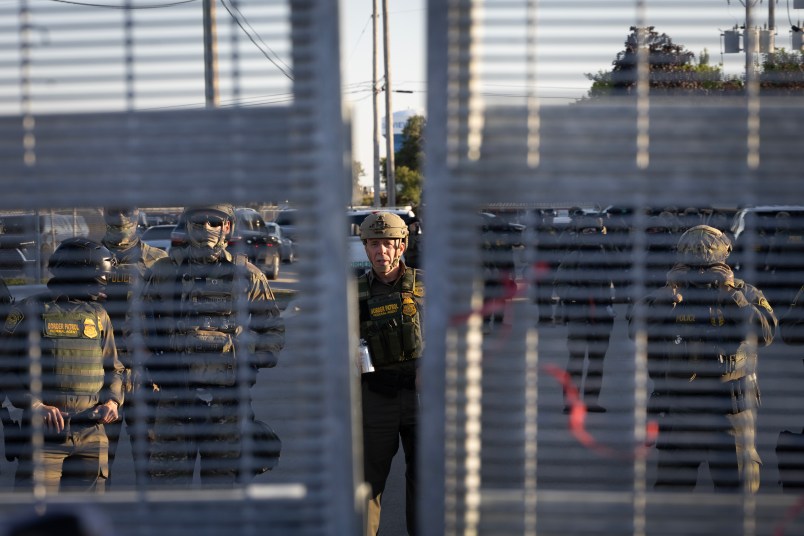
Grand jury sessions are among the most tightly held elements of the criminal justice system. But thanks to the collapse of the federal case against Chicago’s Broadview Six, transcripts from the proceedings were released into public view on Tuesday.
The transcripts document interactions between prosecutor Sheri Mecklenburg and the grand jurors that later gave rise to allegations of prosecutorial misconduct. They show how, over the course of three separate appearances on three separate days, Mecklenburg made a series of errors before the grand jury that later infuriated the judge in the case. Before the grand jury finally voted to return an indictment, U.S. Attorney Andrew Boutros addressed the jurors himself, a highly unusual event, telling them they were faced with a “constitutional” duty and asking if they had strong feelings about “a certain type of cases, such as the immigration cases.”
Hours later, Mecklenburg began the presentation that led to the Broadview Six’s indictment, which saw then-congressional candidate Kat Abughazaleh and other Chicago-area people affiliated with Democratic Party politics face an extremely rare conspiracy charge.
The indictment took prosecutors three tries to secure. The grand jury proceedings show how the case focused on a September 2025 protest in the middle of Operation Midway Blitz, the Trump administration’s surge of federal agents into Chicago. Grand jurors were skeptical, the records show, in part because the defendants were accused of conspiracy over a protest in which they blocked a federal agent who was driving slowly through a crowd on his way to work. The agent was the facilities manager for a local detention facility.
The three attempts took place across October, with sessions on Oct. 9, 16, and 23. At some points, the alleged misconduct seemingly prompted Boutros to respond in real-time; he has said that he only learned of other allegations of prosecutorial wrongdoing in April.
In each attempt, after a new instance of alleged misconduct, the same prosecutor returned to make the same case before the same grand jury.
Mecklenburg started her first attempt to secure an indictment by apparently asking grand jurors to vote based not on the evidence or law she was presenting, but on their trust in her.
Another prosecutor in the room would “vouch for me,” Mecklenburg told the grand jurors, per the transcript.
“I said I want to go in front of the Thursday grand jury because I know you and I trust you and you know me and you trust me, and I would never ask you to charge somebody if I didn’t think there was probable cause,” the transcript reads. “And you know you’ve asked me before, ‘Well, what about this person?’ And I said, ‘I don’t charge people unless I’m absolutely sure.'”
That formed one of three separate instances of alleged prosecutorial misconduct that later enraged Judge April Perry, who oversaw the case. Perry said at a hearing last month that prosecutors initially provided her versions of the transcript that redacted three areas in which misconduct allegedly occurred.
In this case, the alleged misconduct was vouching: asking grand jurors to rely not on the evidence but on the assurance of the prosecutor. The other two instances were an allegation that prosecutors removed grand jurors from deliberations without asking a judge, and speaking to grand jurors about the case outside of the grand jury room.
Mecklenburg allegedly directed a dissenting grand juror to leave during her second try, after she had lost the week before on an indictment. After she began, a juror asked her: “do you have unlimited tries?”
“I hope you don’t have your mind made up already that I’m going to need more tries,” Mecklenburg responded, after a short exchange.
After the juror said that they had an open mind, Mecklenburg turned the question on the whole grand jury: “Is there anybody here who feels differently?” she asked.
“Are you actually presenting any new actual facts or just a different viewpoint on your side?” one grand juror asked, after some discussion.
Mecklenburg replied: “I’m feeling the skepticism already,” before asking: “are you going to be able to listen with an open mind? Tell me the truth.”
“No,” the person replied. Mecklenburg told the juror to “go,” before the person added: “I heard this case like last week and I thought it was a crock of shit then and I still think it is.”
“Okay. Thank you for your opinion for everybody,” Mecklenburg replied, before telling the grand juror to leave and wishing the person a “good evening.” From there, Mecklenburg counted the number of grand jurors to confirm that at least 16 remained — there were 17. Under federal law, a grand jury must have a quorum of 16 members to operate. Later on, a second juror said “I don’t think I can vote,” bringing the number down to a minimum of 16.
One week later, on Oct. 23, Mecklenburg returned. Per a statement issued last week by Boutros, he addressed the grand jury beforehand.
“You’re the umpire and you can’t come in and be an umpire in favor of particular team. You gotta call balls and strikes and that’s all we ask,” he said. “But we also recognize that these are trying times, these are emotional times. You can’t help but turn on the news, read the newspapers, or for those of you who use TikTok and Instagram, and there’s stuff in there all the time.”
He then, according to his statement, added: “If there’s anyone here who is struggling with a certain type of cases, such as the immigration cases or other cases where they do not believe that they can set aside their personal, their personal emotions, that they cannot listen and deliberate honestly and objectively, I would ask that you raise your hand and identify yourself, because we have a different procedure for that.”
Hours later, Mecklenburg walked in to the grand jury room. She had to apologize for something, she told those assembled.
She had spoken with two grand jurors outside of the grand jury room, she said, offering a “mea culpa.”
Mecklenburg chose to put the interactions on the record and in the transcript. “I’m the one who knows the rules, and I did something today that I’m not supposed to do,” she said, according to the transcript.
In one of the interactions, Mecklenburg said, a grand juror who “walked out” had “apologized” to her, and she replied that she “accepted his apology.”
“The Grand Juror said at that time that he did have feelings, and he’s sure that he’s right, but he shouldn’t have walked out the way he did,” she said.
In the second instance, another grand juror purportedly apologized for the previous week, and promised to “apply the facts to the law.” Mecklenburg said that she replied, “That’s true. That’s exactly what we’re asking you to do.”
The revelation that Mecklenburg had spoken with grand jurors outside of the jury room prompted Boutros to dismiss the felony conspiracy count in the case, he later said. Even that raises serious questions about a cover-up: in a hearing in April, a federal prosecutor said that removing the conspiracy charge made “moot” whether the judge should be able to read the full transcripts.



Here’s hoping Ms. Mecklenburg’s law license goes through some things.
Obligatory Cat:
What is the process for a lawyer having their law license revoked? Do these actions reach that level?
So much for the presumption of regularity. You can’t trust these GOP goons to do anything right.
Isn’t Micklenburg working for a US Senator now?
Vouching, the Trump-brand of evidence…
“Trust me, these are some bad hombres. You wouldn’t believe the things these guys did. Just the absolute worst. Take my word for it; so nasty.”