

This article is part of TPM Cafe, TPM’s home for opinion and news analysis. It was originally published at Balls and Strikes.
Last week, Minnesota’s top federal prosecutor appeared before two federal district court judges and asked them to not hold the Trump administration in contempt for violating court orders. The judges, Biden appointee Jeffrey Bryan and Clinton appointee John Tunheim, had both directed the government to release dozens of unlawfully detained people and return their personal belongings. After learning that the administration released 28 detainees but kept their cash, phones, driver’s licenses, passports, work permits, and more, Bryan held a hearing on March 3 to give U.S. Attorney Daniel Rosen a chance to explain himself. Tunheim similarly held a hearing on March 5 after finding that the government retained the possessions of at least six other detainees without any lawful basis.
During the hearing, Bryan said that ordering Rosen’s imprisonment “would be a historical low point for the office of the United States Attorney and for this District,” and that it was “very, very unlikely.” But Bryan was angry enough to tell Rosen that he hadn’t “ruled [it] out,” either.
Since President Donald Trump took office in January 2025, courts have been reluctant to impose consequences on the administration for its myriad violations of court orders. In recent weeks, however, some judges have started to recognize their power to compel compliance with their directives. A New York Times analysis published last month shows that since August, federal judges have issued at least 35 orders requiring the administration to explain why it shouldn’t be held in contempt. Twice since February, federal judges in Minnesota actually followed through, and briefly held the administration in civil contempt. And twice more in the past two weeks, federal judges in Minnesota and New Jersey threatened the administration with criminal contempt, too.
Last month, Judge Laura Provinzino, a Biden appointee, held federal prosecutor Matthew Isihara in civil contempt over his mishandling of the case of Rigoberto Soto Jimenez, a detainee who filed a habeas petition in early February. Provinzino granted Soto Jimenez’s petition on February 9, ordering the government to give him his things and release him in Minnesota by February 13, and to confirm that it had done so by February 17. Sometime after that deadline, Soto Jimenez’s counsel told the court that the government released him on February 12, but in Texas, and without any of his documents. Soto Jimenez had to spend the night in a homeless shelter, and his attorney flew him back to Minnesota using his own airline miles.
The next day, Provinzino imposed a $500 fine for each day after February 19 that Soto Jimenez was without his property. Isihara asked the court to exercise its “discretion” and “good graces” in light of the administration’s caseload, but Provinzino firmly rejected this request. “This Court would never allow a private attorney or litigant to rely on an ‘I’m too busy’ excuse to justify disobedience of a court order,” she wrote. “The Government is no different.”
The government immediately returned Soto Jimenez’s ID, so Isihara was able to avoid paying a fine. But on February 23, Judge Eric Tostrud found the administration in contempt again, under very similar circumstances. In late January, Tostrud, a Trump appointee, had ordered the government not to remove a detainee from Minnesota while his habeas petition was pending. After the government transferred the man to Texas anyway, Tostrud ordered it to bring him back to Minnesota by the end of the day on January 24.
Again, the government released the detainee. But again, it did so in Texas, and it did not return any of the man’s belongings, forcing his lawyer to pay $568.29 for airfare to fly him back to Minnesota.
Recognizing that judges can use civil contempt to compensate victims for losses associated with violations of a court order, Tostrud ordered the administration to pay back the $568.29. A few days later, he issued a new order vacating the monetary award for technical reasons. But Tostrud did not vacate the underlying contempt finding, and suggested that there might be other legal grounds for requiring the government to pay for its actions.
Other judges do not share Tostrud’s view on whether some forms of contempt are off-limits for the government. On March 2, Judge Michael Farbiarz, a Biden appointee in New Jersey, considered fining or imprisoning members of the Trump administration for violating court orders, writing that the “everyday rules of the road” in litigation still apply to the federal government. “A federal official can be held in contempt. So can a federal agency,” Farbiarz said. “And if federal officials or a federal agency are held in contempt, the full range of contempt sanctions is available.”
Farbiarz ultimately did not hold the administration in criminal contempt, acknowledging that doing so would be “a last resort.” But he suggested that if the violations were to continue, he would consider that last resort a more viable option. “Local ICE leaders must square up to the serious problem in their midst of non-compliance with judicial orders,” Farbiarz wrote. In the event of future violations, he continued, “the ball will start off at a different place.”
Judge Patrick Schiltz, a George W. Bush appointee, also threatened the Trump administration with criminal contempt late last month. After listing 96 court orders that ICE had violated across 74 cases, Schiltz concluded that the agency “has likely violated more court orders in January 2026 than some federal agencies have violated in their entire existence.” He wrapped by promising to do “whatever is required to protect the rule of law, including, if necessary, moving to the use of criminal contempt.”
Schiltz’s threat was sufficient to secure compliance with his order, but he stressed that he remained concerned by the administration’s lawlessness, and would not hesitate to take more serious action. “The judges of this District have been extraordinarily patient with the government attorneys,” he wrote. “The Court is not aware of another occasion in the history of the United States in which a federal court has had to threaten contempt—again and again and again—to force the United States government to comply with court orders.”
The Trump administration has shown that it will keep violating court orders until courts force it to stop. Judges are starting to remember their responsibilities to enforce the rules by which everyone else must abide—and the full range of tools available for enforcement.





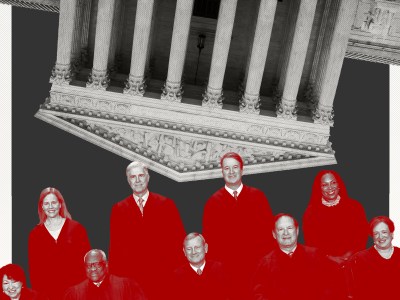
Too bad the Supreme court hasn’t realized this.
It’s taken the federal court system a long, long time to figure this out. Meanwhile, the destruction has been irreparable. Democrats (the only viable political party in this sad nation) need to be putting together plans to reform the process. Faster, smarter, less prone to pointless delays, much less deference to the wealthy and powerful.
Nice cat, by the way.
With a DOJ that is so openly contemptuous of the judiciary, it seems only fair that their contempt be recognized and celebrated by federal judges!
Doesn’t look to me like they’ve figured it out yet:
After the first “again” you throw the fuckers in jail or fine them personally. If you get to the second and third “again” and still haven’t done it, you haven’t figured it out.
Oh, they know.
The MAGA majority simply chooses to treat the patient like a king, in violation of their oaths and duties.
As for the rest of the federal court system … well, what was that old line about wheels that turn slowly but grind exceedingly fine?