

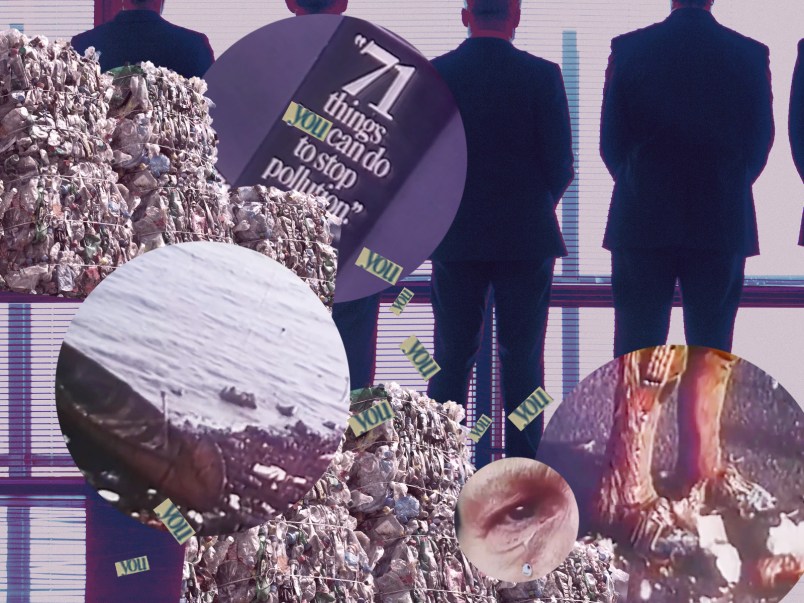
This TPM Cafe article is an excerpt from PLASTIC INC.: The Secret History and Shocking Future of Big Oil’s Biggest Bet by Beth Gardiner.
In 1969, Republican Congressman Paul McCloskey warned executives gathered at a packaging conference that they had to do something about the waste they were creating — “not dispose of it, but reduce the actual amount.” Rising public concern about the environment “should not be underestimated,” and could, before long, prompt “sweeping changes in our laws,” he warned. Soon, Congress would probably consider requiring a five‑cent deposit on bottles, he said. While McCloskey acknowledged politicians’ consideration of tougher action was driven by public opinion, he nonetheless feared that as “the pendulum swings to the protection of the environment,” there was a danger “the swing can be too far.”
He needn’t have worried. In the years to come, companies would go to extraordinary lengths to protect the lucrative model for cheap, disposable plastic packaging they’d created, even as the mountains of trash it churned out grew ever larger.
Congressman McCloskey had been right about the country’s mood though.
The packaging waste conference coincided with a growing awareness of consumerism’s dark side that crystallized with the first Earth Day, in April 1970. In Atlanta, where an underground newspaper urged readers to “bring the trash home to the people who make it,” 1,500 protesters showed up at Coke’s head office with bags — and a pickup truck — full of empty cans and bottles. Even President Richard Nixon got on the bandwagon, decrying the shift toward disposable packaging. “We often discard today what a generation ago we saved,” he said, noting that “pouring more and more public money into collection and disposal of whatever happens to be privately produced and discarded” amounted “to a public subsidy of waste.”
Plastic executives feared the upswell of antagonism might “really end the industry,” the editor of the journal Modern Plastics later recalled. But they were ready to fight. In 1954, after Vermont prohibited disposable beer cans — farmers blamed them for damaging equipment and injuring cows when they were tossed into fields — nearly two dozen beverage, cigarette, candy, and packaging companies had formed an alliance they called Keep America Beautiful. In billboards and print ads, the group framed the country’s waste issues as a matter of littering, the result not of excessive production, but rather the bad habits of irresponsible individuals. Keep America Beautiful printed handbooks to teach schoolchildren “good outdoor manners,” distributed “how‑to‑do‑it” litter‑reduction kits, and instructed drivers to keep trash bags in their cars instead of tossing empties out windows. Under pressure from brewers and can makers, Vermont let its ban expire in 1957. But the organization whose creation it had prompted was just getting started.
No matter the medium, Keep America Beautiful’s message was clear. The problem wasn’t the overwhelming amounts of waste the shift to throwaway packaging was generating, but merely that a fraction of it was ending up in the wrong place. In other words, the mess wasn’t the fault of companies reaping huge profits from disposability, but of Americans themselves. And responsibility for fixing it was on them too. “Keeping America clean and beautiful is your job,” one ad lectured. Another accused readers of hiding behind the “alibi” that “average people don’t pollute. It’s the corporations,” and — with impressive nerve — exhorted them to “stop shifting the blame.” That very American message of individual responsibility — and its failure to acknowledge larger economic and political forces — was not unique to the issue of waste. Indeed, one packaging executive’s assertion that “packages don’t litter, people do,” carried eerie echoes of gun rights proponents’ claim that “guns don’t kill people, people kill people.”
Companies hammered home the idea in their own ads. One Coke campaign, “Bend a Little,” featured an attractive woman bending over to pick up litter, “to remind people that cleaning up America called for a little extra effort from all of us.” Another favorite theme was that consumers, not drink makers, had driven the shift toward disposability. The public “demands a choice of containers in many products, including soft drinks,” Coke explained in one ad, as if it were a helpless actor in the change it had pioneered. “We have to go along.” Not only were individuals responsible for littering; the entire system of throwaway containers was their fault too.
By 1967, with public concerns about waste nonetheless mounting, Keep America Beautiful decided to take things up a notch. “Our ‘soft sell,’” executives at one planning meeting concluded, should be toughened to slam litterers as “slobs.” Before long, a new TV commercial showed pigs trotting down a rubbish‑strewn street, then nosing through garbage on a beach, as a sanctimonious voice‑over said, “Spreading and living in litter is for … Well, certainly not for people.”
With Earth Day 1970 bringing the threat to yet another level, companies had to up their game again. Keep America Beautiful’s ad team got to work on a spot that would become part of TV history. In “The Crying Indian,” which debuted in 1971, a man with a craggy face, tasseled buckskin jacket, and long braids paddles a canoe to a riverbank covered with trash, then walks to the side of a highway. When a bagful of garbage thrown from a passing car lands at his feet, he looks into the camera with a tear on his cheek. “Some people have a deep, abiding respect for the natural beauty that was once this country,” a narrator intones over dramatic music. “And some people don’t. People start pollution. People can stop it.”
Producers realized its power immediately, “Iron Eyes” Cody, the actor who portrayed the Crying Indian — he was actually Italian American — later wrote. “People who had been working on the project were moved to tears just reviewing the edited version,” he recalled. It was “an iconic moment” that “was like nothing else on television,” one media scholar concurred. Audiences agreed. The ad achieved one of the highest viewer recognition rates in history, airing so often that within a few years, broadcasters were ordering replacement films because they’d “literally worn out the originals from the constant showings.” It was showered with awards and, even more telling of its place in popular culture, was later spoofed on The Simpsons and referenced on Friends. Cody’s face appeared on billboards and in print too, and new iterations of the commercial ran throughout the ’70s. In an extraordinary twist for a character cooked up by polluting industries, “the Crying Indian became for millions of Americans the quintessential symbol of environmentalism,” author Finis Dunaway wrote in his book Seeing Green.
Much of the campaign’s power came from viewers’ perception of Keep America Beautiful as an impartial civic organization. Its corporate sponsors — they included Coke, Pepsi, Philip Morris tobacco, and the American Can Company — didn’t trumpet their involvement, and few knew of it. The ad’s genius, Dunaway observed, was that it “promoted an ideology without seeming ideological; it sought to counter the claims of a political movement without itself seeming political.” And with “the guilt‑inducing tear,” it managed to “propagandize without seeming propagandistic.” The ad deftly weaponized stereotypes of Native Americans’ connection to the land — and their sorrow — to intensify its punch and lend a counterculture feel. Industry had “co‑opted the icon of resistance and made him support the interests of the very consumer culture he appeared to protest,” journalist Ginger Strand noted. “There he stood, stoic and sad, a rebuke to individuals rather than a rejection of the ideology of waste.” Just as important, the spot neatly shrank disposability’s harms down to litter alone. If consumers would simply dispose of throwaway containers properly, it suggested, everything would be fine.
“The Crying Indian” had helped muddy public understanding of what was causing the waste deluge, what might fix it — and even what the problem was. That intentional sowing of confusion made it a defining prototype for the burgeoning genre of greenwash, the deceptive set of marketing tactics aimed at imbuing products with an aura of environmental friendliness. And it perfectly prefigured the concept of the “carbon footprint,” an industry‑propagated framing that focuses us on our own contribution to climate change, and consequent feelings of guilt, while ignoring the ways corporate and political leaders’ decisions have constrained our choices.
The goal was clear. If a group like Keep America Beautiful could persuade Americans to swallow its message, author Heather Rogers explained in Gone Tomorrow: The Hidden Life of Garbage, it would mean “laws will not be enacted, government won’t intervene, and production can continue on industry’s terms.” She pointed out that “the way Americans waste today is not just a normal result of organic human development.” Vast and tremendously profitable corporations had set out to create the throwaway world we live in. Now they were blaming us for its consequences.
Like disposability itself, the personal‑responsibility framing would soon be exported, as industry plowed money into anti‑litter groups such as Keep Australia Beautiful, Keep Britain Tidy (whose first chairman ran an oil company), Gestes Propres (Clean Gestures) in France, and Paisaje Limpio (Clean Landscape) in Spain. The UK got its own heartstring-tugging TV spot, in which a stirring rendition of Britons’ much‑loved hymn “Jerusalem” — whose lyrics imagine Christ visiting their “green and pleasant land” — plays over images of a road heaped with rubbish. “Britain is a beautiful country, not a litter bin,” a narrator scolds. A British Rail poster exhorting riders not to leave trash at stations featured the Swedish pop stars ABBA in yellow “Keep Britain Tidy” T‑shirts — sparkly bodysuits presumably left at home — holding brooms and cleaning gloves.
The early 1970s upswell of environmental worry was the first of what would become regular moments of crisis for the industries making and using throwaway packaging and goods. With Keep America Beautiful and “The Crying Indian,” companies had created an effective template for defusing and deflecting anger about waste — embracing and co‑opting environmental concerns, then directing blame back onto the public. They would turn to it again and again in the years to come.
While industry draped itself in green language, it was fighting furiously against measures that could actually solve the problem it purported to be so concerned about. In 1971, Yonkers, New York, like cities across America, was struggling to manage its growing tide of trash. Not only was garbage strewn around streets and parks (Keep America Beautiful wasn’t wrong about litter being a problem; it just wasn’t the only problem), but landfill space was getting more expensive. A student committee appointed by Mayor Alfred DelBello suggested a solution that had been bandied about repeatedly in state legislatures across the country — and in Congress too — but only rarely enacted. The panel’s proposal would require beverage companies to include a five‑cent deposit in the cost of bottled and canned drinks; customers could reclaim it when they returned containers for refill or recycling. Projections estimated it would cut the city’s trash hauling costs by a million dollars a year, and save Yonkers shoppers $2 million annually on drinks. DelBello, a Democrat, cosponsored the bill with the city council’s top Republican, and it looked to have a good shot at passage.
Then industry showed up. Suddenly, Yonkers, a city of two hundred thousand just north of the Bronx, found itself on the receiving end of intensive lobbying by soft drink, beer, and packaging interests. At a marathon city council hearing, Sidney Mudd, president of a big 7‑Up bottling company, said the soda was no longer available in returnable bottles in the New York area, and vowed he’d stop selling in Yonkers before spending what he estimated would be $21 million to retool his plants for returnables. If the plants had to close, five hundred jobs would go with them, he said. Representatives of Coke, Pepsi, the US Brewers Association, a state grocers’ alliance, and major can and bottle makers echoed his message. “The young people who spoke in favor of the bill were well prepared,” Councilman Peter Mancusi told The New York Times. “But they couldn’t put on a show like this. It was like a Broadway play.” A bill that had seemed like “a non‑controversial, beneficial, ecology‑minded thing” had become explosive, the mayor said. The politicians were spooked by industry’s predictions of a huge economic hit. In any case, one councilman said, “I learned that companies are understanding and facing the waste problem themselves.” And “who can solve problems better than private industry?” Some lawmakers swung behind the plan again later, after other bottlers told the students shifting to returnables wouldn’t kill jobs after all. But the bill never came back to the full council for a vote.
Similar stories played out across America. In Washington state, a container‑deposit ballot measure polled at 80 percent weeks before the vote, but lost 51–49 after industry poured $2 million into ads opposing it. Supporters, by one account, spent only $6,000. By 1972, more than 350 state and local bills mandating deposits or otherwise restricting throwaway beverage containers had been introduced, but only a couple of dozen had passed, in places from Davis, California, to Madison, Wisconsin, and Edgewater, New Jersey. Even many of those were ultimately repealed under pressure or reversed by courts following industry lawsuits. Among the first to be struck down was a two‑cent tax New York City slapped on plastic containers in 1971.
The deposit laws, known as “bottle bills,” were anathema to industry because they pushed the costs of dealing with used packaging — which disposability had so successfully off‑loaded to municipal governments — back onto companies. Thrilled to have freed themselves from the hassle and expense of handling empties, they were determined not to go back. One Keep America Beautiful executive slammed bottle‑bill advocates as “communists” and urged the group to resist such laws.
In 1971, Oregon became the first state to enact a bottle bill, and Vermont soon followed. Both measures survived court challenges, and a year after the Oregon law took effect, an analysis found roadside litter had decreased by 35 percent, nearly four hundred million fewer cans and bottles were used even as drink sales kept growing, and the energy savings were enough to heat fifty thousand homes. What’s more, the law was extremely popular — 91 percent of Oregonians approved.
But passing bottle bills proved tremendously difficult. The same day as the testy 1971 Yonkers hearing, state lawmakers across the Hudson River in New Jersey were considering a similar law. Americans, its Republican sponsor said, could save $1.5 billion a year on drink purchases if all beer and soda containers carried deposits. But his bill soon ran into trouble, with even some cosponsors rescinding support after bottle makers said it threatened thirty thousand jobs in the state’s glass industry. The claim was false. Given its reduced labor requirements, a state analyst explained, it was disposability — not a deposit‑and‑return system — that would be the job‑killer. It didn’t matter. The bill was dead.
Industry’s biggest worry was a national bottle bill. Congress took up the idea at least five times in the 1970s alone. One analysis found such a law would save the equivalent of five million gallons of gasoline a day. Another estimated it would reduce drink prices by nearly a third, and increase — not decrease — employment. Nearly three‑quarters of Americans approved of the idea, and in 1974, the Nixon administration backed it. In response, Pepsi’s president fired off a letter to the head of the Environmental Protection Agency: “Your position defies and denies the free will of the people expressed by their free choice of containers,” he sniped. In 1979, as the House considered yet another bill, an executive from one of Coke’s largest bottlers said the Oregon law had more than doubled his company’s fuel costs. “Left unsaid was the fact that municipal agencies had been paying the fuel costs of picking up the company’s waste,” business historian Bartow Elmore wrote in Citizen Coke: The Making of Coca-Cola Capitalism.
Bill after bill would be proposed in the years that followed, but a national container deposit law never came to be. By the mid‑1980s, ten states had enacted bottle bills. Since then, only Hawaii has done so, and with Delaware repealing its law, the total today still stands at ten. In Washington state, where the 1970 container deposit referendum lost narrowly, a 2024 headline carried more than a bit of déjà vu: “Bottle Deposit Proposal Fizzles Out in Legislature.”
Where bottle bills did make it into law, industry often sought to undermine their implementation. A Vermont resident complained labels were intentionally confusing, writing to a magazine that “many bottles have NO DEPOSIT NO RETURN cast into their sides, but have the deposit notice on the bottom.” New York, after passing its bottle bill in 1982, required the adoption of reverse vending machines, where consumers could return bottles and cans and claim their deposits. A Norwegian company tried to introduce them, but Coke argued the scanning technology would be unable to distinguish among brands, making it impossible for companies to know how much they owed.
Container deposit laws are common in Europe. For Scandinavians, “returning your empty bottles to the store is a perfectly normal, everyday activity” for everyone from hungover students to kids seeking pocket money and families heading to the grocery store, environmental historian Finn Arne Jørgensen wrote. The same is true in Germany, which — with a twenty‑five euro cent deposit on plastic bottles — gets 98 percent back.
But around the world, industry continues to fight such laws. In Australia, a New South Wales lawmaker said a lobbyist for food, drink, and packaging companies had threatened a $4 million ad campaign against the Liberal and National parties ahead of 2011 elections if they backed a container deposit proposal. The politician, Catherine Cusack, called it “a nasty experience” that was “one of my worst moments in the job.” The Liberals dropped their bottle bill, although New South Wales, Australia’s most populous state, passed one a few years later. In Edinburgh, Coke lobbied against a mandatory bottle deposit plan, arguing that “consumers don’t want” such a law, even as a poll found three‑quarters of Scots supported the idea. The measure passed in 2019, but its start date was repeatedly postponed, in part because of disputes with Britain’s Conservative national government, which said its details needed to align more closely with England’s plans. (England, Scotland, and Northern Ireland later moved to begin requiring deposits in 2027.)
When it comes to bottle bills, industry has won even where it’s lost. For the most part, they’ve become a way to get containers back for recycling, not a means of returning to the old system of refill and reuse. Companies had managed to “shut down debate over whether disposable beverage containers were a good idea in the first place,” one writer observed. Vermont’s original 1953 law had “required manufacturers to accept and refill their empties. No one’s talking about that now.”
From PLASTIC INC.: The Secret History and Shocking Future of Big Oil’s Biggest Bet by Beth Gardiner. Published by Avery, an imprint of Penguin Publishing Group, a division of Penguin Random House, LLC. Copyright © 2026 by Beth Gardiner.







I worked in a grocery store in the mid sixties. On Saturday there was always one clerk working returns, reorganizing beer and soda bottles. At college returnable cases of beer were very popular. All this disappeared for ‘convenience.’
Most shocking, I should suspect, is the common man’s lack of understanding of how integral to Big Oil plastics stand.
I knew of a number of students who kept several around as kind of a “bank” for hard times.
On the other hand, (reusable) plastic containers are great. They don’t shatter like glass. If your home has children or cats, this is a big safety feature (etc). The squeeze bottle is a good idea. Sadly, apparently it’s now been decided that it’s too dangerous to put food into plastic containers.
So what now? We’re back to using metals? Some kind of natural fiber, like bamboo or paper? Good old glass?
And what of the medical industry, which churns out megatons of plastic waste? Each and every instrument comes swathed in throw-away plastic. Each and every swab or bandage. Manufacture sterile, wrap in plastic, open, use, and throw away.
It’s time to get creative again. More science and engineering, less financializing and lawyering.
While safer in terms of shattering, microplastics are a huge and growing health concern. There is evidence linking microplastics to diseases including dementia. Microplastics have been found to cross the placenta into mammal fetuses. Plastic containers shed these tiny particles in many different scenarios where they become trapped in the body and brain, and have even been shown to disrupt the human endocrine system or mimic estrogen in the body. These health impacts have massive implications for health. Some - like estrogen mimicking plastics and their effects on males and females - we have barely begun to grapple with. We can scarcely chart the full human cost of plastics, even now. But the more we know the worse it gets.
In Iowa, there is a deposit bill but recent Republican legislatures have made it less useful, as redemption centers are few and far between, and they have rejected bottles on which deposits were paid–who’s going to argue with them over a nickel when the check that came two weeks after the bottles were returned is for $2.15?
But the biggest loophole, and I think this goes for all bottle bills, is the change in consumer taste in the last 30 years. When bottle bills were enacted, they covered beer and soda pop. The by far largest amount of plastic bottle trash is non-carbonated, water and energy drinks, which aren’t included.