



Hello, it’s the weekend. This is The Weekender ☕️
One minor mystery of the DHS surge into Minneapolis has been the relative dearth of prosecutions.
Recall what happened in Chicago: DHS, having flooded the city with federal agents, sought aggressive charges against anyone who it perceived as having gotten in the way. They supplied affidavits for prosecutions run by the area’s U.S. Attorney’s Office; those largely failed. Per a review by the Chicago Sun-Times this week, 31 defendants have been charged over incidents related to the Chicago surge.
There’s no evidence I can find that Minneapolis is seeing anywhere near as many prosecutions, as of this writing, as Chicago saw weeks into the DHS campaign. Federal prosecutors tend to view the cases that they bring as part of their personal reputation: the more, bigger cases they win, the farther they’ll go. That can incentivize ambition, but it has a darker side: after the financial crisis, the threat of losing at trial led some senior federal law enforcement officials to take a more timid approach to the aftermath.
It’s part of why the Chicago prosecutions were so shocking. These cases largely died upon making initial contact with the justice system. Grand juries declined to return indictments; judges trimmed charges after seeing that body-worn camera footage failed to support prosecutors’ allegations.
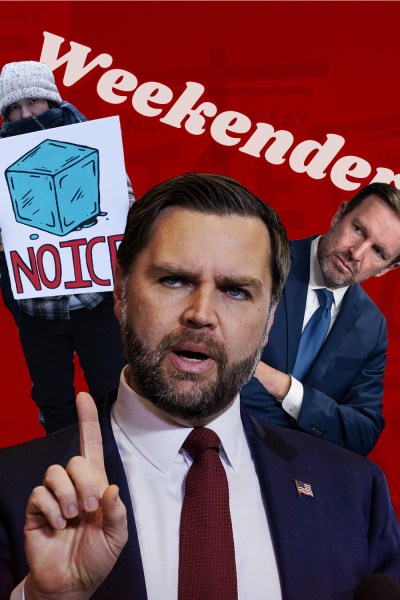
There’s some evidence that this is happening in Minneapolis, albeit at an even earlier stage. Per MSNOW, judges are rejecting arrest warrants in cases around ICE protestors. That’s extremely rare — it happening at any kind of scale is essentially unheard of. Stephen Miller has spent the last week on social media fuming darkly about the judiciary; JD Vance, albeit speaking about immigration orders, endorsed an ICE attempt to claw power away from the judiciary while speaking in Minneapolis this week.
None of this means that the DHS cases and the administration’s maximally aggressive approach to prosecuting its opponents has stopped. On Thursday, a man who allegedly (and implausibly from the start) put a $10,000 price on Greg Bovino’s head was acquitted by a Chicago federal jury. Parts of the system are still intact.
— Josh Kovensky
More DOJ Overreach: Virginia Edition
In the latest in DOJ overreach, the Justice Department is now suing Virginia because the state has refused to hand over sensitive voter information that the DOJ is simply not entitled to, as experts have told TPM.
The DOJ is asking for Virginia’s voter database, which includes information like: social security numbers, drivers licenses, and addresses. And if this sounds like something the DOJ is not allowed to do, it’s because it’s not. It’s not supported by any statutory authority or the Constitution.
Virginia is one of 24 states that the Justice Department has demanded this type of data from. It remains a mystery why the DOJ could possibly need this type of data. (Hint— they don’t!) As experts have told TPM previously, it’s just a way for Trump’s corrupt DOJ to help him cast doubt on our-already very secure election system.
A federal judge recently tossed out similar cases brought against California and Oregon. So, it’s fair to say that things aren’t looking great for the administration’s voter file crusade.
— Khaya Himmelman
Congress May End Up Funding the Gov’t
The House passed the remaining six appropriations bills on Thursday, including the Department of Homeland Security funding bill, despite the majority of House Democrats voting against the bill in protest of ICE’s cruel and violent conduct in cities across the nation. Seven House Democrats joined Republicans to help pass the DHS bill.
The six-bill minibus, which includes the final tranche of the 12 appropriations bills needed to fund the government until the end of the fiscal year, is now headed to the Senate for a floor vote. Some Senate Democrats are showing early signs that they won’t support the DHS funding bill.
“We are not living in normal times. The President is acting chaotically and unlawfully and we shouldn’t give his deranged decisions the imprimatur of congressional approval by passing this legislation without significant amendment,” Sen. Tim Kaine (D-VA) — who was among the group of Democratic senators who caved to reopen the government after the historic government shutdown last year — said in a statement this week.
Sens. John Hickenlooper (D-CO) and Chris Murphy (D-CT) are also among the Democrats expressing their deep opposition to that portion of the appropriations package.
“I’m a NO on the DHS funding bill that allows ICE to keep terrorizing our communities,” Hickenlooper said on social media. “ICE’s conduct this past year is beyond comprehension. Now, Trump is asking Congress for more funding. No way.”
Since the DHS bill is a part of a minibus, opposing DHS funding means voting “no” on all six appropriations bills in the Senate.
Top Democratic appropriators who will support the package argue that a shutdown triggered by opposition to ICE would not actually stop ICE operations, but would instead hurt other agencies and programs funded under the DHS bill, including the Federal Emergency Management Agency (FEMA), the Disaster Relief Fund, the U.S. Coast Guard, the Transportation Security Administration (TSA) and more.
“ICE received $75 billion in the One Big Beautiful Bill Act. In the event of a lapse in funding, ICE would be able to sustain regular operations for multiple years, while the other agencies under this bill would likely be forced to furlough workers and reduce operations,” a press release from House Appropriations Committee Ranking Member Rosa DeLauro (D-CT) reads.
Republicans need seven Democrats to join them to approve the legislation in the Senate to avoid a possible partial government shutdown that could come at the end of the month. It remains unclear where Democratic leadership stands on the issue. While public sentiment around the Trump administration’s immigration enforcement in blue states like Minnesota has reached new lows in recent weeks in the wake of an ICE agent killing a U.S. citizen, some Democrats argue that the constraints added to the DHS bill are better than nothing.
The bill includes funding that would require ICE agents to wear body cameras and language that “encourages” DHS to create a new uniform policy that would “ensure that law enforcement officers are clearly identifiable as Federal law enforcement.” It would also cut down the amount of funding for ICE removal operations by $115 million.
— Emine Yücel
Updates in the Nationwide Redistricting Battle
Maryland
Maryland’s Redistricting Advisory Commission voted this week to recommend a new congressional map.
The fate of the map is still unclear and faces opposition from Democratic state Senators.
New York
A New York state Judge ruled this week that the state’s only Republican-led district in New York City is unconstitutional and has to be redrawn by early February. A redrawn district could flip the city’s only Republican district to a more Democratic-leaning one.
The decision is expected to be appealed in an appellate state court.
Virgina
The state’s special election for a Democratic-led redistricting ballot measure will take place on April 21.
— Khaya Himmelman



First. Those failed prosecutions are cracking me up. Careers are being ruined.
Posted a couple days ago on the NYC Mayor Zohran Kwame Mamdani thread in the Hive –
I added the following to my above post –
Dan Goldman is a well-liked and popular congressman with this country’s democrats. Though Brad Lander, who is currently primarying Goldman, is more popular with the NY’s 10th district’s residents. Lander has been their neighbor and advocate for 30 years. Goldman is a first term congressman.
Isaiah 5:20-23
20
Ah, you who call evil good
and good evil,
who put darkness for light
and light for darkness,
who put bitter for sweet
and sweet for bitter!
21
Ah, you who are wise in your own eyes,
and shrewd in your own sight!
22
Ah, you who are heroes in drinking wine
and valiant at mixing drink,
23
who acquit the guilty for a bribe,
and deprive the innocent of their rights!
Screams into the void.